SUDDEN STRATOSPHERIC WARMING EVENT: A major disruption of the polar vortex appears to be underway as the Arctic stratosphere suddenly warms. Researchers call this a "sudden stratospheric warming event." It's caused by planetary atmospheric waves crashing into the vortex and breaking it up. Cold air spilling out of the weakened vortex could plunge the USA, Canada, and parts of Europe into bitter cold little more than a week before the arrival of Spring. This also marks the end of polar stratospheric cloud season for Arctic observers.
CIR HITS EARTH, SPARKS AURORAS: If you've never heard of a co-rotating interaction region (CIR), just think of it as a mini CME. One hit Earth on March 8th, sparking more than 10 hours of geomagnetic storms. "The auroras in Minnesota were some of the brightest I’ve seen in awhile," reports Anna Eastman, who watched the show from the Agassiz Wildlife Refuge:

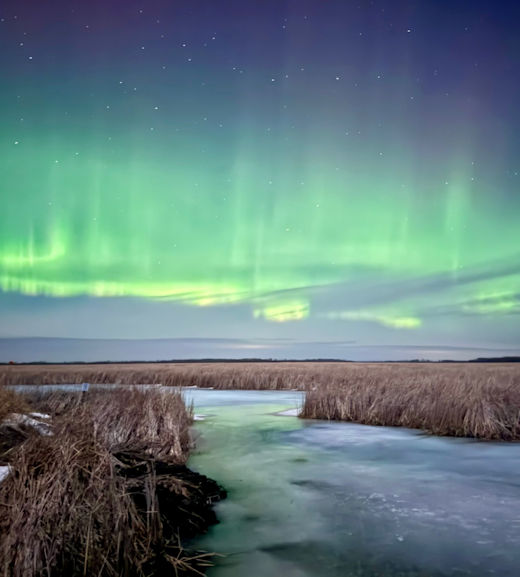
"Even with a bright Moon, it was a beautiful light show," she says.
CIRs are transition zones between fast- and slow-moving streams of solar wind. They contain magnetic fields and shock waves akin to those of CMEs. While CMEs require some sort of explosion on the sun, CIRs do not. They form gently from the sandwiching of solar wind streams--no solar flare required.
The arrival of the CIR on March 8th immediately caused a G1-class (Minor) storm, intensifying to category G2 (Moderate) on March 9th. Sky watchers in Iceland, Canada and multiple US states from New York to Utah saw the geomagnetic glow.


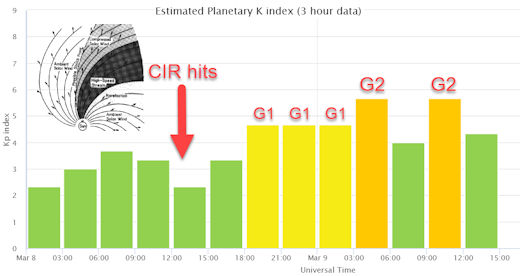
Click on the inset diagram to learn more about CIRs.
A fast-moving solar wind stream has arrived on the heels of the CIR. This is the same stream that created the CIR in the first place by compressing a region of slower solar wind ahead of it. Blowing 600 km/s, the fast stream could cause additional category G1 (Minor) storms on March 9-10. High-latitude sky watchers should remain alert for auroras. Aurora alerts: SMS Text.
Realtime Aurora Photo Gallery
Free: Spaceweather.com Newsletter
YOU CAN HAVE THIS FAR-OUT SCIENCE EXPERIMENT: This gift started out as a science project. The young scientists of Earth to Sky Calculus wanted to see what Earth looked like when viewed through a spherical lens. The answer: very cool.
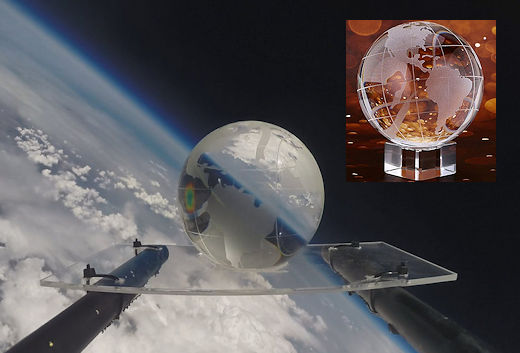
We flew this crystal ball to the stratosphere onboard a cosmic ray balloon and photographed the planet behind it from an altitude of 111,640 feet. After the balloon exploded (as planned) the payload parachuted back to Earth, landing safely in the volcanic tablelands north of Bishop, California.
You can have it for $141.95. The crystal sphere has the continents of Earth lightly laser-etched on its surface, making it a unique "art meets science" conversation piece. It comes with a greeting card showing the sphere in flight and telling the story of its journey to the stratosphere and back again.
Far Out Gifts: Earth to Sky Store
All sales support hands-on STEM education
THE HOT NIGHT SIDE OF VENUS: Venus is approaching the sun for an inferior conjunction on March 22nd. Between now and then, Venus will be turning its night side toward Earth. You might suppose the night side of Venus would be dark, but astronomers are seeing it. Maximilian-Vlad Teodorescu sends this picture from the Institute of Space Science in Romania:
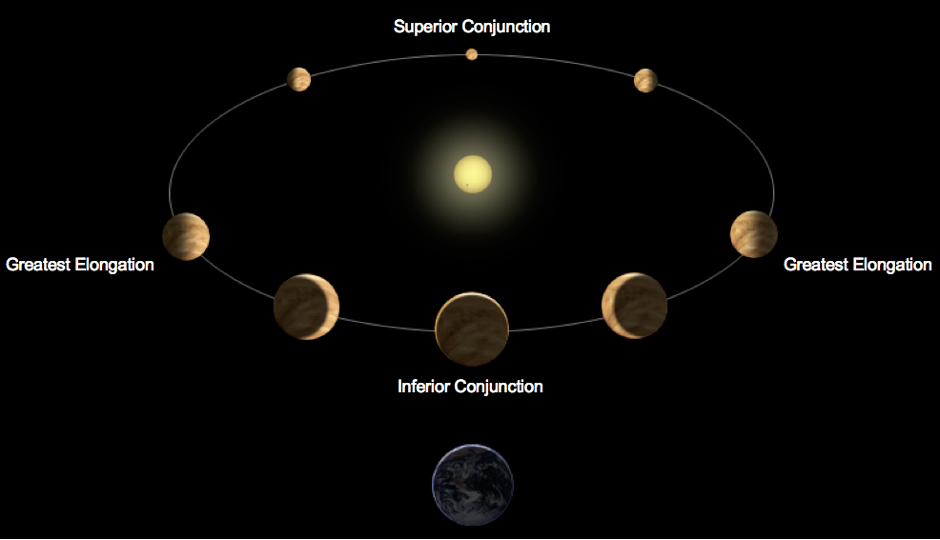
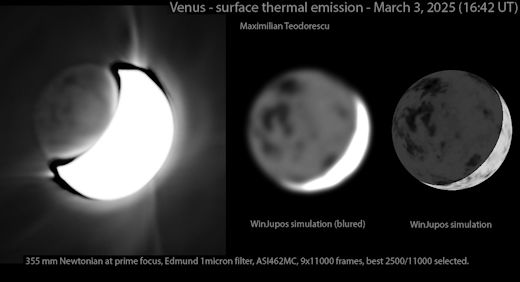
These images of Venus may remind some readers of a crescent Moon with Earthshine. There's a big difference, though. The night side of the Moon shines with light reflected from Earth. The night side of Venus, however, produces its own light. It's glowing because it is incredibly hot.
"I used a 1 μm infrared filter," explains Teodorescu. "That allows me to photograph Venus's thermal emission."
Ten years ago, Japan's Akatsuki spacecraft (also known as the "Venus Climate Orbiter") used infrared cameras to map the surface of Venus. According to the data, the average surface temperature is 698 K (800 F), hot enough to melt lead. Here is a global map from Akatsuki:
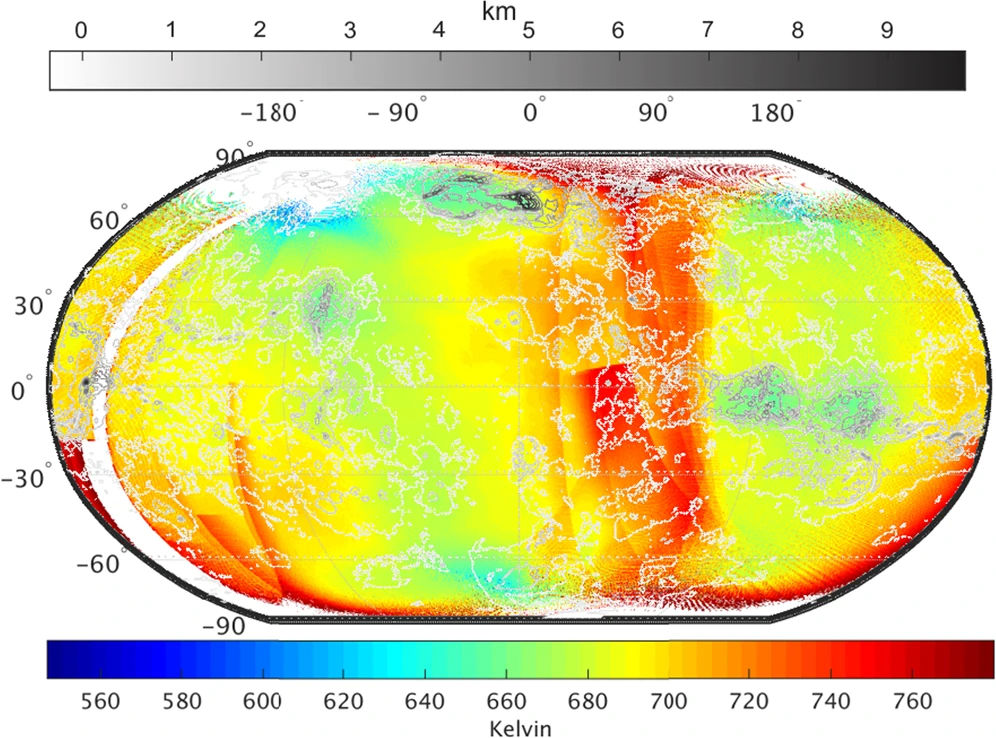
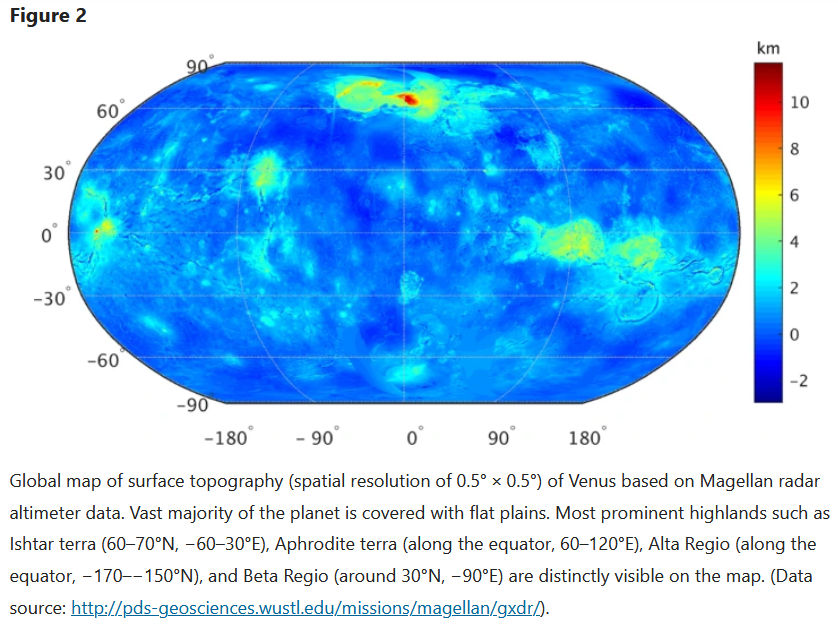
In this map, colors represent temperature. The white contours trace altitude measured by a radar on the Magellan spacecraft. High places are cooler; low places are warmer. Some of these cool regions (Ishtar terra, Aphrodite terra, Alta Regio, and Beta Regio) also appear in Teodorescu's image.
Amateur astronomers with infrared filters are encouraged to check out Venus this month. The night side is hot stuff.
more images: from Philip Smith of Manorville, NY; from Frank J Melillo of Holtsville, NY
Realtime Venus Photo Gallery
Free: Spaceweather.com Newsletter
THE EMERALD PEARL NECKLACE: Are you looking for a far-out gift? Consider the Emerald Pearl Necklace, launched to the edge of space Jan. 15th onboard an Earth to Sky Calculus cosmic ray research balloon. Here it is, floating 111,202 feet above the Sierra Nevada mountains of central California:
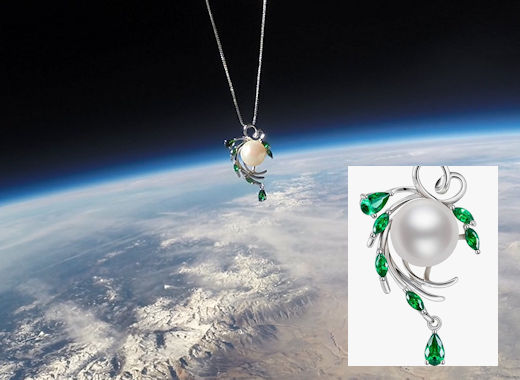
You can have it for $179.95. This 10mm freshwater white pearl, surrounded by a splash of emerald-green cubic zirconia, spent more than 2 hours in the stratosphere while sensors inside the payload measured cosmic rays. Later, it parachuted back to Earth, landing in the Inyo Mountains near Bishop, California. The pearl had a wild ride and the students got great data for their atmospheric radiation monitoring project.
The necklace comes with a greeting card showing the pearl in flight and telling the story of its journey to the stratosphere and back again.
Far Out Gifts: Earth to Sky Store
All sales support hands-on STEM education
Realtime Space Weather Photo Gallery
Free: Spaceweather.com Newsletter