A GEOMAGNETIC STORM IS UNDERWAY: A minor G1-class geomagnetic storm is underway on March 12th. Why? A crack has opened in Earth's magnetic field. Solar wind flowing throgh the gap is fueling magnetic unrest. High latitude sky watchers shold be alert for auroras mixed with waxing full Moonlight. Aurora alerts: SMS Text.

LUNAR ECLIPSE ALERT--TOMORROW! The full Worm Moon is about to pass through Earth's shadow, producing a lunar eclipse visible from North and South America. This time-tagged animation shows how the Moon will turn red during the 90-minute event:
In the Pacific time zone, the eclipse straddles the midnight divide between March 13th and 14th. Further east, it happens entirely during the early hours of March 14th. For a local movie, pick your own time zone: UTC, EDT, CDT, MDT, PDT.
What makes the eclipsed Moon turn red? A trip to the Moon provides the answer. Imagine yourself standing on the lunar surface looking up at the sky. Overhead hangs Earth, hiding the sun behind it. The eclipse is underway.
You might expect Earth to be utterly dark, but it's not. The rim of the planet looks like it is on fire. As you scan your eye around Earth's circumference, you see every sunrise and every sunset in the world--all at once. This incredible light beams into the heart of Earth's shadow, painting the Moon sunset red.
Enjoy the show! And submit your photos here.
Realtime Lunar Eclipse Photo Gallery
Free: Spaceweather.com Newsletter
RAINBOW PLANET: Something special is happening to Venus. The brightest of all planets is hanging low in the western sky at sunset, and if you look at it with a backyard telescope, you'll see that it is a slender 5% crescent. But that's not the special part.
What's special is, Venus looks like a rainbow:
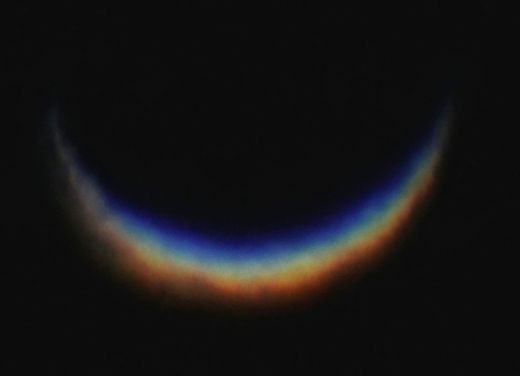
Douglas Kostyk took this picture on March 8th from the Farash Center for Observational Astronomy in Ionia, New York. "Venus is becoming very slender as it approaches inferior conjunction on March 22nd, and the rainbow effect was striking," he says.
Venus resembles a rainbow because Earth's atmosphere acts like a prism. When Venus is near the horizon, refraction separates the red crescent from the blue. The crescent is so thin, the splitting of colors is obvious. Later this month, Venus will disappear into the glare of the spring sun--so catch the rainbow planet while you can!
more images: from Kevin R. Witman of Cochranville, Pennsylvania; from Ralph Ford of Redondo Beach, California; from Geir T Birkeland Øye of Ørsta, Norway
Realtime Venus Photo Gallery
Free: Spaceweather.com Newsletter
"METEOR CRATER" CRYSTAL PENDANT: Have you heard of Moissanite? It's a very rare mineral discovered in Arizona's Meteor Crater by 19th-century chemist Henri Moissan. At first, he thought it was diamond, but later realized it was even more rare. It came from meteorites! On March 4, 2025, the students of Earth to Sky Calculus launched a Moissanite pendant to the stratosphere onboard a cosmic ray research balloon:
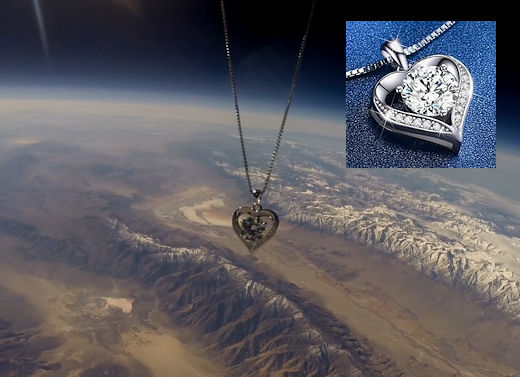
You can have it for $299.95. Almost indistinguishable from natural diamond, the 3-carat crystal is held by a sterling silver frame with the words "I Love You" engraved on the back. It's a truly out of this world gift.

The students are selling space jewelry to pay the helium bill for their high altitude ballooning program. Each pendant comes with a greeting card showing the item in flight and telling the story of its journey to the stratosphere and back again.
Far Out Gifts: Earth to Sky Store
All sales support hands-on STEM education
Realtime Space Weather Photo Gallery
Free: Spaceweather.com Newsletter
Realtime Aurora Photo Gallery
Free: Spaceweather.com Newsletter