THE SUN'S NORTHERN HEMISPHERE IS WAKING UP: For much of the past year, solar activity has been dominated by southern sunspots. Now, the sun's northern hemisphere is waking up. Two-thirds of today's sunspot groups are north of the sun's equator, and the sunspot number is climbing again. Could this herald a second peak for Solar Max? Stay tuned. Aurora alerts: SMS Text.
TOTAL ECLIPSE ON EARTH *AND* THE MOON: Last night, the full Moon passed through Earth's shadow, turning the lunar disk red. Sky watchers in the Americas had a beautiful view of the 90 minute event. For a small number of astronomers, however, the real action happened a quarter million miles away in Mare Crisium, where Blue Ghost watched the eclipse from the other direction. Eric Allen of Quebec, Canada, created this composite of both views:
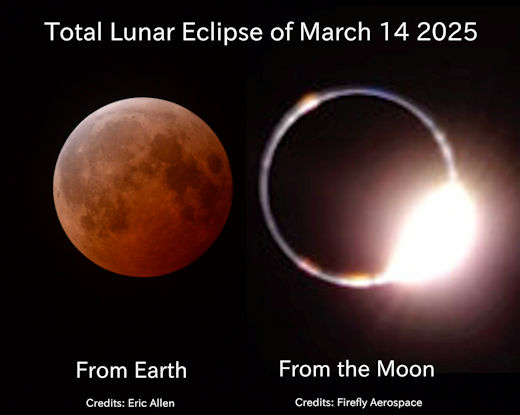
"I've wanted to do this for so long!!" says Allen. "Now I can show my astrophysics students the comparison of views from the Earth and from the Moon at the same time of a total lunar eclipse. Congratulations to Firefly Aerospace for making this possible!"
Blue Ghost is a commercial lunar lander, which sucessfully touched down on the Moon March 2nd following a 45-day trip from Earth. It was perfectly positioned in the Sea of Crises to observe the Earth as it passed in front of the sun. While people on Earth watched a lunar eclipse, Blue Ghost observed a solar eclipse. The two always go together, but rarely are they both seen at the same time.
This isn't the first time a lunar lander has witnessed an eclipse. On April 24, 1967, a television camera on NASA's Surveyor III took this picture of Earth blocking the sun over Oceanus Procellarum:
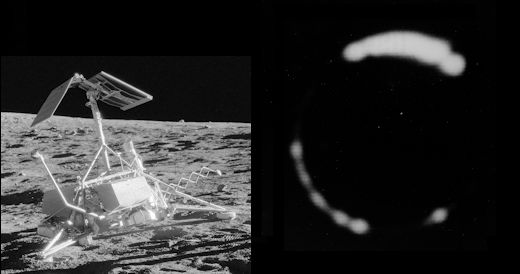
Clearly, Blue Ghost's photo is better; the best ever, in fact.
Browse our realtime gallery for more images of the eclipsed Moon--and submit your own images here!
Lunar Eclipse Photo Gallery
Free: Spaceweather.com Newsletter
HAPPY PI DAY: March 14th (3.14) is  day and all around the world mathematicians are celebrating this compelling and mysterious constant of Nature. Pi appears in equations describing the orbits of planets, the colors of auroras, the structure of DNA. It's everywhere.
Humans have been struggling to calculate for thousands of years. Divide the circumference of a circle by its diameter; the ratio is . Sounds simple, but the devil is in the digits. While the value of is finite (a smidgen more than 3), the decimal number is infinitely long:
3.1415926535897932384626433832795
02884197169399375105820974944592307
81640628620899862803482534211706...more
Supercomputers have succeeded in calculating more than 105 trillion digits and they're still crunching. The weirdest way to compute : throw frozen hot dogs on the floor. Party time!
Realtime Space Weather Photo Gallery
Free: Spaceweather.com Newsletter
"METEOR CRATER" CRYSTAL PENDANT: Have you heard of Moissanite? It's a very rare mineral discovered in Arizona's Meteor Crater by 19th-century chemist Henri Moissan. At first, he thought it was diamond, but later realized it was even more rare. It came from meteorites! On March 4, 2025, the students of Earth to Sky Calculus launched a Moissanite pendant to the stratosphere onboard a cosmic ray research balloon:
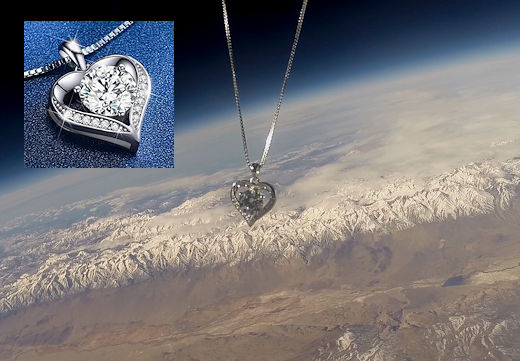
You can have it for $299.95. Almost indistinguishable from natural diamond, the 3-carat crystal is held by a sterling silver frame with the words "I Love You" engraved on the back. It's a truly out of this world gift.

The students are selling space jewelry to pay the helium bill for their high altitude ballooning program. Each pendant comes with a greeting card showing the item in flight and telling the story of its journey to the stratosphere and back again.
Far Out Gifts: Earth to Sky Store
All sales support hands-on STEM education
Realtime Space Weather Photo Gallery
Free: Spaceweather.com Newsletter
Realtime Aurora Photo Gallery
Free: Spaceweather.com Newsletter