AURORAS LOVE EQUINOXES: The vernal equinox is only three days away. That's good news for sky watchers because auroras love equinoxes. Researchers call it the "Russell-McPherron effect." At this time of year, cracks form in Earth's magnetic field. Even a weak stream of solar wind can enter and spark a good display. Happy Spring! Aurora alerts: SMS Text.
VENUS ON FIRE: Venus is approaching inferior conjunction on March 22nd, and this is creating some unusual atmospheric optics. Raffaello Lena of Rome, Italy, captured this example on March 16th:
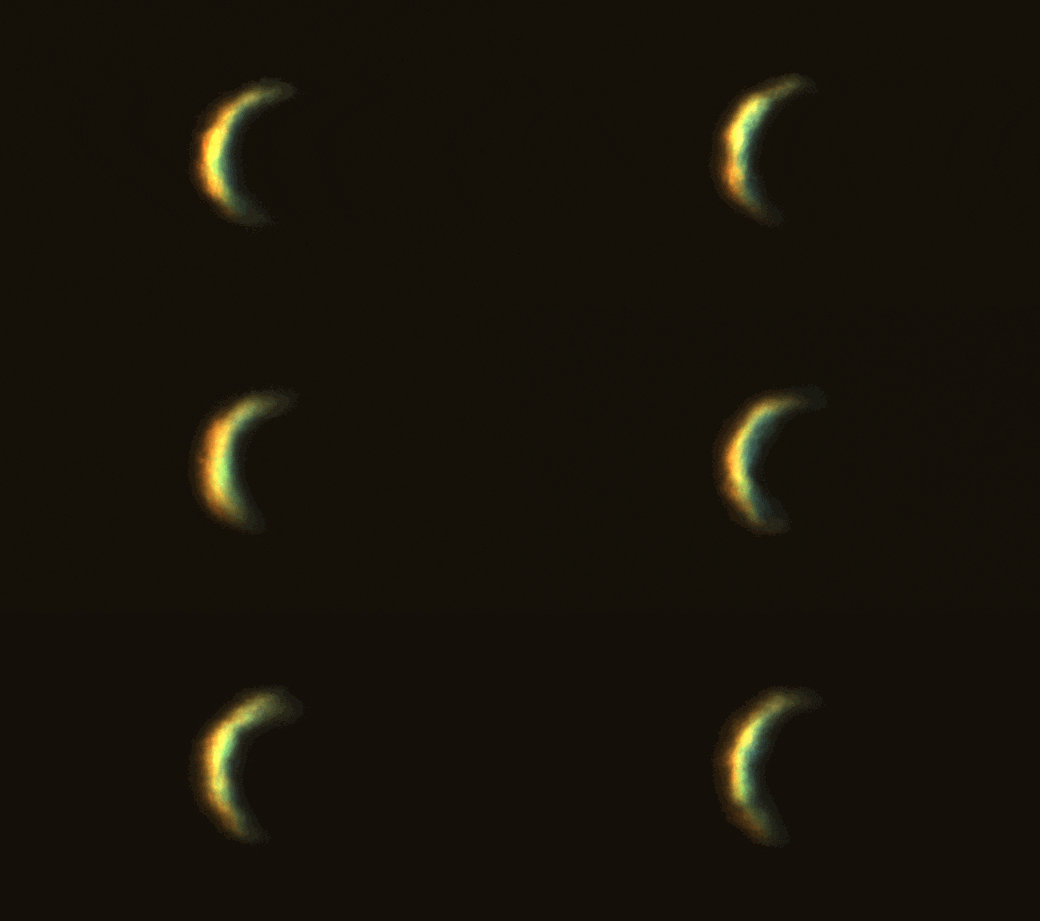
"It looks like a fire on the planet!" says Lena.
What's going on? Three things: (1) Venus is a narrow crescent because it is turning its night side toward Earth. (2) Earth's atmosphere acts like a prism, splitting the narrow crescent into rainbow colors. (3) Turbulence in the atmosphere over Rome set the colors in motion, resembling fire.
Between now and March 22nd, Venus will become even bigger, thinner, and more colorful. Stay tuned!
Realtime Venus Photo Gallery
Free: Spaceweather.com Newsletter
THE OZONE FRINGE: During a lunar eclipse, the Moon is supposed to turn red. Yet during the eclipse on March 14th, some photographers caught a different color: Pale blue. Alan Friedman saw it from Buffalo, New York:
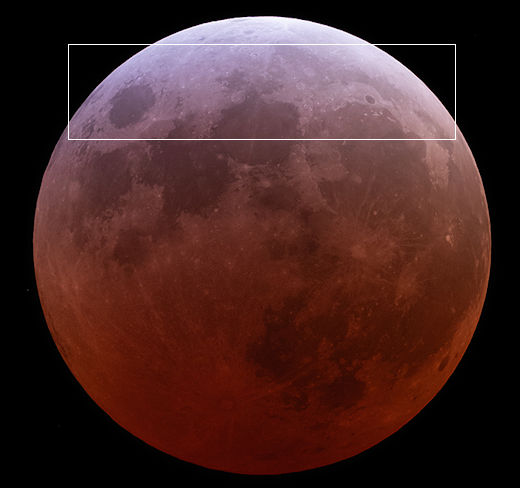
"I took this picture during the first moments of totality," says Friedman.
The blue light is caused by ozone. During a lunar eclipse, most of the light illuminating the Moon passes through Earth's stratosphere, which is reddened by scattering. However, light passing through the upper stratosphere penetrates the ozone layer, which absorbs red light and actually makes the passing light ray bluer.
The blue "ozone fringe" is visible only during the first and last moments of totality. Often, photographers don't even realize they have caught it. Many examples may be found in our lunar eclipse photo gallery. Check it out.
Realtime Lunar Eclipse Photo Gallery
Free: Spaceweather.com Newsletter
"METEOR CRATER" CRYSTAL PENDANT: Have you heard of Moissanite? It's a very rare mineral discovered in Arizona's Meteor Crater by 19th-century chemist Henri Moissan. At first, he thought it was diamond, but later realized it was even more rare. It came from meteorites! On March 4, 2025, the students of Earth to Sky Calculus launched a Moissanite pendant to the stratosphere onboard a cosmic ray research balloon:
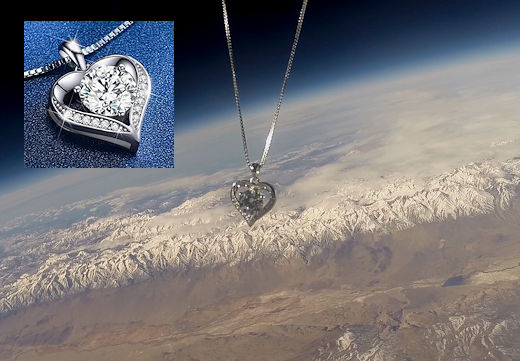
You can have it for $299.95. Almost indistinguishable from natural diamond, the 3-carat crystal is held by a sterling silver frame with the words "I Love You" engraved on the back. It's a truly out of this world gift.

The students are selling space jewelry to pay the helium bill for their high altitude ballooning program. Each pendant comes with a greeting card showing the item in flight and telling the story of its journey to the stratosphere and back again.
Far Out Gifts: Earth to Sky Store
All sales support hands-on STEM education
Realtime Space Weather Photo Gallery
Free: Spaceweather.com Newsletter
Realtime Aurora Photo Gallery
Free: Spaceweather.com Newsletter