AURORAS LOVE EQUINOXES: Today is the first day of northern spring. That's good news for sky watchers because auroras love equinoxes. Researchers call it the "Russell-McPherron effect." At this time of year, cracks form in Earth's magnetic field. Even a weak stream of solar wind can penetrate to spark a good display. Happy Spring! Aurora alerts: SMS Text.
NEW EVIDENCE THAT COSMIC RAYS SPARK LIGHTNING: Every second, almost 50 bolts of lightning zig-zag across the skies of Earth. Despite centuries of study, however, researchers still aren't sure how the bolts get started. Electric fields in thunderclouds are often too weak to ignite a powerful discharge.
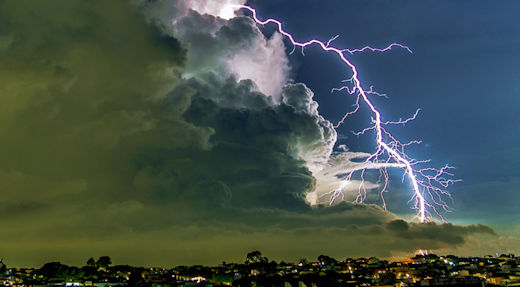
A lightning bolt over Brazil. Photo credit: Sergio Mazzi
A new study just published in the Journal of Geophysical Research may have solved the mystery.
"We believe that that most lightning flashes in thunderstorms are ignited by cosmic ray showers," says the study's lead author Xuan-Min Shao, a senior scientist at the Los Alamos National Laboratory in New Mexico.
To investigate the earliest moments of lightning formation, Shao and colleagues built a radio interferometer named "BIMAP-3D." Consisting of an array of 8 antennas in Los Alamos, BIMAP-3D can make three dimensional images of lightning and pinpoint the bolts inside thunderclouds. Here's an example:
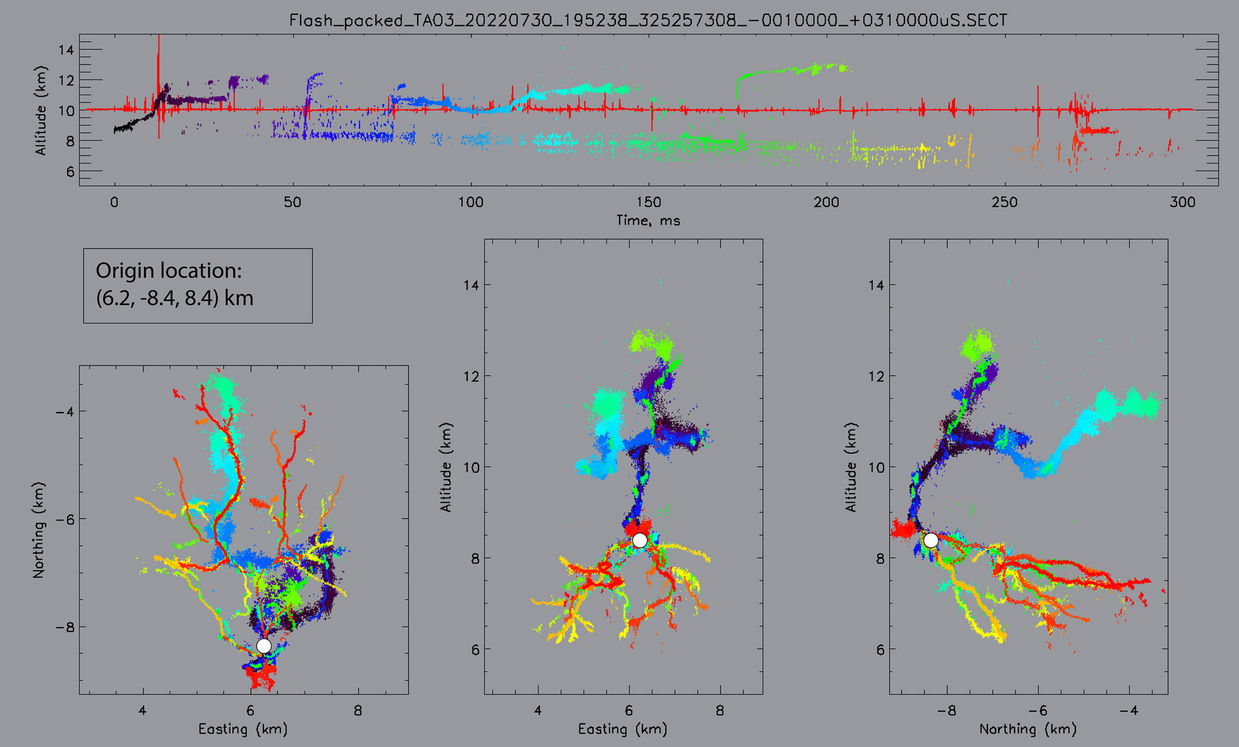
Caption: Colors in the image represent time. Blue traces the earliest moments of the bolt, while red denotes the end.
This is a lightning bolt from a massive thunderstorm that passed by Los Alamos on July 30, 2022. BIMAP-3D imaged more than 300 bolts during the 90-minute storm. It was a treasure trove of data.
The experimenters realized that some of the bolts they observed happened in parts of the storm where electric fields were too weak to cause the "Initial Breakdown Event" (IBE)--the initial spark that sets the lightning in motion. Modern theories of relativistic electron avalanche couldn't explain what they saw. Their suspicions soon focused on cosmic rays.
Cosmic rays are high energy particles that come from distant supernova explosions and other violent events across the cosmos. They strike Earth's atmosphere all the time, creating a secondary spray of particles called "cosmic ray showers." Regular readers are familiar with these showers because we routinely monitor them using Earth to Sky cosmic ray balloons over California.
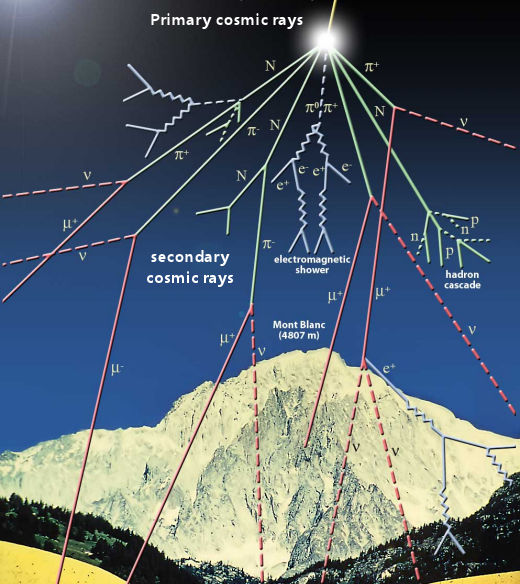 One of the important things about cosmic ray showers is that they contain antimatter--positrons as well as ordinary electrons. The Los Alamos 3D lightning maps contained strong evidence for positrons. Electrons and positrons are bent in opposite directions by Earth's magnetic field, so they leave opposite imprints on the lightning's polarization, which BIMAP-3D also measured.
"It took me a while to figure this out," admits Shao. "I started with electrons only at the beginning, but could not explain the observations. With both electrons and positrons involved, all the observations can be consistently explained."
Positrons clinched the case for cosmic rays. "The fact that a cosmic ray shower provides an ionized path in the cloud that otherwise lacks free electrons strongly favor the inference that most lightning flashes are ignited by cosmic rays," the authors wrote.
In fact, it's still unclear how much of Earth's lightning is sparked by cosmic rays. Many more storms need to be studied with this method to improve the statistics. "This will require a lot of long-term and good quality lightning data," Shao says.
Stay tuned! And meanwhile, read the original research here.
Realtime Lightning Photo Gallery
Free: Spaceweather.com Newsletter
ROSE QUARTZ TREE OF LIFE PENDANT: You cannot buy this on Amazon. Only the Earth to Sky Store has the Rose Quartz Tree of Life Space Pendant. This one flew to the stratosphere March 4th onboard a cosmic ray research balloon:

You can have it for $129.95. The pendant's rose quartz gemstone is surrounded by a hand-wrapped stainless steel tree of life. During its 3-hour flight, it experienced temperatures as low as -63 C and air pressures less than 0.3% of sea level--truly, an out-of-this world gift!
The students are selling space jewelry to pay the helium bill for their high altitude ballooning program. Each pendant comes with a greeting card showing the item in flight and telling the story of its journey to the stratosphere and back again.
Far Out Gifts: Earth to Sky Store
All sales support hands-on STEM education
VENUS APPROACHES INFERIOR CONJUNCTION: This weekend (March 23rd), Venus will pass between Earth and the sun--an event astronomers call "inferior conjunction." It's a special time to observe the second planet, because around inferior conjunction the disk of Venus turns into an otherworldly crescent. Maximilian-Vlad Teodorescu photographed it today from the Institute of Space Science in Romania:
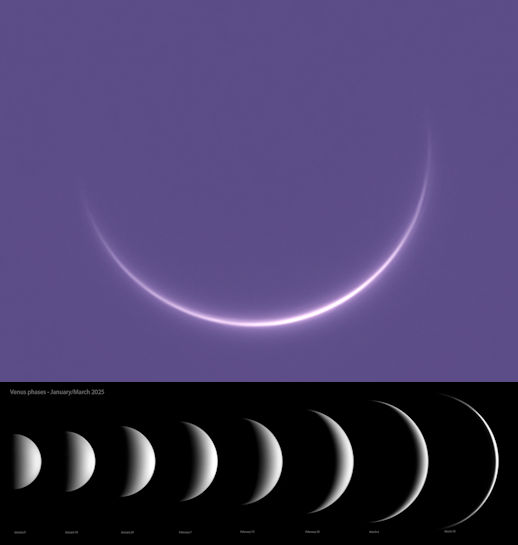
"This was one of the hardest imaging sessions yet, as rolling clouds, strong winds and poor seeing combined with Venus' proximity to the sun to complicate photography,"says Teodorescu. "It was worth the effort to capture Venus as a very thin crescent."
Teodorescu has been monitoring the transformation of Venus as it approaches inferior conjunction. The bottom panel shows a selection of his photos since January. He plans to add one final crescent: "I will attempt to image on the day of conjunction as well," he says. Stay tuned!
Realtime Venus Photo Gallery
Free: Spaceweather.com Newsletter
Realtime Space Weather Photo Gallery
Free: Spaceweather.com Newsletter
Realtime Aurora Photo Gallery
Free: Spaceweather.com Newsletter