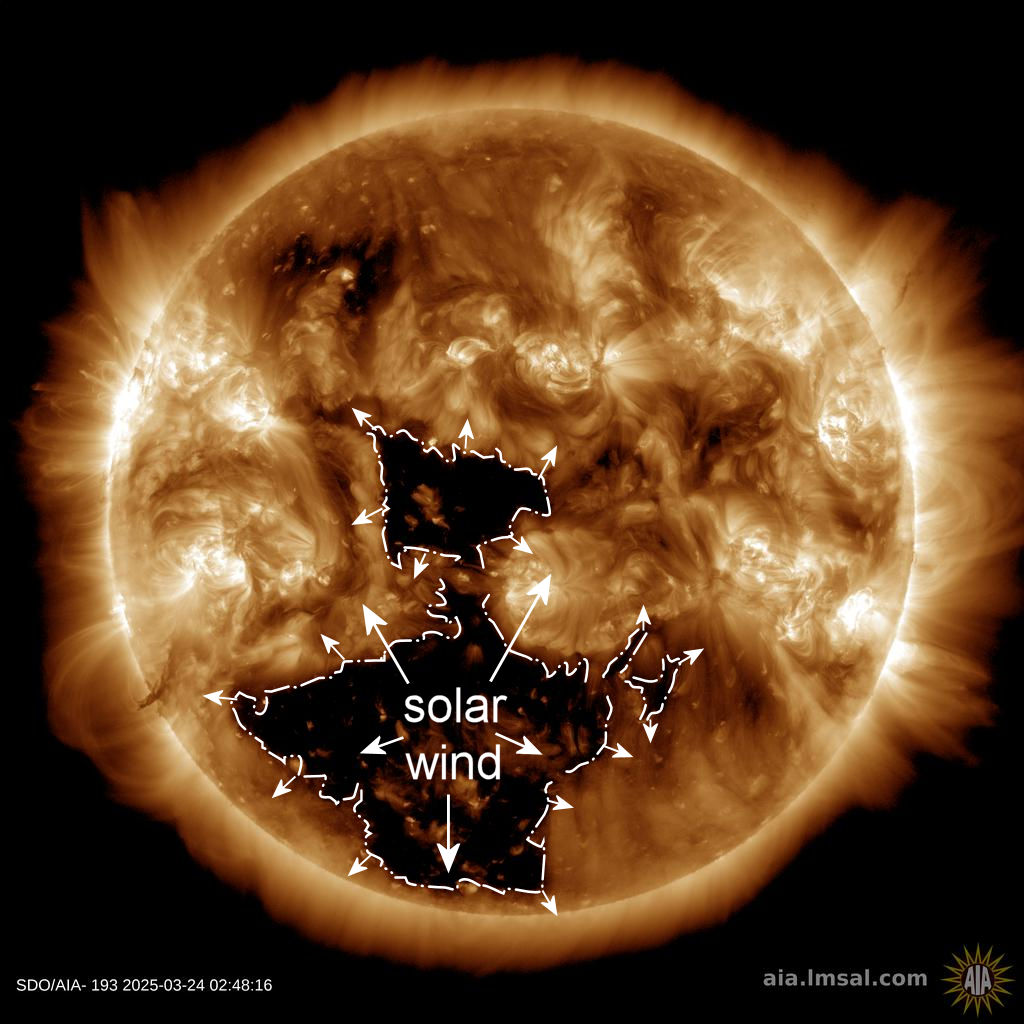
CO-ROTATING INTERACTION REGION: NOAA forecasters say that G2-class geomagnetic storms are possible on March 25-26, when a co-rotating interaction region (CIR) is expected to hit Earth. CIRs are transition zones between fast- and slow-moving streams of solar wind. They contain shock waves akin to CMEs. Today's CIR is powered by a giant hole in the sun's atmosphere. Aurora alerts: SMS Text.

A SPYSAT SPACEX SPIRAL: Yesterday, SpaceX launched a spy satellite for the US National Reconnaissance Office (NRO). Two hours after the Falcon 9 rocket lifted off from Cape Canaveral, a magnificent blue spiral pinwheeled across western Europe. "I was watching the night sky when I noticed a strange bright star with a weird halo moving towards me," says Joe Hyde of Preston, England. "As it grew larger, I photographed it using my iPhone16."
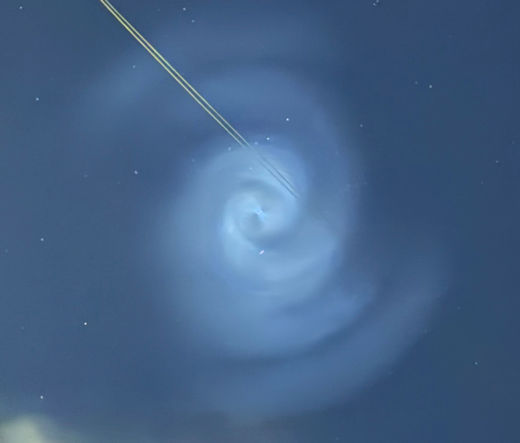
"At first I had no idea what it was," he says, "but some Googling revealed it was probably a fuel dump from a SpaceX rocket."
Correct! The rocket's second stage was spinning when it executed a deorbit burn and fuel dump, naturally shaping the exhaust into a spiral. Spirals are an increasingly routine by-product of SpaceX operations. In recent years, similar blue swirls have been seen over the Barents Sea, New Zealand, east Africa, Hawaii (twice!), and Alaska.
Why was the rocket spinning? It may mean there was more than one satellite on board. Spinning the rocket body gives satellites a bit of separation when they pop out one after another. Indeed, there is speculation that this payload was actually a pair of surveillance satellites akin to the US Navy's Naval Ocean Surveillance System (NOSS), which has conducted signals intelligence from space since the 1970s.
more images: from Alessandro Gambaro of Castano Primo (MI) - Italy; from Anton Spenko of Kamnik, Slovenija; from Henk Troostheide of Lindås, Kalmar Lan, Sweden; from Andrew Greenwood of Lincolnshire, UK; from Anders of Stockholm, Sweden; from Tony Blackman of Rayleigh, Essex, England; from Helen Dillon of Rothley, Leicestershire, UK;
Realtime Space Weather Photo Gallery
Free: Spaceweather.com Newsletter
TWO INFERIOR CONUNCTIONS OF VENUS: It took Philip Smith almost two years to create this animation. "I imaged two inferior conjunctions from my Manorville, New York, observatory--the first on 08-13-23 and the second on 03-23-25," he explains. "Then I combined the two crescents into a single ring."
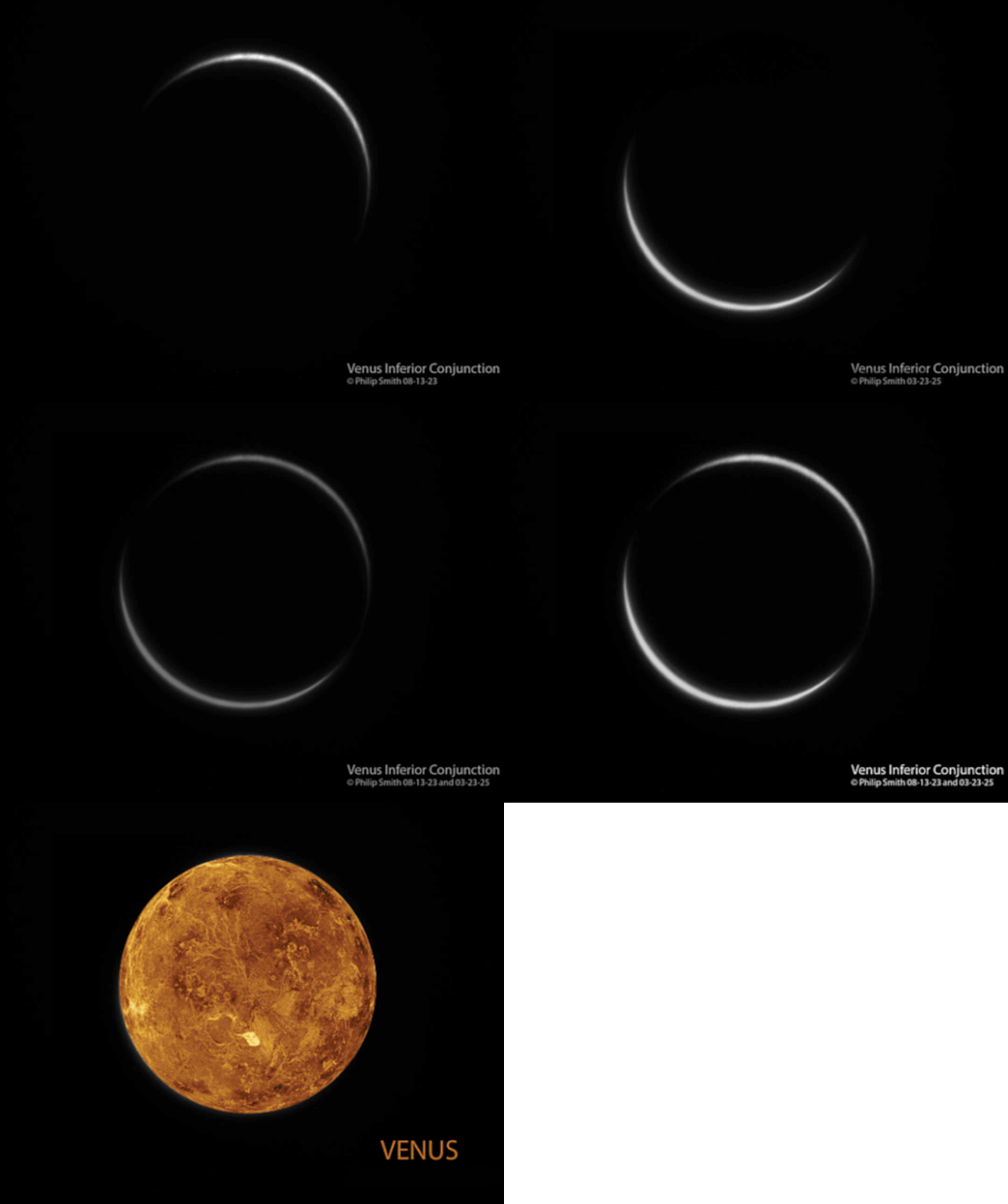
"In 2023 and 2025, Venus passed on opposite sides of the sun," Smith continues. "Opposite sides of Venus were therefore illuminated. Combining them reveals the planet's outer diameter. I punctuated the animation with a radar image of Venus from NASA."
Why is Venus a crescent? This diagram explains it all. During the days around inferior conjunction, Venus's night side faces Earth with only a thin sliver of sunlight filtering through the planet's acid cloudtops. Many photos were taken of the exquisite arc during this year's conjunction. Browse the gallery for more:
Realtime Venus Photo Gallery
Free: Spaceweather.com Newsletter
ROSE QUARTZ TREE OF LIFE PENDANT: You cannot buy this on Amazon. Only the Earth to Sky Store has the Rose Quartz Tree of Life Space Pendant. This one flew to the stratosphere March 4th onboard a cosmic ray research balloon:

You can have it for $129.95. The pendant's rose quartz gemstone is surrounded by a hand-wrapped stainless steel tree of life. During its 3-hour flight, it experienced temperatures as low as -63 C and air pressures less than 0.3% of sea level--truly, an out-of-this world gift!
The students are selling space jewelry to pay the helium bill for their high altitude ballooning program. Each pendant comes with a greeting card showing the item in flight and telling the story of its journey to the stratosphere and back again.
Far Out Gifts: Earth to Sky Store
All sales support hands-on STEM education
Realtime Venus Photo Gallery
Free: Spaceweather.com Newsletter
Realtime Aurora Photo Gallery
Free: Spaceweather.com Newsletter