CO-ROTATING INTERACTION REGION: Minor G1-class geomagnetic storms are possible on April 4th when a co-rotating interaction region (CIR) is expected to hit Earth. CIRs are transition zones between fast- and slow-moving solar wind. Solar wind plasma piles up in these regions, producing shock waves and intense magnetic fields that do a good job sparking auroras. This could be good news for Fram2--see below. Aurora alerts: SMS Text.

FRAM2 NEEDS OUR HELP -- URGENT CALL FOR AURORA PHOTOS: On Monday night, four first-time astronauts soared into space onboard a SpaceX Falcon 9 rocket, becoming the first humans to orbit over Earth's poles. Their mission is named "Fram2." For the next 3 to 5 days, the pioneering astronauts will have an unprecedented view of polar auroras.
"I am the lead scientist on an aurora project called SolarMaX that takes place with the Fram2 astronauts," says Katie Herlingshaw of the University Centre in Svalbard. "We're going to be warning the crew when there are auroras coming up in their orbit--especially the 'weird auroras’ we are interested in such as fragments, STEVE, streaks, and continuum aurora."
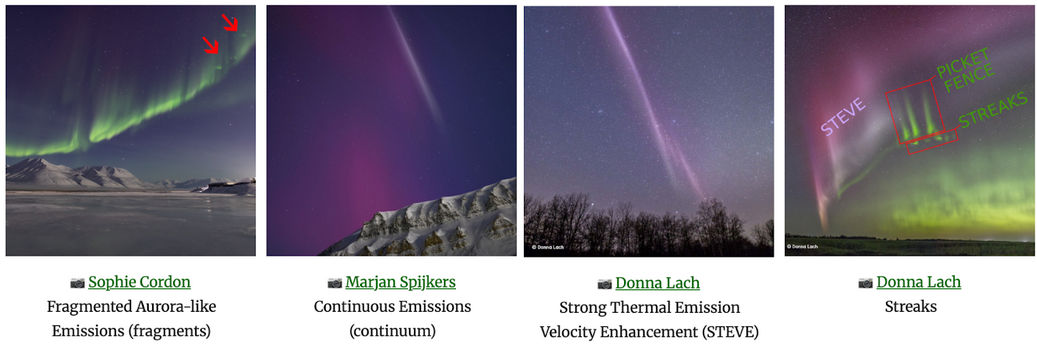
Above: Four types of "weird auroras" Fram2 will study. [more]
They need our help. Ground sightings and photos are essential to the project.
"We need photographers to submit their pictures of auroras,' says Herlingshaw. "We are especially interested in times when Fram2 passes overhead a location with auroras present. This will allow us the triangulate the auroral features using the photographs from the ground and also from space."
Usually our readers submit aurora photos to the Space Weather Gallery. For this project, we ask that you also submit them to Fram2. "To make the photos useful, people should collect the correct camera time (to the second if possible) and their location for the observations," she says. "We can't use the photo for research unless it has the correct time and location."
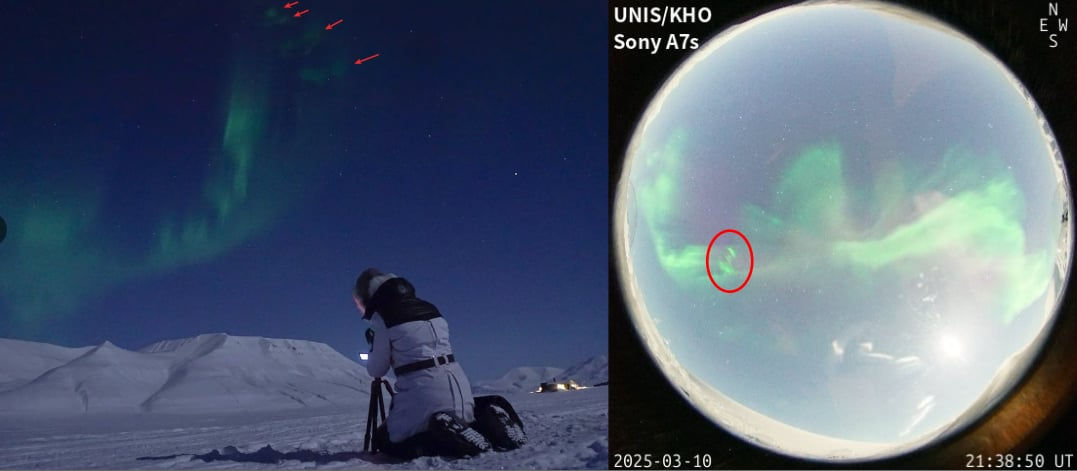
Above: Jannicke Mikkelsen photographing aurora fragments during Fram2 training
Inside the Fram2 capsule, 38-year-old Jannicke Mikkelsen will take the lead on these observations. "Our ground support team hope we can watch people's observations and advise her on when to run to the window!" says Herlingshaw.
More resources: Submit Your Photos!, Ground Support Map, Detailed Photography Instructions
Realtime Aurora Photo Gallery
Free: Spaceweather.com Newsletter
NORTHERN LIGHTS SPACE PENDANT: Are you looking for a far-out gift? Consider the Northern Lights Space Pendant. Here it is, hitching a ride to the stratosphere onboard an Earth to Sky Calculus cosmic ray balloon:
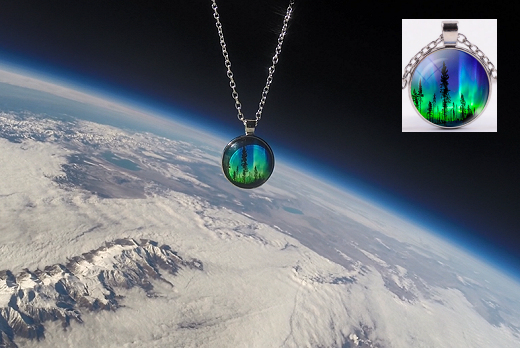
You can have it for $129.95. The students are selling these pendants to support their cosmic ray ballooning program. Each one comes with a greeting card showing the pendant in flight and telling the story of its journey to the edge of space. It makes an out-of-this-world birthday or anniversary gift!
Far Out Gifts: Earth to Sky Store
All sales support hands-on STEM education
Realtime Venus Photo Gallery
Free: Spaceweather.com Newsletter
Realtime Space Weather Photo Gallery
Free: Spaceweather.com Newsletter