GEOMAGNETIC STORM WATCH (G1): NOAA forecasters say that minor G1-class geomagnetic storms are likely on April 4-5 due to the effects of a co-rotating interaction region (CIR). CIRs are transition zones between fast- and slow-moving streams of solar wind. They contain shock waves akin to those of CMEs and often do a good job sparking high-latitude auroras. Aurora alerts: SMS Text.

A "WORMHOLE" OVER ALASKA: Spoiler alert: It was not a wormhole. Anyone who saw it, however, had to wonder, what was that luminous ring over central Alaska last Saturday?
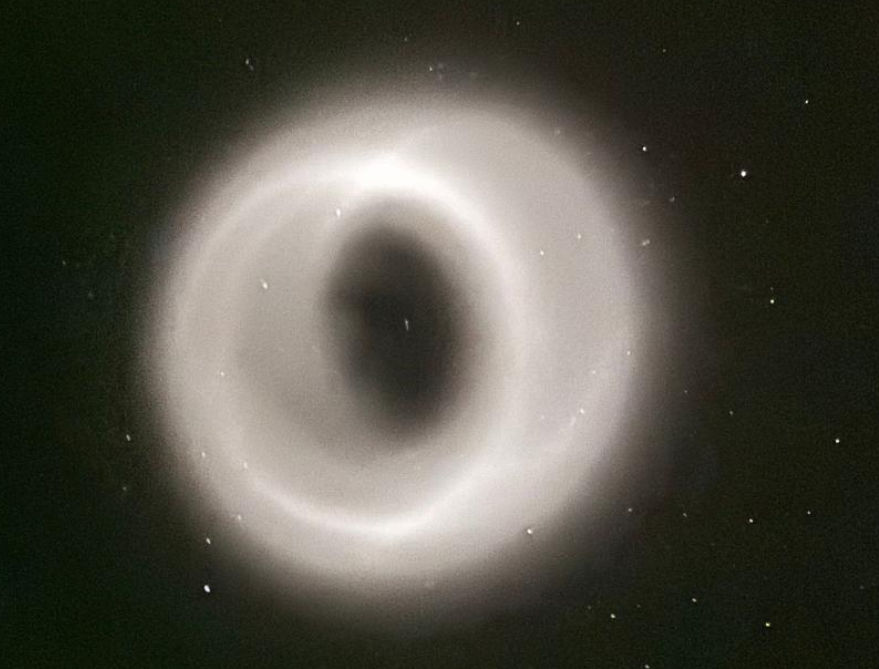
Photo credit: Eric Marshall. University of Alaska (Fairbanks)
Answer: A science experiment. It was exhaust from a sounding rocket launched from the Poker Flats Research Range north of Fairbanks on March 29th at 1:33 am Alaska time
Mark Conde, space physics professor at the University of Alaska Fairbanks Geophysical Institute, is responsible for the display. He's the principal investigator of "AWESOME" (Auroral Waves Excited by Substorm Onset Magnetic Events), a complicated mission in late March that launched three sounding rockets into the aurora borealis. The ring was created by the third rocket.
"[It] was extremely bright and absolutely unmissable," says Conde, who estimates that the ring was 60 to 75 miles high with a diameter of 15 miles. "This very clean ring shape was easy to track. Looking at the way it distorted over time [gives us] a detailed view of local-scale motions in the atmosphere."
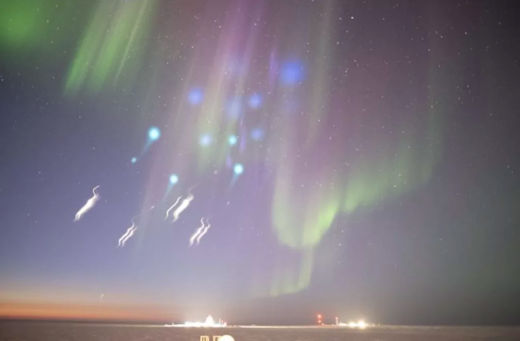
AWESOME sounding rockets fly into auroras over Poker Flats on March 25, 2025
The goal of the AWESOME project is to understand how auroras make the atmosphere "boil." Normally, convection doesn't happen in the uppermost layers of Earth's atmosphere. The thermosphere is hot on top and cooler down below--an upside-down temperature gradient that stops convection in its tracks.
Auroras, however, can "light a fire" underneath the thermosphere, causing it to roil like a pot of water on a hot stove. Vapors released by the AWESOME sounding rockets trace these motions, which have a big influence on satellite drag and navigation.
According to Conde, "the mission was a success. We should now have the data to address these questions." Stay tuned for results.
Realtime Space Weather Photo Gallery
Free: Spaceweather.com Newsletter
BLUE OPALITE SOLAR ECLIPSE PENDANT: This crystal pendant has touched the shadow of the Moon. On Aug. 21, 2017, during the Great American Solar Eclipse, the students of Earth to Sky Calculus launched 11 space weather balloons from the path of totality. The Blue Opalite Eclipse Pendant flew into the Moon's shadow over the Malher National Forest in Oregon:

You can have it for $199.95. During the 2.5 hour stratospheric flight, the jewelry was wrapped in the Moon’s cold (-50 C) shadow for more than two minutes. After the shadow passed, the balloon popped at an altitude of 96,465 feet, and the pendant parachuted back to Earth. It comes with a greeting card telling the story of the eclipse and showing the crystal in flight.
Far Out Gifts: Earth to Sky Store
All sales support hands-on STEM education
FARSIDE SCHRöDINGER PEAKS: It *is* possible to see the farside of the Moon. Patricio Leon proved it on April 3rd when he photographed the Schrödinger peaks from Santiago, Chile:

The peaks he saw are the tops of mountains inside Schrödinger basin, a large farside impact crater near the Moon's south pole. "I was able to see them because of an extreme lunar libration," says Leon. "This is the second year in a row I have photographed these peaks."
Most of us learned in school that the same side of the Moon always faces Earth. That's not entirely true. The Moon actually wobbles back and forth, rocking and rolling as it elliptically orbits Earth. These lunar librations allow us to "peek around the edges." Over time, up to 59% of the lunar surface can be observed from Earth--including the Schrödinger peaks.
"Apparently these peaks have not been reported before because, even when libration is most favorable, they can be seen only from Earth's southern hemisphere," says Leon. Of course, NASA spacecraft have seen the peaks from directly overhead, and they are spectacular. Take a look.
Realtime Space Weather Photo Gallery
Free: Spaceweather.com Newsletter
Realtime Venus Photo Gallery
Free: Spaceweather.com Newsletter
Realtime Aurora Photo Gallery
Free: Spaceweather.com Newsletter