THE CENTENNIAL GLEISSBERG CYCLE: You've heard of the 11-year sunspot cycle. But what about the Centennial Gleissberg Cycle? The Gleissberg Cycle is a slow modulation of the solar cycle, which suppresses sunspot numbers every 80 to 100 years. It may have been responsible for the remarkable weakness of Solar Cycle 24 in 2012-2013. New research published in the journal Space Weather suggests that the minimum of the Gleissberg Cycle has just passed. If so, solar cycles for the next 50 years could become increasingly intense. Read the paper here.
NEW COMET DISCOVERY: Amateur astronomers are monitoring a bright new comet easily detectable by backyard telescopes. Introducing, Comet SWAN25F:

"Newly-discovered Comet SWAN25F is brightening nicely as it approaches the sun," reports Mike Olason, who sends these pictures from Tucson, Arizona. "On the morning of April 6th, the comet was magnitude 8.4 with a bright green 3' wide coma and a thin tail that extended well beyond my field of view."
The comet is named after the SWAN camera onboard the Solar and Heliospheric Observatory (SOHO). Australian amateur astronomer Michael Mattiazzo noticed the comet in online images. SWAN is a special camera that maps hydrogen in the solar wind, which suggests this comet may be rich in the element.
"The comet's tail is at least 2 degrees long," says Michael Jaeger, who teamed up with Gerald Rhemann to photograph the comet low in the morning sky from Weißenkirchen, Austria:

"At the turn of the month, the comet could become brighter than 5th magnitude," predicts Jaeger.
"The comet appears to be brightening quite quickly," says Nick James of the British Astronomical Association. "It is too early to predict what the peak brightness will be. We need a few more days of observations to confirm the current trend, but it should become at least a binocular object."
To generate an ephemeris for your location, click here.
Realtime Comet Photo Gallery
Free: Spaceweather.com Newsletter
AMBER DRAGONFLY SPACE PENDANT: This dragonfly has touched space. The students of Earth to Sky Calculus launched it to the stratosphere onboard a cosmic ray research balloon, 109,228 feet above California's Sierra Nevada:
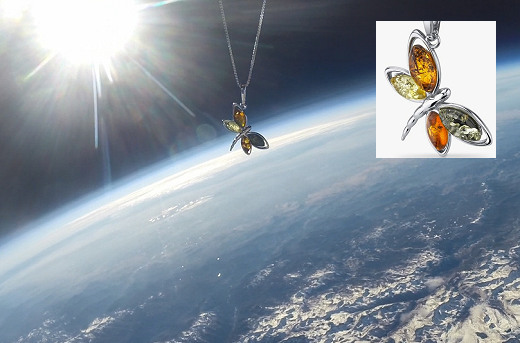
You can have it for $179.95. Made of genuine Baltic Amber with a sterling silver exoskeleton, the pendant measures 1 1/4 inch and comes with a matching 18-inch sterling silver chain. The wings of the dragonfly include four pieces of natural amber colored Cognac, Olive Green and Honey Yellow.
The students are selling space pendants to pay the helium bill for their cosmic ray ballooning program. Each one comes with a greeting card showing the jewelry in flight and telling the story of its trip to the stratosphere and back again.
Far Out Gifts: Earth to Sky Store
All sales support hands-on STEM education
Realtime Aurora Photo Gallery
Free: Spaceweather.com Newsletter
Realtime Space Weather Photo Gallery
Free: Spaceweather.com Newsletter