QUIET WITH A CHANCE OF FLARES: Solar activity is low, with nothing stronger than a C-class solar flare for more than a week. The quiet could end today with an explosion from big sunspot 4048; it has an unstable 'beta-gamma' magnetic field. NOAA forecasters say there is a 55% chance of M-class solar flares and a 10% chance of X-flares on April 8th. Solar flare alerts: SMS Text.
BOMBS ARE GOING OFF IN THIS SUNSPOT: With two dark cores wider than Earth, growing sunspot 4048 has become a tempting target for astrophotographers. Philippe Tosi of Nîmes, France, photographed the active region this morning and found it crackling with bomb-blasts:
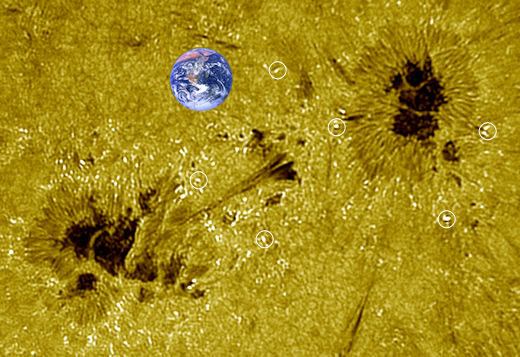
These are Ellerman bombs--magnetic explosions about one-millionth as powerful as true solar flares. A handful are circled above for reference. They are named after physicist Ferdinand Ellerman who studied the tiny blasts in the early 20th century. Note that "tiny" is relative. A single Ellerman bomb releases about 1026 ergs of energy--equal to about 100,000 World War II atomic bombs.
Explosions like these are a sign of magnetic complexity in a sunspot. Opposite polarities bump together, reconnect, and--boom. A full-fledged flare may not be far behind.
Realtime Space Weather Photo Gallery
Free: Spaceweather.com Newsletter
HANDMADE TOTAL ECLIPSE PENDANT: Exactly one year ago today (April 8, 2024), the students of Earth to Sky Calculus launched a cosmic ray research balloon to the stratosphere during a total solar eclipse. This handmade pendant went along for the ride. Floating more than 118,110 feet high, it spent 3 minutes and 45 seconds wrapped in the shadow of the Moon:
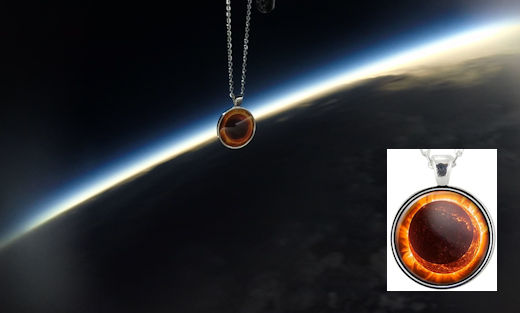
You can have it for $149.95. Created by an artist in Texas where totality occured, the pendant displays a solar eclipse art print sealed under a smooth glass cover. It comes with a greeting card showing the pendant in flight and telling the story of its journey to the edge of space during the total eclipse.
Far Out Gifts: Earth to Sky Store
All sales support hands-on STEM education
NEW COMET DISCOVERY: Amateur astronomers are monitoring a bright new comet easily detectable by backyard telescopes. Introducing, Comet SWAN25F:

"Newly-discovered Comet SWAN25F is brightening nicely as it approaches the sun," reports Mike Olason, who sends these pictures from Tucson, Arizona. "On the morning of April 6th, the comet was magnitude 8.4 with a bright green 3' wide coma and a thin tail that extended well beyond my field of view."
The comet is named after the SWAN camera onboard the Solar and Heliospheric Observatory (SOHO). Australian amateur astronomer Michael Mattiazzo noticed the comet in online images. SWAN is a special camera that maps hydrogen in the solar wind, which suggests this comet may be rich in the element.
"The comet's tail is at least 2 degrees long," says Michael Jaeger, who teamed up with Gerald Rhemann to photograph the comet low in the morning sky from Weißenkirchen, Austria:

"At the turn of the month, the comet could become brighter than 5th magnitude," predicts Jaeger.
"The comet appears to be brightening quite quickly," says Nick James of the British Astronomical Association. "It is too early to predict what the peak brightness will be. We need a few more days of observations to confirm the current trend, but it should become at least a binocular object."
To generate an ephemeris for your location, click here.
Realtime Comet Photo Gallery
Free: Spaceweather.com Newsletter
Realtime Aurora Photo Gallery
Free: Spaceweather.com Newsletter