SOLAR WIND SPARKS MINOR STORMS: Today, a relatively fast-moving (500 km/s) stream of solar wind is buffeting Earth's magnetic field, and this is causing minor G1-class geomagnetic storms. High-latitude sky watchers should be alert for auroras. Aurora alerts: SMS Text.

PLASMA FALLS: Imagine a waterfall made of hot plasma falling from a precipice tall enough to swallow Earth. Here it is:
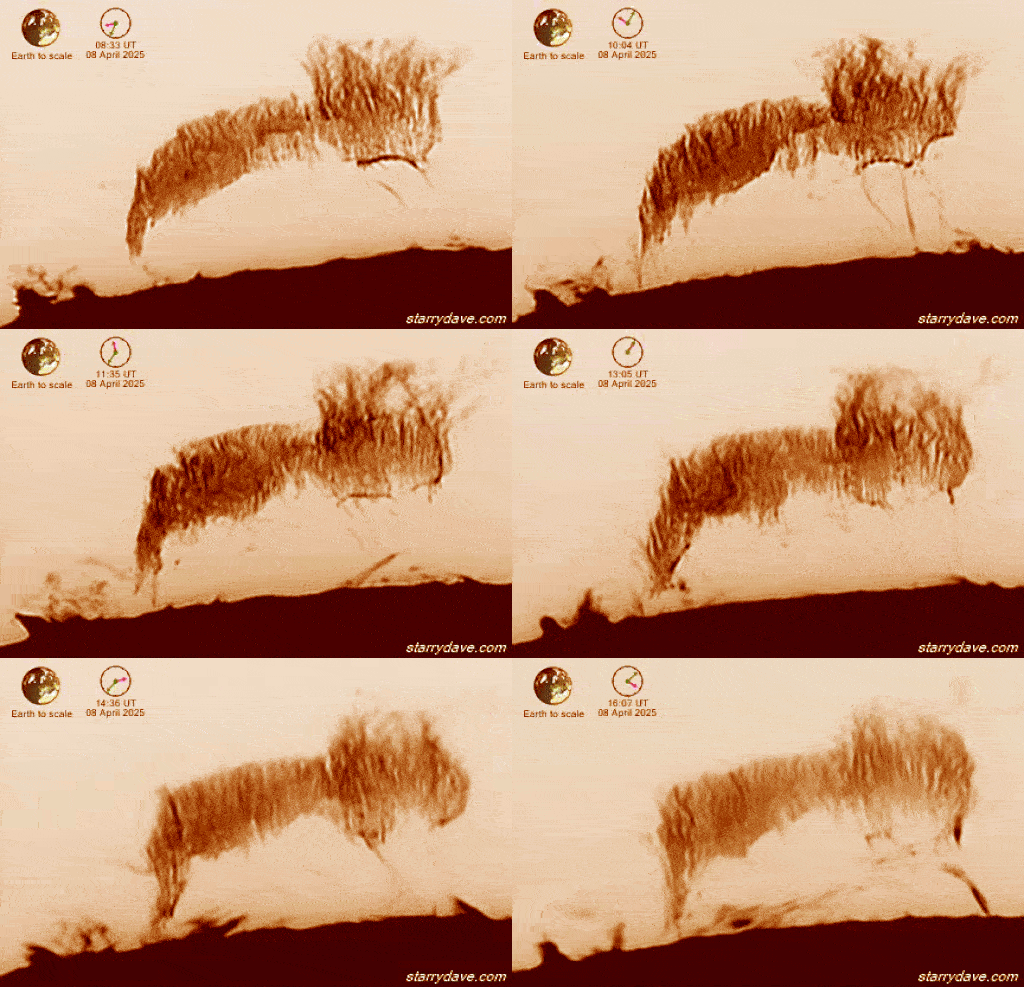
"Another cloud-free day in Scotland let me catch almost 9 hours of this huge and lively prominence," says David Wilson of Inverness. Into his video, he inserted a picture of Earth to demonstrate the scale of "plasma droplets" falling to the surface of the sun.
These droplets and streamers have been seen on the sun many times before, but researchers still don't fully understand them. The mystery is this: The sun's plasma droplets fall faster than ambient magnetic forces wold seem to allow. Nuclear engineers would like to figure out how this happens, because it also happens on a smaller scale in fusion reactors on Earth, frustrating their efforts to sustain an energy-producing reaction. Studies of these prominences could therefore lead to practical breakthroughs here on Earth.
Realtime Space Weather Photo Gallery
Free: Spaceweather.com Newsletter
WHAT YOU CAN SEE FROM YOUR OWN BACKYARD: There's an alien world in your backyard, visible in spectacular detail through common binoculars and telescopes. It's the Moon. To illustrate the point, Raffaello Lena of Rome, Italy, photographed the Moon's south pole on April 4th:
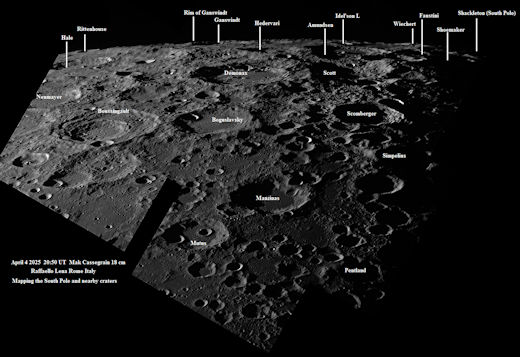
The view through an 18-cm Mak Cassegrain telescope. Credit: Raffaello Lena
"Mapping the south pole of the Moon is one of my interests," says Lena. "In this mosaic I have identified craters Amundsen, Faustini and Shoemaker, which is centered at 89.9° south, 0.0° east. Shackleton crater, which lies at the South Pole itself, is at the upper edge of the photo."
Most worlds in the Solar System are staggeringly far away. Tens, even hundreds of millions of miles separate us from them. Have you ever tried to see a crater on Mercury or a glacier on Pluto through a backyard telescope? Be prepared to use your imagination. Not so, the Moon. Take a look tonight!
more Moon shots: from Philippe Tosi of Nîmes, France;
Realtime Space Weather Photo Gallery
Free: Spaceweather.com Newsletter
HANDMADE TOTAL ECLIPSE PENDANT: One year ago yesterday (April 8, 2024), the students of Earth to Sky Calculus launched a cosmic ray research balloon to the stratosphere during a total solar eclipse. This handmade pendant went along for the ride. Floating more than 118,110 feet high, it spent 3 minutes and 45 seconds wrapped in the shadow of the Moon:
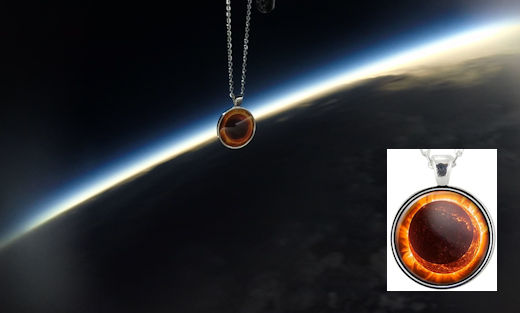
You can have it for $149.95. Created by an artist in Texas where totality occured, the pendant displays a solar eclipse art print sealed under a smooth glass cover. It comes with a greeting card showing the pendant in flight and telling the story of its journey to the edge of space during the total eclipse.
Far Out Gifts: Earth to Sky Store
All sales support hands-on STEM education
Realtime Comet Photo Gallery
Free: Spaceweather.com Newsletter
Realtime Aurora Photo Gallery
Free: Spaceweather.com Newsletter