GEOMAGNETIC STORM WATCH (G1): NOAA forecasters say that minor G1-class geomagnetic storms are possible on April 11th when a CME is expected to graze Earth's magnetic field. The CME was hurled into space by an erupting solar filament on April 8th. High-latitude sky watchers should be alert for auroras mixed with nearly-full moonlight. Aurora alerts: SMS Text.

PLASMA FALLS: Imagine a waterfall made of hot plasma falling from a precipice tall enough to swallow Earth. Here it is:
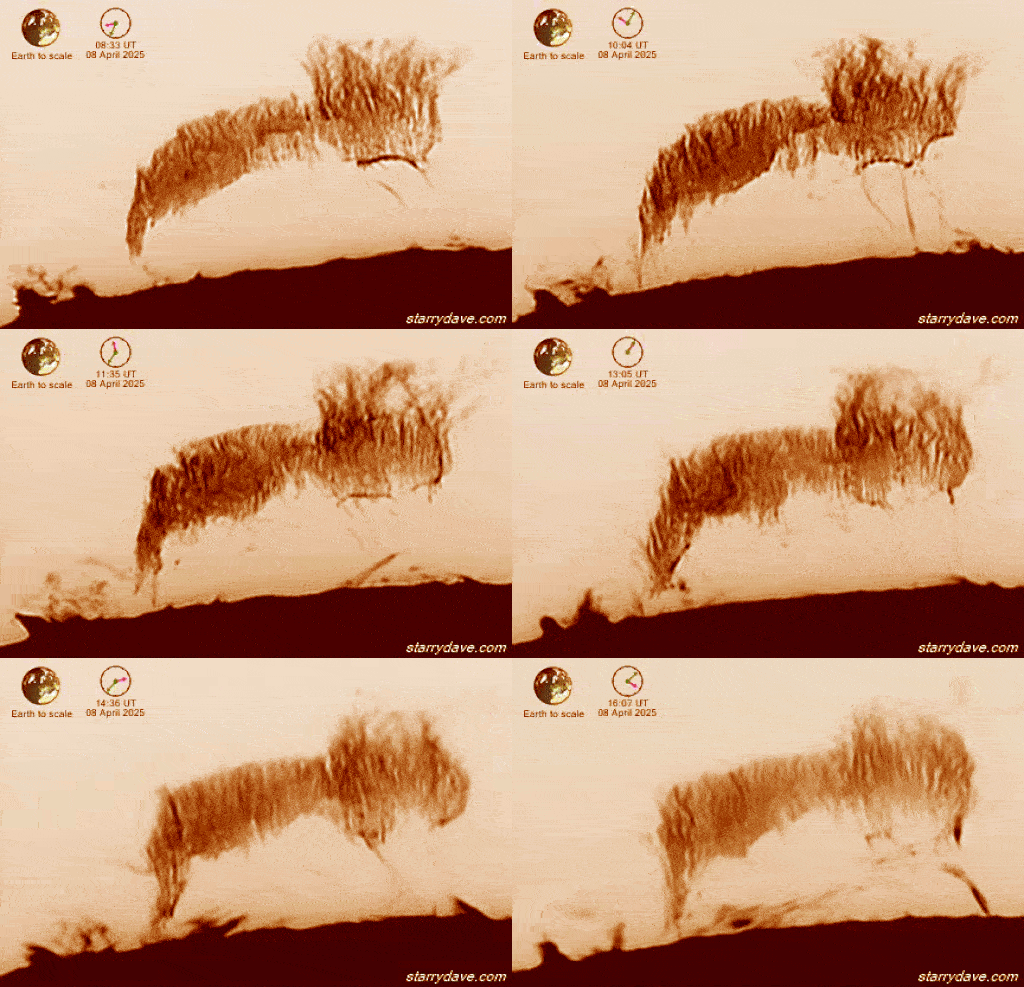
"Another cloud-free day in Scotland let me catch almost 9 hours of this huge and lively prominence," says David Wilson of Inverness. Into his video, he inserted a picture of Earth to demonstrate the scale of "plasma droplets" falling to the surface of the sun.
These droplets and streamers have been seen on the sun many times before, but researchers still don't fully understand them. The mystery is this: The sun's plasma droplets fall faster than ambient magnetic forces wold seem to allow. Nuclear engineers would like to figure out how this happens, because it also happens on a smaller scale in fusion reactors on Earth, frustrating their efforts to sustain an energy-producing reaction. Studies of these prominences could lead to practical breakthroughs here on Earth.
more images: from Neo of the Netherlands; from Philippe Tosi of Nîmes, France
Realtime Space Weather Photo Gallery
Free: Spaceweather.com Newsletter
ROSE GOLD MOONSTONE PENDANT: It's one big Moonstone. On April 9, 2024, the students of Earth to Sky Calculus launched this premium pendant to the stratosphere onboard a cosmic ray research balloon. For almost two hours it floated 102,800 feet above the Sierra Nevada mountains of Central California:
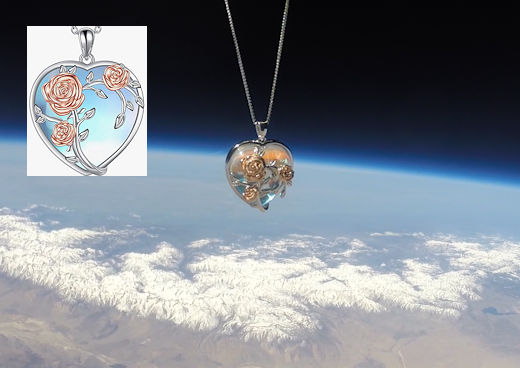
You can have it for $172.95. The heart-shaped moonstone is wrapped in a sterling silver frame decorated with 18K rose gold-plated roses. It makes a great anniversary or birthday gift and comes with a greeting card showing the mooonstone in flight. All sales support the student's cosmic ray research program.
Far Out Gifts: Earth to Sky Store
All sales support hands-on STEM education
COMET SWAN CONTINUES TO BRIGHTEN: More than a week after its discovery, Comet SWAN finally has an official name: C/2025 F2 (SWAN). On April 1st, amateur astronomer Michael Mattiazzo found the comet in images from SOHO's SWAN camera; then, on April 6th, he photographed it himself:
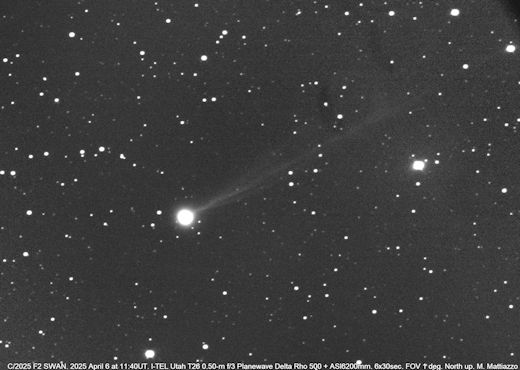
"I took this picture using a remote 0.5 meter telescope in Utah," says Mattiazzo. "At the time, Comet SWAN had a total magnitude of +9.6."
Since then, the comet has more than doubled in brightness. If current trends hold, it could brighten to magnitude +5 or +6 when it approaches the sun for a close encounter inside the orbit of Mercury on May 1st. That would make it an easy binocular object and possibly even visible to the naked eye. Stay tuned!
more images: from Chris Schur of Payson, Arizona; from Dr Paolo Candy of Ci.A.O. Cimini Astronomical Observatory, Italy; from Georg Klingersberger of Kobernaußen Upper Austria;
Realtime Comet Photo Gallery
Free: Spaceweather.com Newsletter
Realtime Aurora Photo Gallery
Free: Spaceweather.com Newsletter