GEOMAGNETIC STORM WATCH (G1): NOAA forecasters say that minor G1-class geomagnetic storms are possible on April 11-12 when a CME is expected to graze Earth's magnetic field. The CME was hurled into space by an erupting solar filament on April 8th. High-latitude sky watchers should be alert for auroras mixed with nearly-full moonlight. Aurora alerts: SMS Text.

WHAT HAPPENED TO SATURN'S RINGS? Saturn is so close to the sun that most astronomers have been missing a big event. The planet's rings have vanished. Sébastien Voltmer captured the phenomenon on April 9th in broad daylight over Spicheren, France:

"This rare daylight shot of Saturn next to the sun is dangerous for your eyes and gear," says Voltmer. "However, it was a great experience finding the ghostly-looking planet without its rings in the very transparent blue sky."
This is called a "ring plane crossing." On March 23, 2025, Earth passed through the plane of Saturn's rings. From our point of view, the vast ring system narrowed to an almost-invisible line. Usually this would make astronomy headlines. However, the ring plane crossing of 2025 occured while Saturn was dangerously close to the sun. Only now in early April is Saturn emerging from the glare so we can see what it looks like as "naked planet."
The next ring plane crossing visible in the night sky will be an incredible triple passage in 2038-39: October 15, 2038; April 1, 2039; and July 9, 2039. Mark your calendar.
Realtime Space Weather Photo Gallery
Free: Spaceweather.com Newsletter
AN ERUPTION ON COMET SWAN: Newly-discovered Comet SWAN (C/2025 F2) just underwent a significant eruption. Astronomer Mike Olason, who has been observing the comet almost every morning from Tucson, Arizona, captured the event:
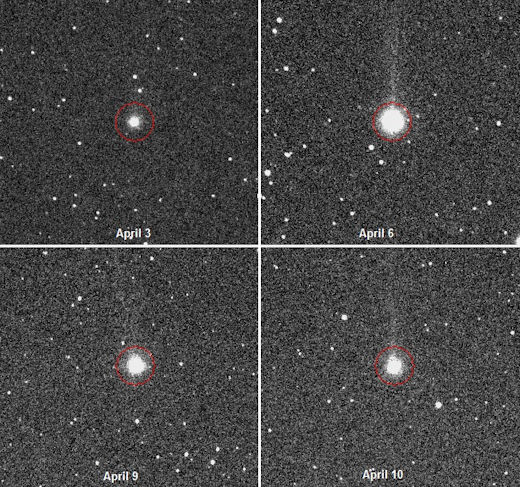
"For those who have wondered why Comet SWAN has been so hard to observe the past few mornings, it is because the comet has faded a magnitude since reaching its brightest point several days ago," says Olason. "Sometime between April 3rd and April 6th, the comet had a major eruption, which increased its brightness by a factor of 4 to magnitude 8.4."
The eruption may have been a pocket of ice, exposed and explosively vaporized by the intensifying heat of the sun. "Since then the comet has faded by a factor of 2 to stabilize at around magnitude 9.3 the past few mornings," he says.
It will brighten again. The comet is falling toward the sun for a close encounter inside the orbit of Mercury on May 1st. Standard light curves suggest it will eventually glow as brightly as a 5th magnitude star, making it an easy target for small telescopes and binoculars. Additional eruptions could shake up that prediction, however, so stay tuned.
more images: from Andrea Aletti and Luca Buzzi at the G.V.Schiaparelli Astronomical Observatory (VA), Italy ;
Realtime Comet Photo Gallery
Free: Spaceweather.com Newsletter
ROSE GOLD MOONSTONE PENDANT: This moonstone has touched space. On April 9, 2024, the students of Earth to Sky Calculus launched the Rose Gold Moonstone Pendant to the stratosphere onboard a cosmic ray research balloon. For almost two hours it floated 102,800 feet above the Sierra Nevada mountains of Central California:
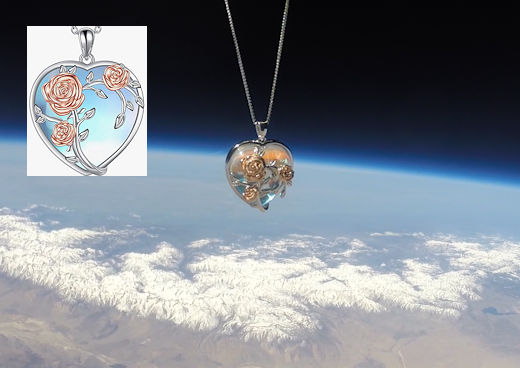
You can have it for $172.95. The heart-shaped moonstone is wrapped in a sterling silver frame decorated with 18K rose gold-plated roses. It makes a great anniversary or birthday gift and comes with a greeting card showing the mooonstone in flight. All sales support the student's cosmic ray research program.
Far Out Gifts: Earth to Sky Store
All sales support hands-on STEM education
Realtime Aurora Photo Gallery
Free: Spaceweather.com Newsletter