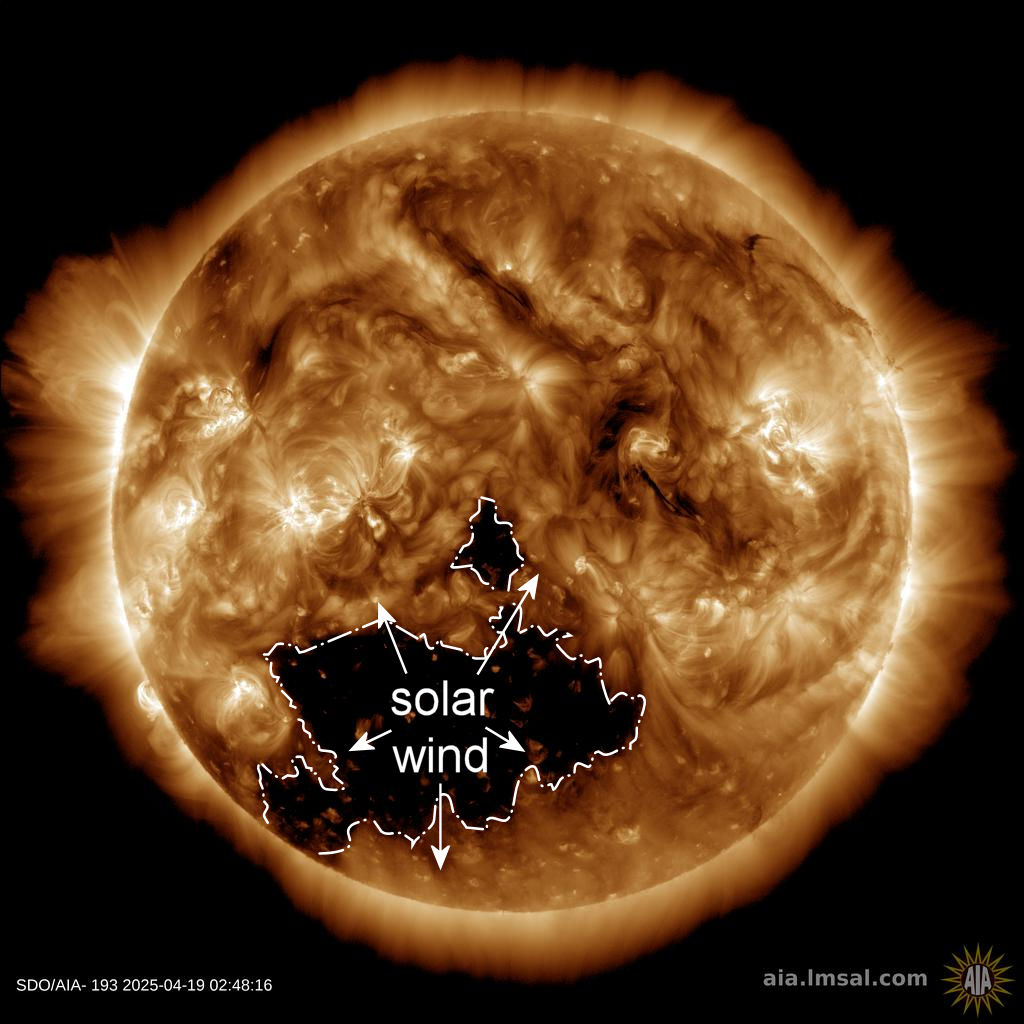
A BIG HOLE IN THE SUN'S ATMOSPHERE: Minor (G1) to moderate (G2) geomagnetic storms are possible on April 21st when a fast-moving stream of solar wind is expected to hit Earth's magnetic field. The gaseous material is flowing from an unsually large coronal hole, now facing Earth. Aurora alerts: SMS Text.


PLASMA DROP: A mass of hot plasma ten times wider than Earth just dropped off the edge of the sun. NOAA's Solar Ultraviolet Imager on GOES -19 recorded the event just after 2330 UTC on April 18th:
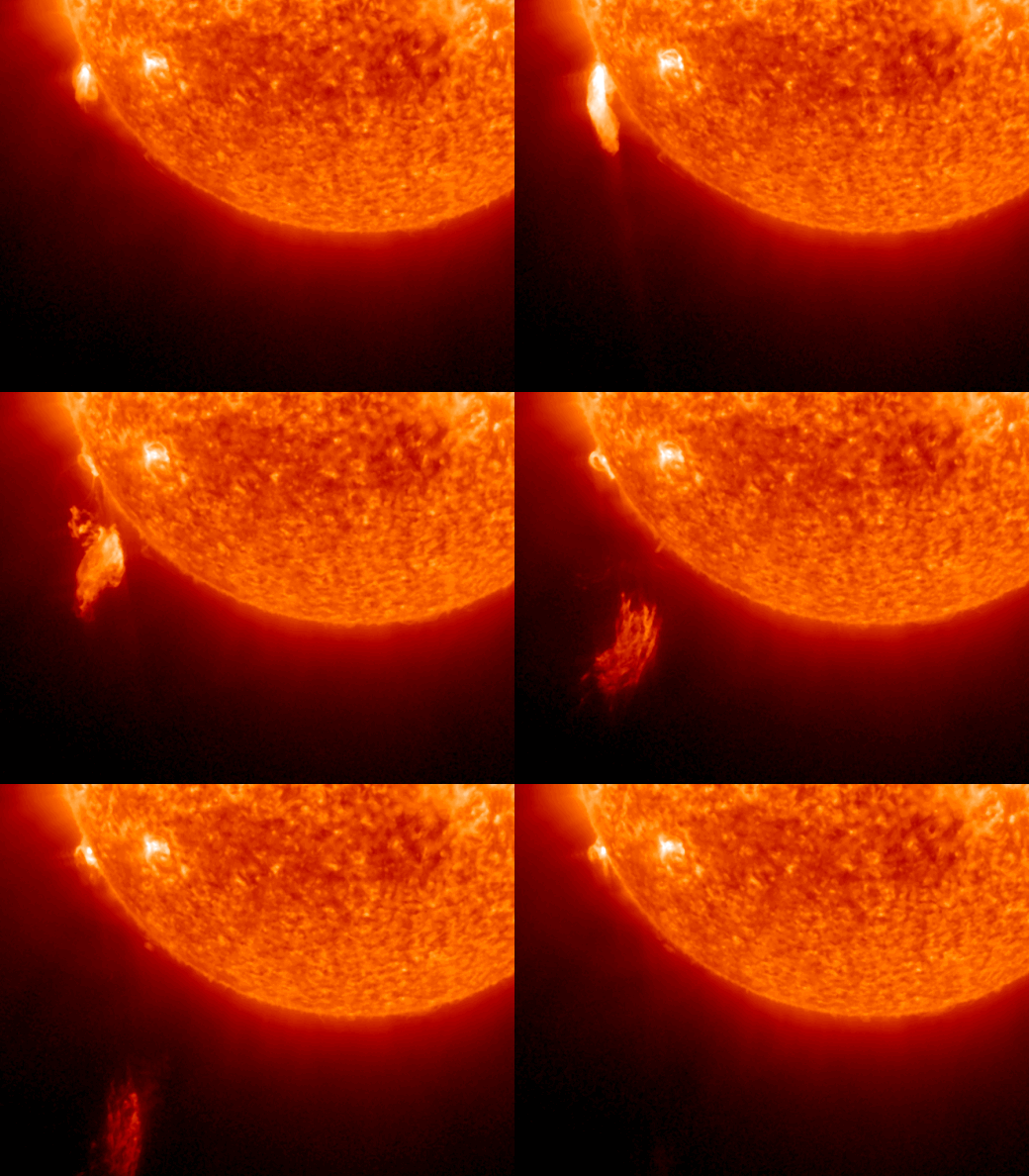
This is the result of an M4.4-class solar flare behind the sun's eastern limb. Something about the magnetic topology of the unseen blast site squirted the debris straight down--an unusual direction for solar explosions. It will *not* hit Earth. Solar flare alerts: SMS Text.
more images: from John Stetson of South Portland, Maine
GEOMAGNETIC GROUND CURRENTS IN NORTH AMERICA: Space weather doesn't only happen in the sky. It's in the ground, too. On April 16th, a severe geomagnetic storm caused electricity to flow through the rocks and soil of North America. Red zones in this animated map from NOAA show where voltages were greatest:

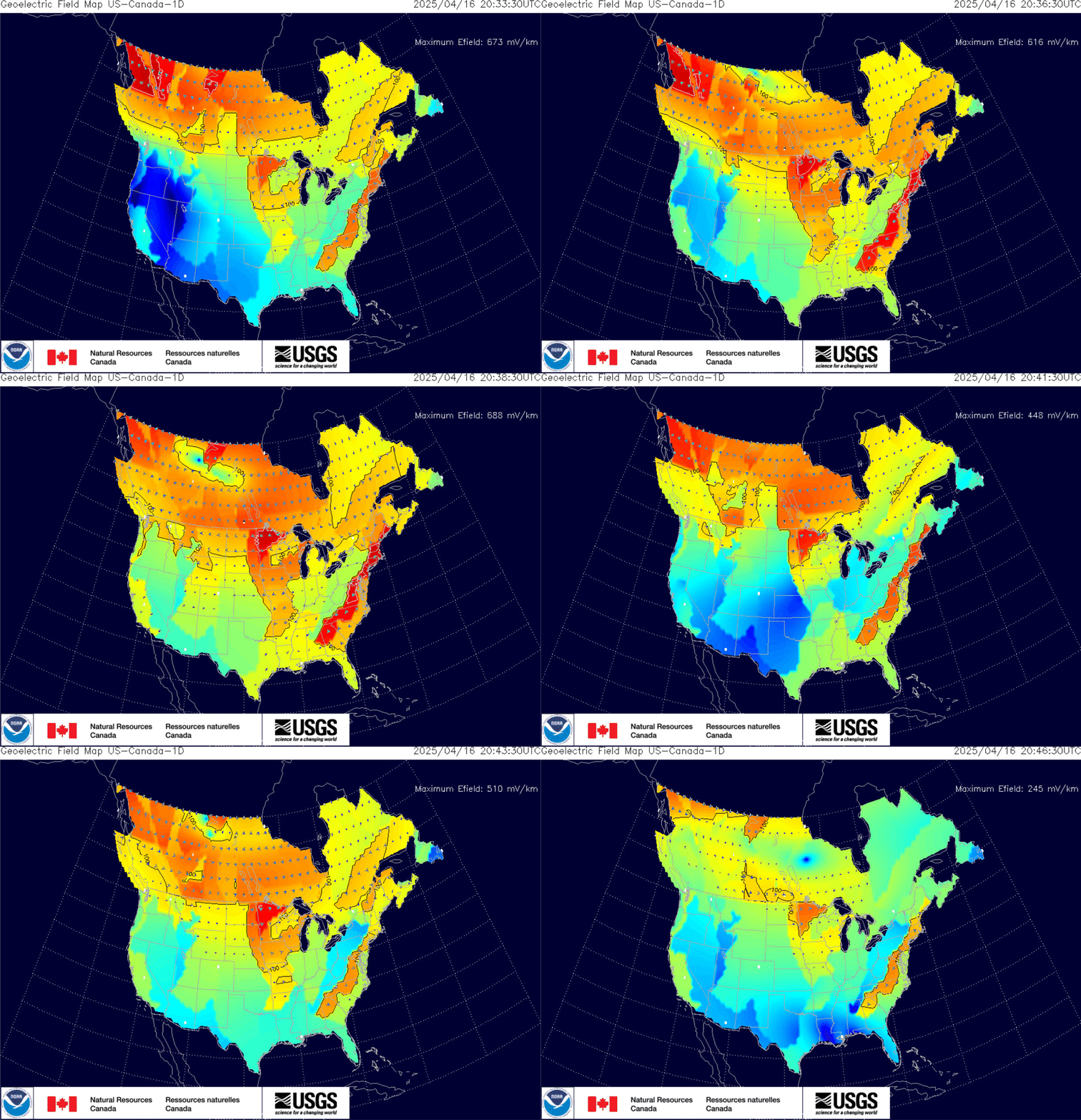
This 10-minute animation shows North American ground currents at the apex of the April 16th G4 geomagnetic storm
Geoelectric voltages were more than 70 times normal in the Appalachian mountain range, northern Minnesota, and northwestern Canada. Texas and other western US states were relatively unscathed.
Researchers track ground currents because in extreme cases they can cause power outages like the Great Québec Blackout of March 13, 1989. This week's storm wasn't intense or long-lasting enough to bring down power grids, but NOAA's maps show where power stations are most vulnerable.
"Generally, geoelectric amplitudes are high over metamorphic rock, such as in the Appalachians and northern Minnesota," explains Jeffrey Love of the US Geological Survey (USGS). "They are usually low over sedimentary rock such as in Texas and northwest of the Appalachians."
Realtime electric field maps are published 24/7 on the NOAA website. During the next geomagnetic storm, click here to see what’s happening underfoot!
Realtime Aurora Photo Gallery
Free: Spaceweather.com Newsletter
CONSTELLATION CAT CRYSTAL NIGHT LIGHT: It's the most far-out feline night light ever--the Constellation Cat. On March 12, 2025, the students of Earth to Sky Calculus launched it to the stratosphere onboard a giant helium balloon.
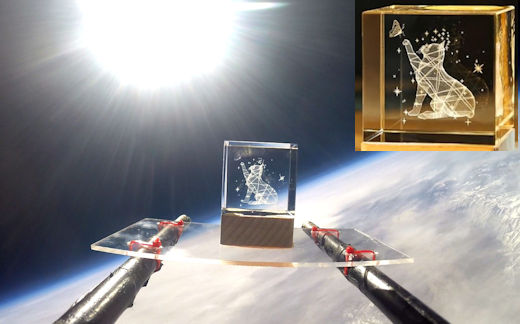
You can have it for $119.95. Outlined by stars in the style of an astronomical constellation, the laser-etched cat comes with an LED stand that produces a soothing glow for your bedside table. Also included: A unique greeting card shows the cat in flight and tells the story of its journey to the edge of space.

Far Out Gifts: Earth to Sky Store
All sales support hands-on STEM education
Realtime Space Weather Photo Gallery
Free: Spaceweather.com Newsletter
Realtime Comet Photo Gallery
Free: Spaceweather.com Newsletter