IBERIAN POWER OUTAGE: The sun was not to blame. Officials are still scrambling to understand the cause of this week's mysterious power outage in Spain and Portugal. It is already clear that space weather didn't do it. There were no solar flares, no geomagnetic storms, and no suspicious fluctuations in the solar wind before or during the outage. Solar flare alerts: SMS Text
A "HIGH INTEREST" REENTRY: In 1972, the Soviet Union's Kosmos 482 spacecraft was supposed to land on Venus. More than 50 years later, it's returning to Earth instead. Touchdown is expected on May 10th, give or take a few days.
"This will not be your standard reentry," says satellite analyst Marco Langbroek, who has been tracking the object for years. "The Kosmos 482 Descent Craft was designed to survive the dense atmosphere of Venus. It will therefore likely survive reentry into the Earth’s atmosphere intact and make a crash landing. This will therefore be a high-interest reentry."

Above: A museum replica of Venera 8, a similar probe launched just days before Kosmos 482.
Kosmos 482 was part of the Soviet Union's successful Venera program to explore Venus. Between 1961 and 1984, thirteen Soviet probes successfully entered Venus's atmosphere, with ten landing on the planet's surface. Kosmos 482, however, never fully escaped Earth. After it was launched from the Baikonur Cosmodrome on March 31, 1972, the upper stage of its Molniya rocket shut down prematurely, leaving it in a 206 x 9802 kilometer orbit that has been decaying ever since.
"With an orbital inclination of 52 degrees, the Kosmos 482 Descent Craft could come down anywhere between 52 degrees north and 52 degrees south latitude," says Langbroek. "This includes much of south and mid-latitude Europe and Asia, as well as the Americas, Africa and Australia." Statistically, an ocean landing is the most likely outcome.

Above: A picture of Venus from Kosmos 482's sister craft Venera 13 [more]
The probe was designed to parachute to the surface of Venus. However, it is very unlikely that the parachute system will work after more than 50 years in space, so this will be a crash landing. How bad will it be? Many details of the descent craft have been lost to history. Langbroek believes it is about 1 meter in diameter with a mass of ~495 kg. It won't do major damage, but you wouldn't want to be standing where it lands.
For updates and improved re-entry predictions, stay tuned to Langbroek's blog. And welcome home, Kosmos 482!
Realtime Space Weather Photo Gallery
Free: Spaceweather.com Newsletter
"BEST WIFE EVER" TEA CUP: Tell your wife what you think of her with the "Best Wife Ever" Tea Cup from Space. On March 21, 2025, the students of Earth to Sky Calculus launched it to the stratosphere onboard a cosmic ray research balloon:

You can have it for $134.95. The crystal glass cup is decorated with 3D pink and purple daisies. There's also a matching teaspoon! This romantic birthday, anniversary or Mother's Day gift comes with a greeting card showing the cup in flight and telling the story of its journey to the stratosphere. See also: The High Tea Cup.
Far Out Gifts: Earth to Sky Store
All sales support hands-on STEM education
RED SPHERES IN THE NIGHT SKY: This has happened twice in the past week. On April 27th, David Blanchard photographed a red sphere over the countryside near Flagstaff, Arizona:
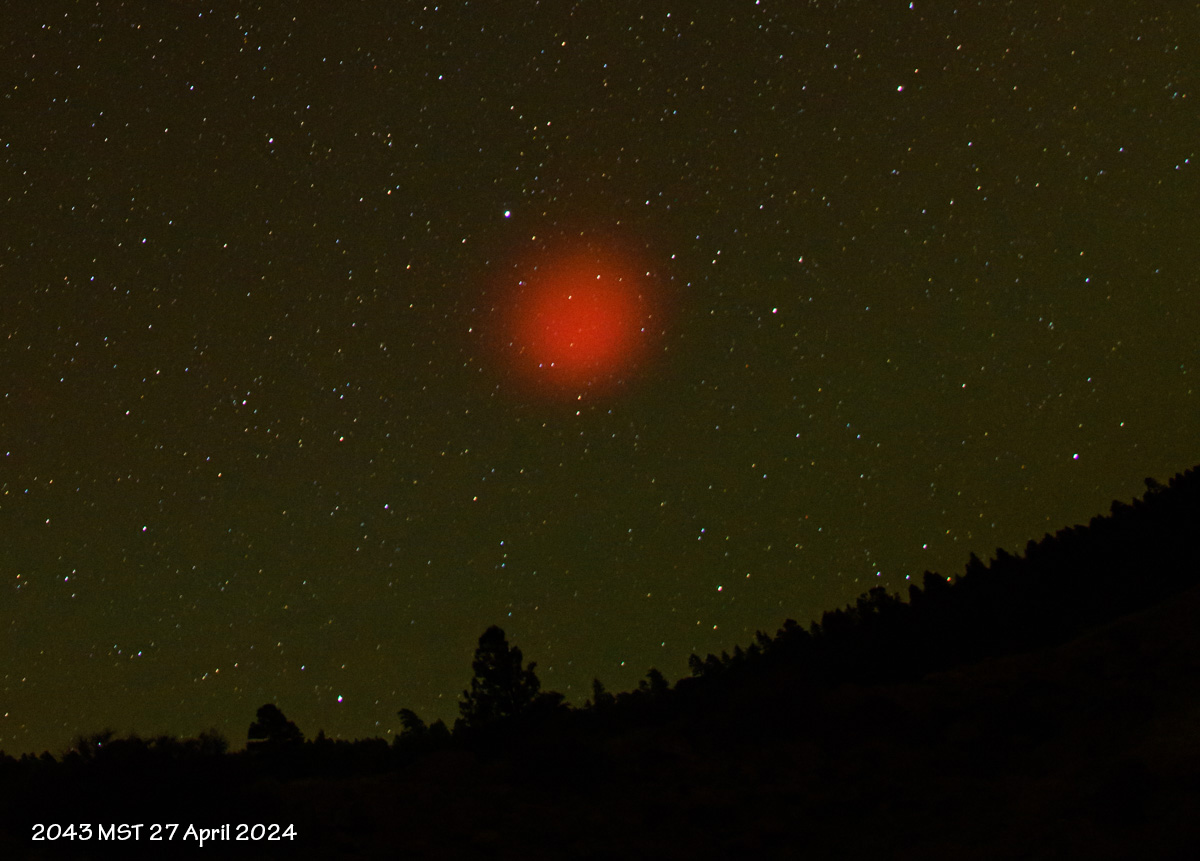
He had seen an almost identical sphere three nights earlier on April 24th. "In each case, they faded after a minute or two," he says.
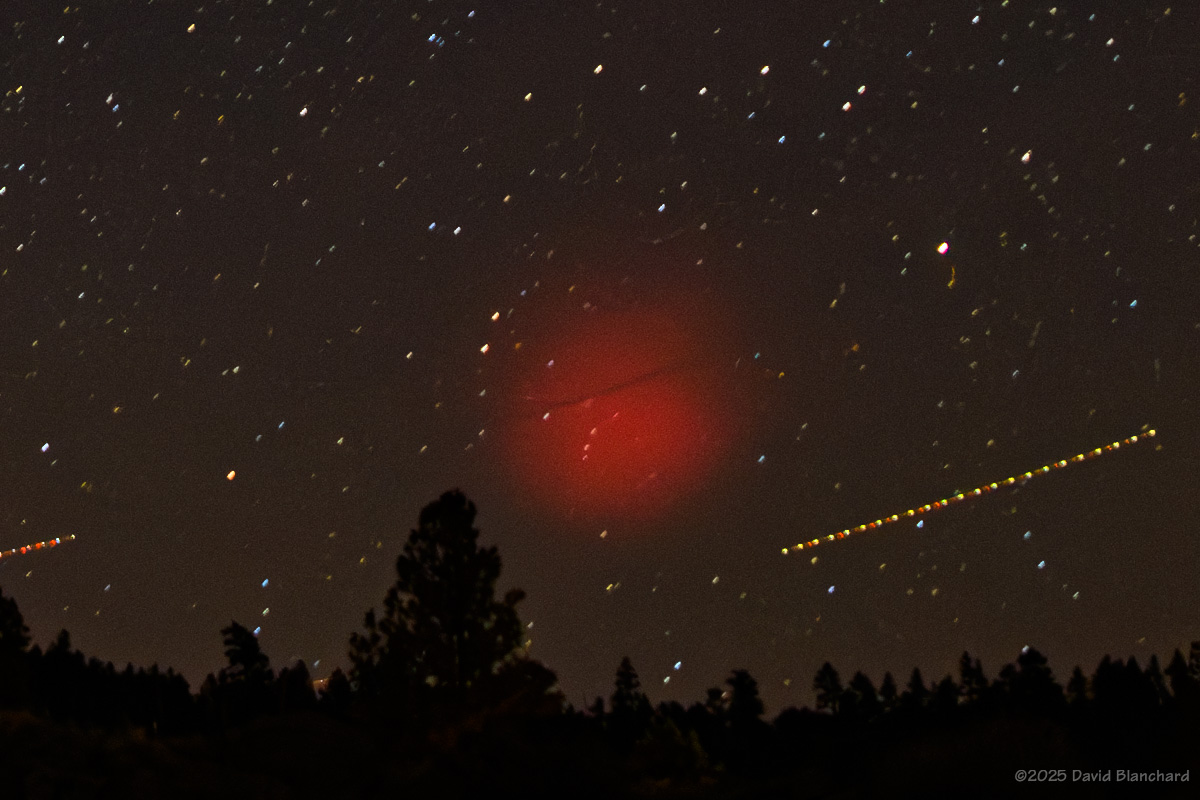
These spheres are caused by SpaceX. On both nights, SpaceX had launched batches of Starlink satellites from Cape Canaveral (Group 6-74 and Group 12-23). After deploying the satellites, the second stage of each rocket executed a deorbit burn over the US west coast, creating the red glow.
Why red? Fire is not involved. During deorbit burns, Falcon 9 second stage engines release about 400lbs of water (H2O) and carbon dioxide (CO2). A complicated series of charge exchange reactions between those molecules and oxygen ions (O+) in the upper atmosphere produce photons at a wavelength of 6300 Å–the same color as red auroras.
In an earlier report on this same phenomenon, Stephen Hummel of the McDonald Observatory in Texas said "we are seeing 2 to 5 of these each month." Thats a lot of red spheres. If you live in the western US you might be be able to see some, too. Observing tips: Check the SpaceX launch schedule for night launches from Cape Canaveral. Deorbit burns occur about 90 minutes after liftoff.
Realtime Space Weather Photo Gallery
Free: Spaceweather.com Newsletter
Realtime Aurora Photo Gallery
Free: Spaceweather.com Newsletter
Realtime Comet Photo Gallery
Free: Spaceweather.com Newsletter