INCREASING CHANCE OF FLARES: Giant sunspot 4079 is still quiet, but maybe not for long. Since yesterday, the sunspot's delta-class magnetic field has become more complex and unstable. It now harbors energy for X-class solar flares. Any eruptions today will be geoeffective as the sunspot is directly facing Earth. Solar flare alerts: SMS Text
GHOST COMET ATLAS: Do you believe in ghosts? Australian amateur astronomer Michael Mattiazzo does. On May 1st, he photographed the ghost of Comet ATLAS (C/2024 G3):
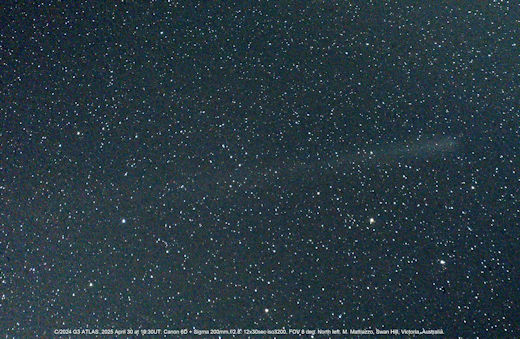
"Earth crossed the orbital plane of Ghost Comet ATLAS on May 1," explains Mattiazzo. "The edge-on geometry allowed me to photograph its remains."
In January 2025, people around the world watched in amazement as Comet ATLAS dive-bombed the sun and survived to become a naked-eye object in the evening sky. Things started to go wrong in late January when the comet began to fall apart. Streamers of debris emerged from the comet's sun-heated core and, soon, a full-fledged disintegration was underway. Four months later, all that remains is a ghostly cloud of uncorporal gas and dust.
"Comet ATLAS is still putting on a good show despite its disintegration," says Mattiazzo, who estimates its magnitude as +12. This makes the ghost an easy target for experienced astrophotographers in the southern hemisphere. Point your optics here.
Realtime Comet Photo Gallery
Free: Spaceweather.com Newsletter
WHAT IS A 'NAKED-EYE SUNSPOT'? Today, there is a naked-eye sunspot on the sun. This does *not* mean you should rush outside and look at the sun with unprotected eyes. Seeing a naked-eye sunspot absolutely requires a solar filter. Syed Mohammad Baqir of Quetta, Pakistan, demonstrates the proper technique:
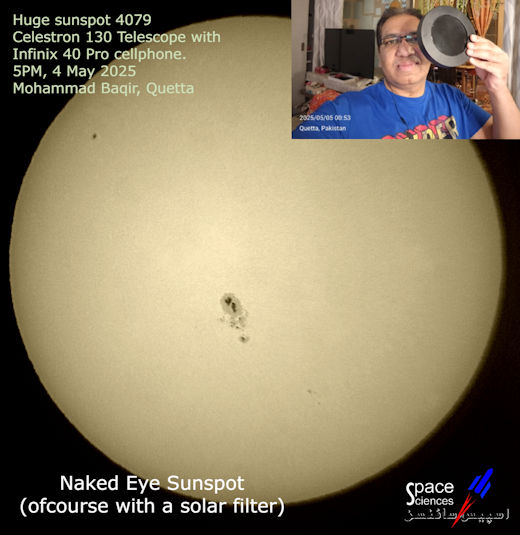
"Sunspot 4079 is large enough to be seen with naked eye without extra magnification. We can even see the light bridge inside this spot," he says. "However, you must use a safe solar filter."
Without a filter, direct sunlight can be blinding. Baqir used a nearly-opaque glass filter designed to cap his telescope. Eclipse glasses work great, too, and many people have them as leftovers from the Great American Eclipses of 2017 and 2024. Take a look!
Realtime Space Weather Photo Gallery
Free: Spaceweather.com Newsletter
BLUE OPALITE SOLAR ECLIPSE PENDANT: This crystal pendant has experienced a solar eclipse at the edge of space. It happened on Aug. 21, 2017, during the Great American Solar Eclipse. The students of Earth to Sky Calculus launched 11 space weather balloons from the path of totality. One of those ballons carried this Blue Opalite Eclipse Pendant into the Moon's shadow:
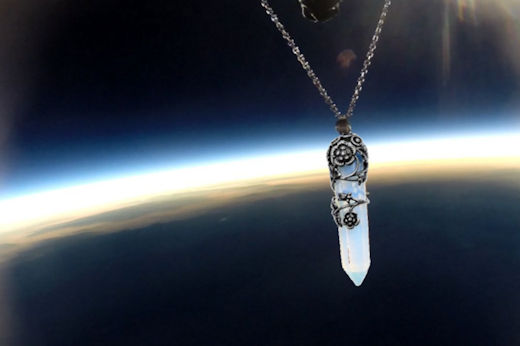
You can have it for $199.95. During the 2.5 hour stratospheric flight, the jewelry was wrapped in the Moon’s cold (-50 C) shadow for more than two minutes. After the shadow passed, the balloon popped at an altitude of 96,465 feet. The pendant parachuted back to Earth, landing in the Malheur National Forest in Oregon. It comes with a greeting card telling the story of the eclipse and showing the crystal in flight.
Far Out Gifts: Earth to Sky Store
All sales support hands-on STEM education
Realtime Aurora Photo Gallery
Free: Spaceweather.com Newsletter