SUPER FAST SOLAR WIND (UPDATED): Solar wind is blowing around Earth faster than 750 km/s (1.7 million mph). This is putting pressure on our planet's magnetic field and setting the stage for possible G1/G2-class geomagnetic storms on May 30th. High-latitude sky watchers should remain alert for auroras. Aurora alerts: SMS Text


A 24-HOUR GEOMAGNETIC STORM: A co-rotating interaction region (CIR) hit Earth on May 29th, sparking 24 hours of non-stop geomagnetic storming. The day started off strong (G3) before settling into a sustained stretch of minor to moderate disturbances:

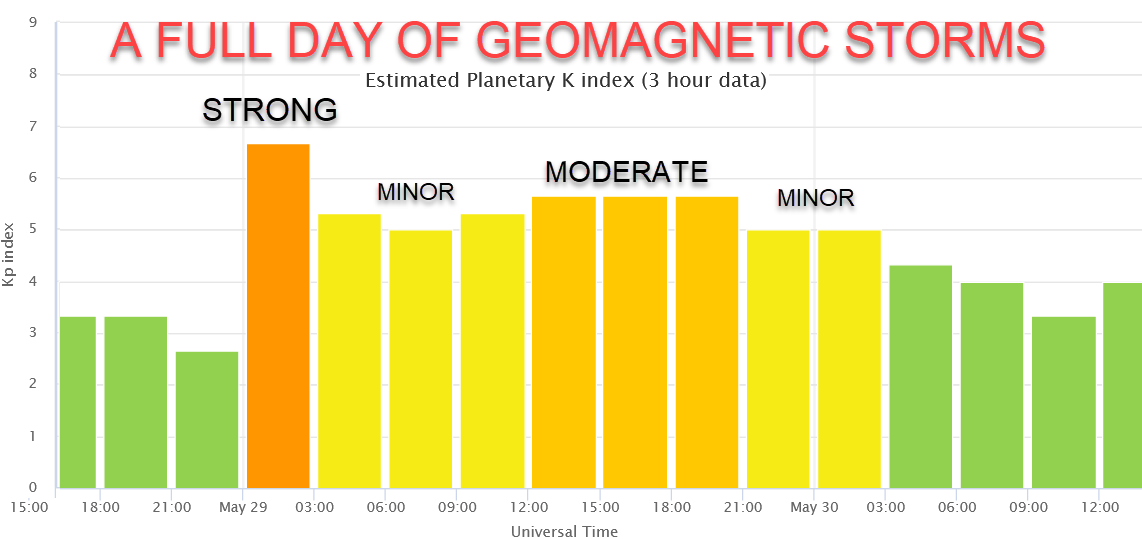
CIRs are transition zones between fast- and slow-moving streams of solar wind. They're like mini-CMEs. They contain shock waves and enhanced magnetic fields that do a good job sparking geomagnetic storms and auroras.
Astronomer Ian Griffin was at home in Portobello, New Zealand, when the CIR arrived. "An aurora alert came across my phone," says Griffin. "I went out into my garden to see what was going on, and I was rewarded by some amazing auroral beams!" This is what he saw:
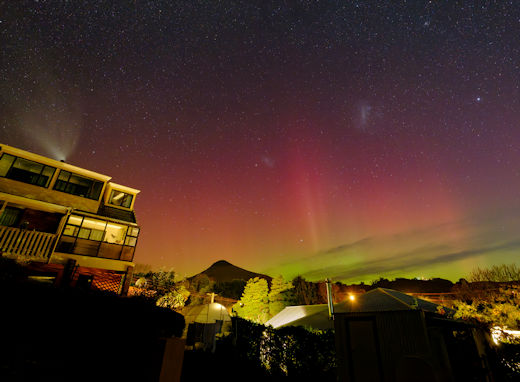
In addition to the aurora australis, his exposure also captured the Large and Small Magellanic Clouds. "It was a beautiful display," he says.
Meanwhile in the northern hemisphere, auroras appeared in Minnesota, Idaho, Illinois and lots of places in Canada. Another 24 hours, anyone? Aurora alerts: SMS Text
Realtime Aurora Photo Gallery
Free: Spaceweather.com Newsletter
THIS IS *REAL* MONEY FROM SPACE: The US Mint has just released a new $1 coin to honor NASA's longest-serving spacecraft: The Space Shuttle. On May 25, 2025, the students of Earth to Sky Calculus launched the coins to the stratosphere onboard a cosmic ray research balloon:
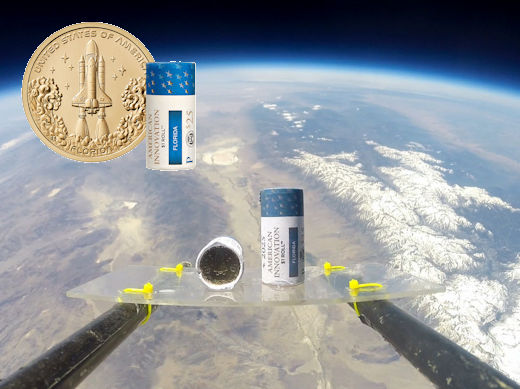
You can have a single coin for $49.95 or an entire unbroken roll for $299.95. No longer available from the US Mint, these rare coins flew 119,343 feet above the Sierra Nevada on July 16, 2024. One side shows the space shuttle lifting off from Launch Complex 39 at Florida’s Kennedy Space Center; the other side features the Statue of Liberty in profile.
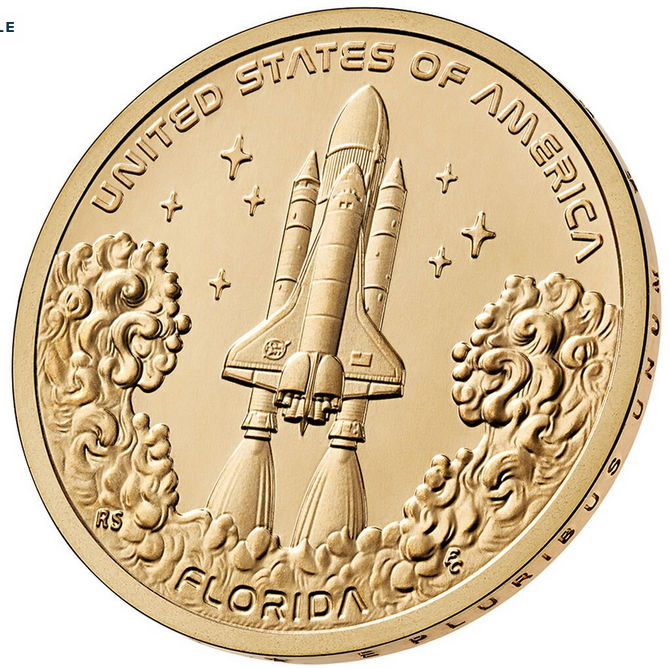
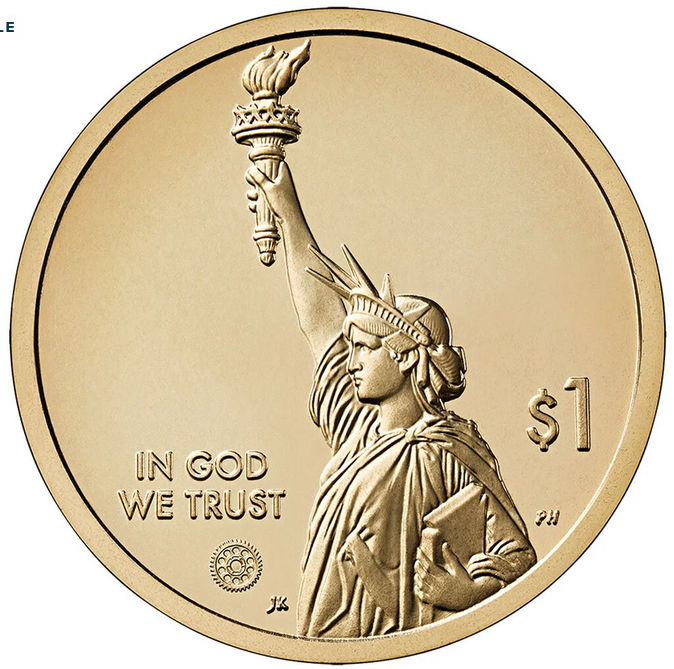
For collectors: The D mint version of these coins is also available: Get the single coin ($49.95) or an entire unbroken roll ($299.95).
The students are selling space coins to support to support their cosmic ray research program. (Helium is expensive!) Each order comes with a greeting card showing the coins in flight and telling the story of their journey to the stratosphere and back again.
Far Out Gifts: Earth to Sky Store
All sales support hands-on STEM education
Realtime Space Weather Photo Gallery
Free: Spaceweather.com Newsletter
Realtime Comet Photo Gallery
Free: Spaceweather.com Newsletter