DAYTIME METEOR SHOWER THIS WEEKEND: The annual Arietid meteor shower peaks this weekend on June 7-8. The Arietids are unusual because they are daytime meteors; the shower is most intense after sunrise. Early risers could spot a small number of earthgrazing Arietids during the dark hours before dawn on Sunday morning. The source of the meteor shower is a mystery, with the most likely candidates being Comet 96P/Machholz or asteroid Icarus.
CORONAL RAIN CAPTURED IN UNPRECEDENTED DETAIL: Solar astronomers have just taken the clearest images yet of rain falling in the sun's atmosphere--a phenomenon called "coronal rain." This movie shows glowing blobs of hydrogen falling along invisible magnetic loops in streams as narrow as 20 km:
This movie shows hydrogen-alpha light emitted by plasma in the sun's outer atmosphere
Coronal rain forms when plasma in the sun's atmosphere (corona) cools, condenses, and falls — like molten rain down a magnetic rollercoaster.
This "rainfall" was detected at the Big Bear Solar Observatory in California where researchers have developed a new adaptive optics system for the sun. Their technology allows the telescope to compensate for turbulence in the Earth’s atmosphere, de-blurring fine structure in the downpour.
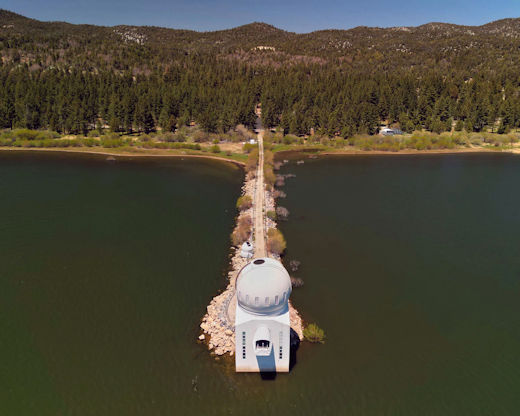
The 1.6-meter Goode Solar Telescope in Big Bear Lake. The steady temperature of the water surface helps keep the air around the telescope calm
This study, published May 27th in Nature Astronomy, isn’t just pretty, it’s pivotal. "These observations represent an important step toward revealing the thermal and magnetic structure of the solar atmosphere," the team wrote in their paper.
The same technology will soon be installed on the giant Daniel K. Inouye Solar Telescope in Hawaii, where adaptive optics should reveal even finer details and more surprises. Stay tuned!
Realtime STEVE Photo Gallery
Free: Spaceweather.com Newsletter
ISS BUZZES THE MOON IN BROAD DAYLIGHT: On June 3rd, skywatchers in the Canary Islands witnessed a daylight transit of the International Space Station (ISS) across the face of the Moon. Photographer Marina Prol of Maspalomas captured the fleeting moment from the courtyard of her apartment building, where the ISS zipped in front of Mare Imbrium:
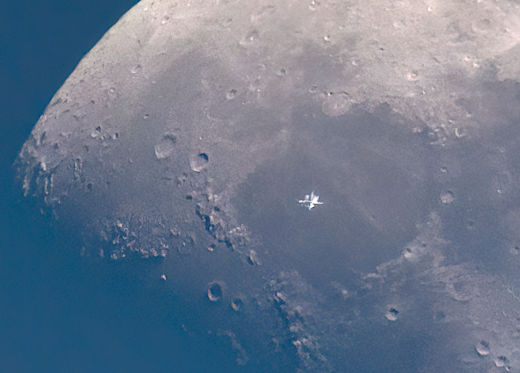
"Living on an archipelago, it's rare to have the right conditions to capture a transit like this," says Prol. A veil of Saharan dust might have helped. Earth-orbiting satellites captured a plume of dust approaching the Canary islands on the day Prol took her picture. Small amounts of dust can help stabilize the atmosphere and allow sharp single-frame photos like this.
Realtime Space Weather Photo Gallery
Free: Spaceweather.com Newsletter
SOLAR SYSTEM STUD EARRINGS: These earrings have flown to the edge of space--and all eight planets are included! On May 21, 2025, the students of Earth to Sky Calculus launched the Solar System Stud Earrings to the stratosphere onboard a cosmic ray research balloon. At the apex of the flight, they floated 104,655 feet high:
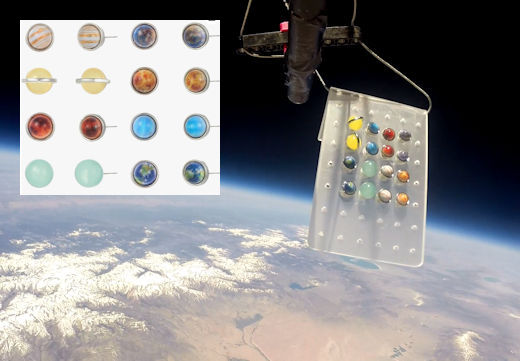
You can have the complete set for $149.95. Only Pluto is omitted from the collection; the dwarf planet was too small for human earlobes. The earrings come with a greeting card showing the studs in flight and telling the story of their journey to the stratosphere and back again.
Far Out Gifts: Earth to Sky Store
All sales support hands-on STEM education
Realtime Aurora Photo Gallery
Free: Spaceweather.com Newsletter
Realtime Noctilucent Cloud Photo Gallery
Free: Spaceweather.com Newsletter