CO-ROTATING INTERACTION REGION: A G2-class geomanetic storm is possible on June 14th when a co-rotating interaction region (CIR) is expected to hit Earth's magnetic field. CIRs are transition zones between slow- and fast-moving streams of solar wind. They contain shock waves and enhanced magnetic fields that do a good job sparlking auroras. Aurora alerts: SMS Text

A HIDDEN WORLD OF SOLAR ACTIVITY: In the 17th century when Anton van Leeuwenhoek looked through a microscope and saw bacteria for the first time, he revealed a new "world of the small" and forever upended the field of biology. Is the same thing about to happen to solar physics?
Maybe. A paper just published in Nature Astronomy reports a new technology for seeing very small things in the atmosphere of the sun. It's a system of adaptive optics that corrects for turbulence in Earth's atmosphere. A test run in July 2023 on the 1.6 m Goode Solar Telescope in California's Big Bear Lake produced an immediate discovery:
"We became astounded witnesses to a strange, short-lived object," recalls the research team, led by Dirk Schmidt of the NSF National Solar Observatory. "We call it a twisted plasmoid."
The plasmoid is unlike anything seen inside the sun's atmosphere before. NASA's Solar Dynamics Observatory was observing at the same time and saw nothing. The Big Bear adaptive optics system is so good at correcting turbulent blur, it outperforms space telescopes.
A movie of the plasmoid shows a narrow stream of plasma less than 100 km wide moving like a flagellate under van Leeuwenhoek's microscope. The front of the stream "suddenly stopped and collided with its own rear half," before fading away.
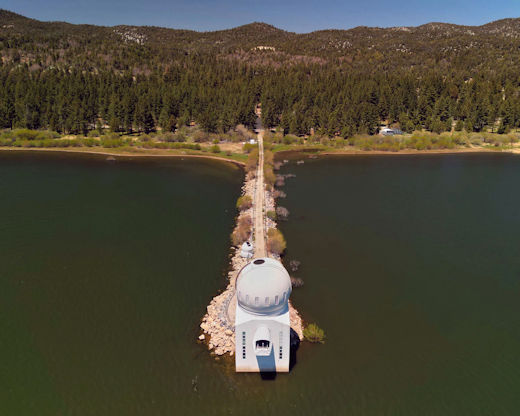
The 1.6-meter Goode Solar Telescope in Big Bear Lake. The steady temperature of the water surface helps keep the air around the telescope calm
It's not clear whether this is a significant discovery or just something idiosyncratic and weird. We'll soon find out. The researchers plan to install the same system on the giant Daniel K. Inouye Solar Telescope in Hawaii, where adaptive optics on its 4-meter mirror could reveal an even greater menagerie. Let the plasmoid hunt begin!
For more images from the new adaptive optics system, click here.
Realtime Space Weather Photo Gallery
Free: Spaceweather.com Newsletter
SOLAR SYSTEM STUD EARRINGS: These earrings have flown to the edge of space--and all eight planets are included! On May 21, 2025, the students of Earth to Sky Calculus launched the Solar System Stud Earrings to the stratosphere onboard a cosmic ray research balloon. At the apex of the flight, they floated 104,655 feet high:
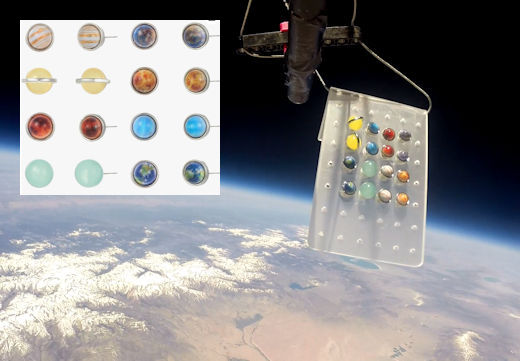
You can have the complete set for $149.95. Only Pluto is omitted from the collection; the dwarf planet was too small for human earlobes. The earrings come with a greeting card showing the studs in flight and telling the story of their journey to the stratosphere and back again.
Far Out Gifts: Earth to Sky Store
All sales support hands-on STEM education
Realtime Aurora Photo Gallery
Free: Spaceweather.com Newsletter
Realtime Noctilucent Cloud Photo Gallery
Free: Spaceweather.com Newsletter