DON'T BE SURPRISED IF THERE'S AN X-FLARE TODAY: Potentially dangerous sunspot 4114 is directly facing Earth. It has an unstable delta-class magnetic field that harbors energy for strong explosions. NOAA forecasters estimate a 75% chance of M-class flares and a 30% chance of X-flares on June 17th. Solar flare alerts: SMS Text
MARS-REGULUS CONJUNCTION: When the sun goes down tonight, step outside and look west. Mars and Regulus are in conjunction, less than one degree apart in the evening twilight sky. "The beauty of their colors is mind-blowing," says Gianluca Masi, who sends this picture from the Virtual Telescope Project facility in Manciano, Italy:

Regulus is a blue-white star in the constellation Leo while Mars, equally bright, is a rusty-red planet passing by for a few nights. Their mis-matched colors are visible to the unaided eye and look great through binoculars and small telescopes.
Masi notes that they are not alone. "Look between between the two bright gems," he says. "There is a pale spot, a bit closer closer to Regulus than to Mars. That phantom is the Leo I dwarf galaxy, about 820,000 light-years away. Capturing it in the same frame as Mars and Regulus is something rare and deeply evocative."
more images: from Mike Olason of SaddleBrooke, Arizona
Realtime Space Weather Photo Gallery
Free: Spaceweather.com Newsletter
STARLINKS + MARS AND REGULUS: SpaceX launched 26 more Starlink satellites from California on Monday evening, June 16th (8:36 p.m. PDT). The twilight liftoff Vandenberg Space Force Base was visible all the way from Arizona:

"We're getting more Starlinks to streak through our astrophotos, but the launch sure was pretty!" says photographer Scott Tucker of Tucson, AZ. "The current close conjunction of Regulus and Mars is just above the cactus."
more images: from David Blanchard of Flagstaff, Arizona; from Paul D. Maley of Carefree, Arizona; from Joe Cache of Vail, Arizona
Realtime Space Weather Photo Gallery
Free: Spaceweather.com Newsletter
THIS IS *REAL* MONEY FROM SPACE: The US Mint has just released a new $1 coin to honor NASA's longest-serving spacecraft: The Space Shuttle. On May 25, 2025, the students of Earth to Sky Calculus launched the coins to the stratosphere onboard a cosmic ray research balloon:
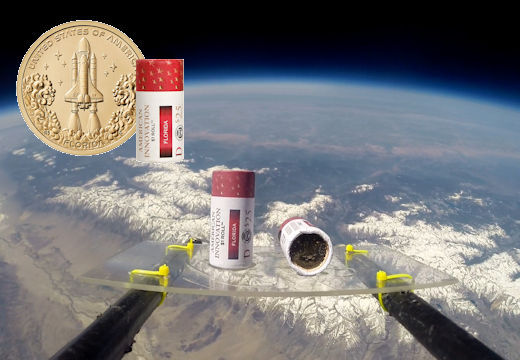
You can have a single coin for $49.95 or an entire unbroken roll for $299.95. No longer available from the US Mint, these rare coins flew 119,343 feet above the Sierra Nevada on July 16, 2024. One side shows the space shuttle lifting off from Launch Complex 39 at Florida’s Kennedy Space Center; the other side features the Statue of Liberty in profile.
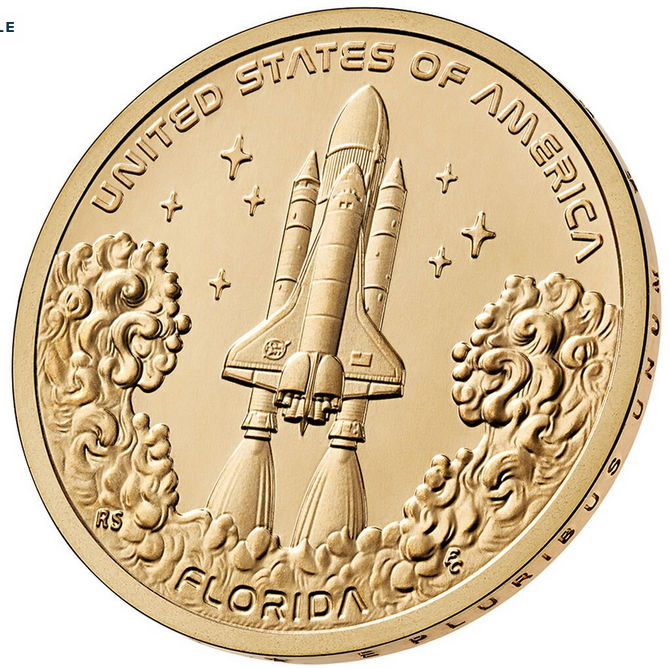

For collectors: The P mint version of these coins is also available: Get the single coin ($49.95) or an entire unbroken roll ($299.95).
The students are selling space coins to support to support their cosmic ray research program. (Helium is expensive!) Each order comes with a greeting card showing the coins in flight and telling the story of their journey to the stratosphere and back again.
Far Out Gifts: Earth to Sky Store
All sales support hands-on STEM education
Realtime Aurora Photo Gallery
Free: Spaceweather.com Newsletter
Realtime Noctilucent Cloud Photo Gallery
Free: Spaceweather.com Newsletter