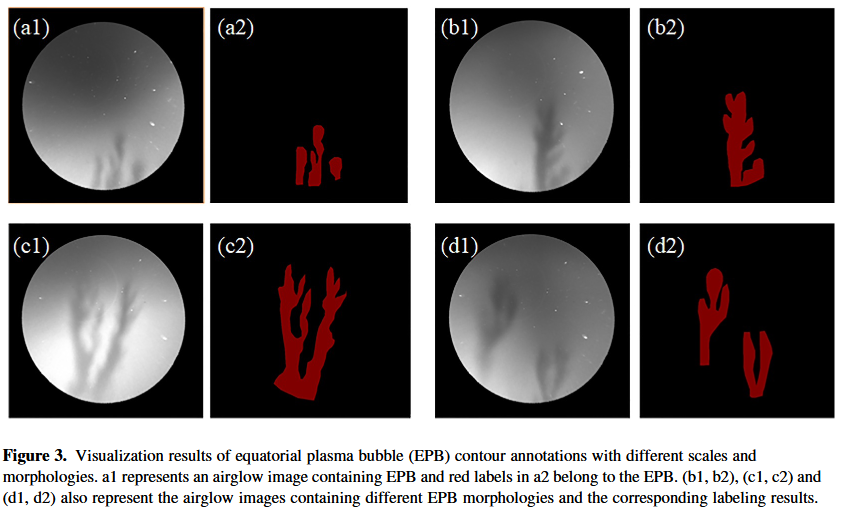
EQUATORIAL PLASMA BUBBLES: Earth's ionosphere is a bit like Swiss cheese. It contains holes called "equatorial plasma bubbles." They are tens to hundreds of kilometers wide, yet invisible to the human eye. New research published in the journal Space Weather explains how machines can be trained to detect these bubbles in optical images of airglow. The technique could lead to space weather alerts for big or strangely-shaped bubbles, which can disrupt GPS navigation.
TITAN'S SHADOW GLIDES ACROSS SATURN: Saturn is putting on a rare and subtle show: Titan’s shadow is transiting across the planet’s cloud tops, and we're squarely in the middle of the season to see it. On June 16th, Robert Lunsford of El Cajon, California, photographed one of these events:

"This photo was captured in infrared light to enhance the sharpness," Lunsford says. "Seeing was 4 out of 10, but still better than the last transit on May 31st." His photo shows the giant planet's rings and cloud bands with the crisp black round shadow of Titan--Saturn’s strangely-Earthlike moon--drifting across its face.
Titan shadow transits are rare. They happen only when the orbits of Saturn’s moons are edge-on as seen from Earth, a geometry that occurs roughly every 15 years. That season has arrived. From May through early October 2025, backyard astronomers in the America's can witness Titan’s inky shadow.
Sky & Telescope's excellent article on this topic gives a timetable of future transits:

These transits are slow-moving and surprisingly photogenic. Titan is the second-largest moon in the solar system, so it casts a shadow that’s darker and sharper than most observers expect.
The next transit is July 2nd. Saturn will rise over the Americas just after midnight, and be 1/3rd of the way up the sky when the shadow crosses the central meridian of Saturn's disk. Submit your photos here!
Realtime Space Weather Photo Gallery
Free: Spaceweather.com Newsletter
SILVER SAPPHIRE SPACE PENDANT: It has just returned from the edge of space: The Silver Sapphire Space Pendant. Using a cosmic ray research balloon, the students of Earth to Sky Calculus launched it to the stratosphere on June 19, 2025:

You can have it for $219.95. Engraved with the words "I love you always and forever", this sterling silver pendant has a heart-shaped sapphire in the middle surrouunded by a ring of glittering 5A cubic zirconia nuggets. It is a visually striking necklace perfect for anniversaries and romantic birthdays.
The students are selling space pendants to pay the helium bill for their cosmic ray ballooning program. Each one comes with a greeting card showing the jewelry in flight and telling the story of its trip to the stratosphere and back again.
Far Out Gifts: Earth to Sky Store
All sales support hands-on STEM education
Realtime Aurora Photo Gallery
Free: Spaceweather.com Newsletter
Realtime Noctilucent Cloud Photo Gallery
Free: Spaceweather.com Newsletter