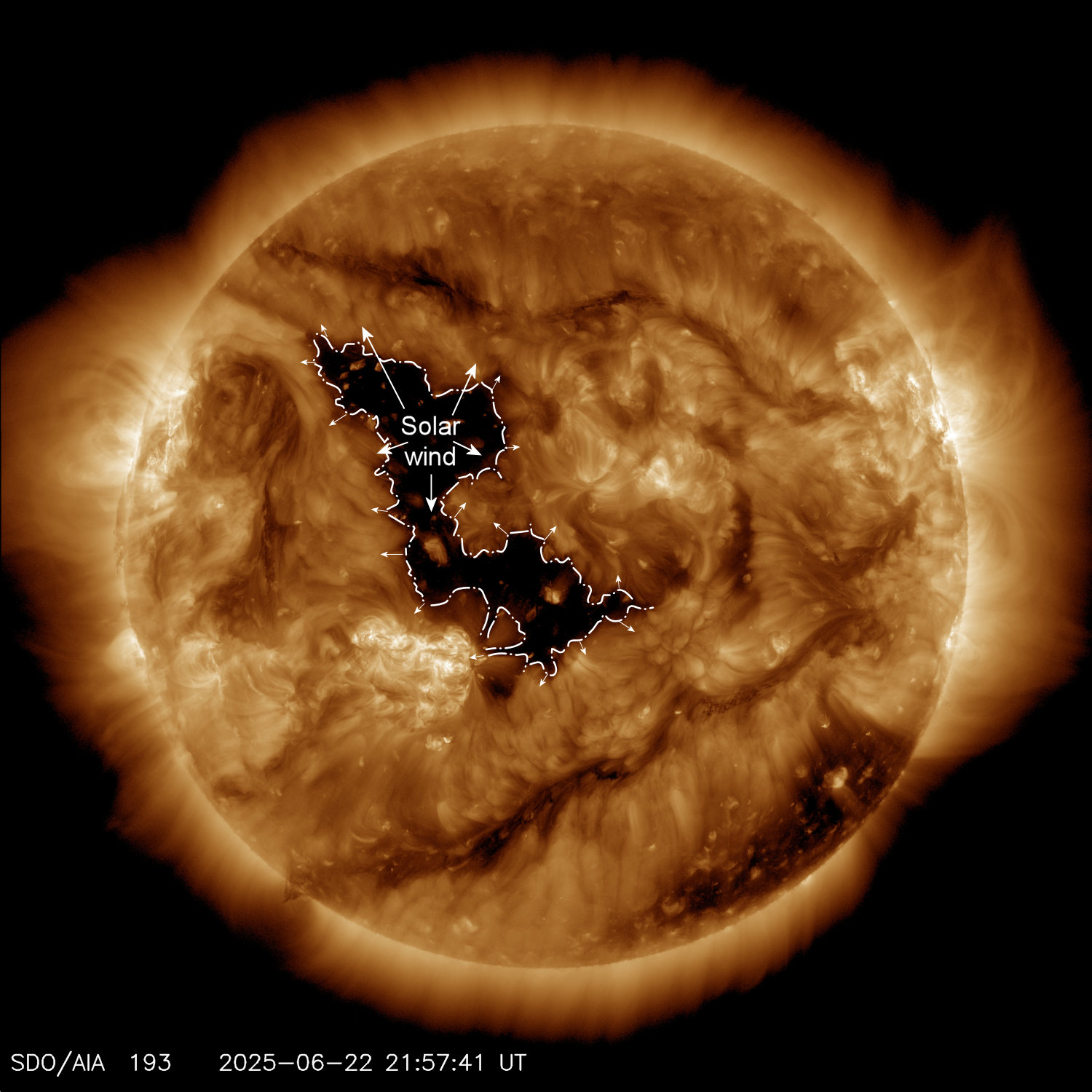
SOLAR WIND SPARKS AURORAS: Blowing faster than 700 km/s (1.6 million mph), a stream of solar wind is buffeting Earth's magnetic field today. So far, it has not caused a full-fledged geomagnetic storm, but auroras have been observed at high latitudes. Gregory Ash photographed the display this morning from Ely, Minnesota:
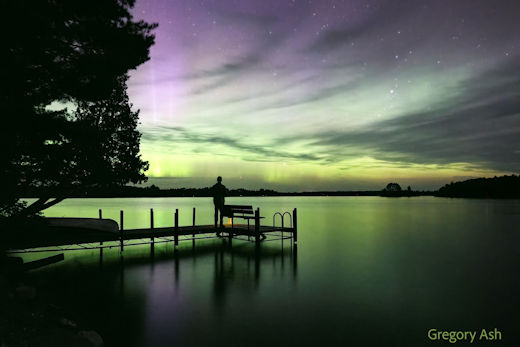
"As a storm was clearing, I was able to enjoy the very visible pillars peaking through the clouds, while listening to the loons and owls in northern Minnesota," says Ash.
The solar wind is flowing from a peanut-shaped hole in the sun's atmosphere. It's putting pressure on Earth's magnetic field and may yet ignite a geomagnetic storm (G1) before the day is over. High-latitude sky watchers should remain alert for auroras. Aurora alerts: SMS Text

Realtime Aurora Photo Gallery
Free: Spaceweather.com Newsletter
DID SPACEX MAKE THESE NOCTILUCENT CLOUDS? Maybe it's just a coincidence. Shortly after midnight on June 24th, people in Europe watched a rocket glide silently overhead. A few hours later, noctilucent clouds (NLCs) filled the sky.
"It was incredible," reports Stanislaw Rokita from Torun, Poland, the hometown of Copernicus. "Silver filaments spread over almost half the horizon and rose all the way to the zenith."

Similar displays were seen in Berlin, Paris and other European cities.
NLCs are a natural phenomenon. They form when summertime wisps of water vapor rise up to the mesosphere (83 km high) and frost specks of meteor smoke. We see them every year during weeks around the summer solstice. This, however, was an unusually bright and widespread display.
Some onlookers wondered if the rocket had anything to do with it. The rocket was SpaceX's Transporter-14 mission, launched the previous evening from California's Vandenberg Space Force Base. Onboard were 70 payloads, including cremated human remains and small surveillance satellites. A fuel dump from the rocket's second stage was widely observed only a few hours before the NLCs appeared.
This picture from Nicolas Rossetto of Jura, France, shows the rocket (inset) trailed by a cloud of discarded propellant:

"This was about 15 minutes past midnight," says Rossetto.
Could Transporter-14 be responsible for the NLCs? Theoretically, yes. Studies show that space traffic does indeed amplify noctilucent clouds. Rocket engines emit water vapor--a key ingredient of NLCs. Moreover, a video of the Transporter-14 launch shows the second stage engine burning through the mesosphere and spewing water exactly where NLCs form.
But there's a problem with this idea. The burn happened over the coast of California, not Europe. To make morning clouds over Paris and Berlin, the water vapor would need to travel 10,000 km in less than 6 hours--*very* unlikely.
The display was probably natural. If so, more NLCs could be in the offing--no rockets required.
Realtime Noctilucent Cloud Photo Gallery
Free: Spaceweather.com Newsletter
GOLDEN SAPPHIRE PENDANT: Are you looking for an unforgettable gift? Consider the Golden Sapphire Space Pendent. On Feb. 20, 2025, the students of Earth to Sky Calculus launched it to the stratosphere onboard a cosmic ray research balloon:

You can have it for $199.95. Engraved with the words "I love you always and forever", this 18K gold-plated sterling silver pendant features a heart-shaped sapphire crystal surrounded by a ring of glittering 5A cubic zirconia nuggets. It is a visually striking premium pendant that makes a once-in-a-lifetime anniversary or birthday gift.
The students are selling space pendants to pay the helium bill for their cosmic ray ballooning program. Each one comes with a greeting card showing the jewelry in flight and telling the story of its trip to the stratosphere and back again.
Far Out Gifts: Earth to Sky Store
All sales support hands-on STEM education
Realtime Aurora Photo Gallery
Free: Spaceweather.com Newsletter
Realtime Space Weather Photo Gallery
Free: Spaceweather.com Newsletter