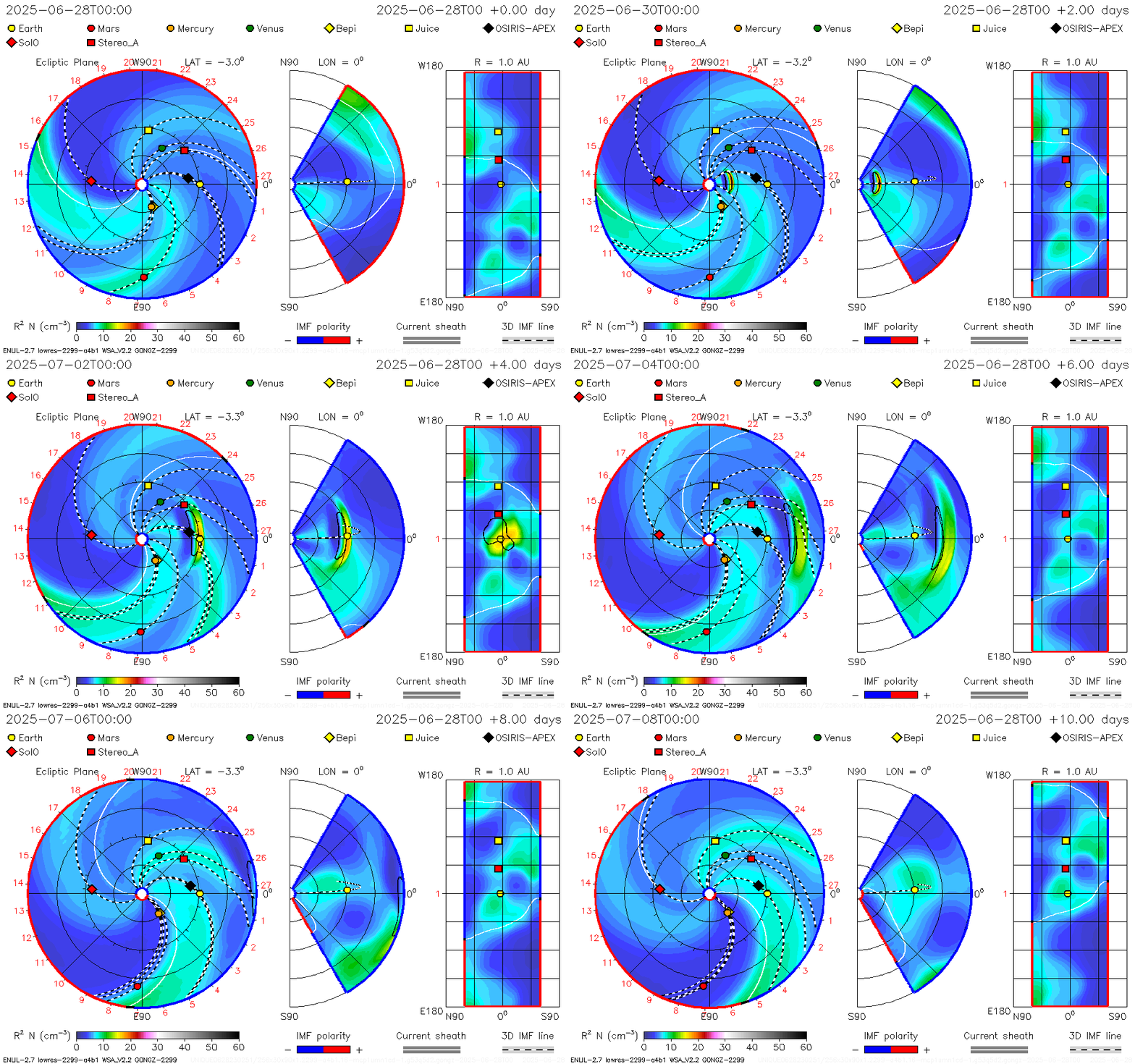
A CME IS COMING: But it's not a big one. A minor CME is expected to strike Earth during the late hours of July 1st, according to a NASA model. The CME was hurled into space on June 28th by a C4-class solar flare from sunspot 4126. Even minor CMEs can cause geomagnetic storms, so high-latitude sky watchers may see auroras this week. CME impact alerts: SMS Text
FROSTED METEOR SMOKE: A giant ring of frosted meteor smoke is surrounding the Arctic Circle. Bianka Doman-Mócsány saw it last night from the window seat of an airplane landing in Sweden:
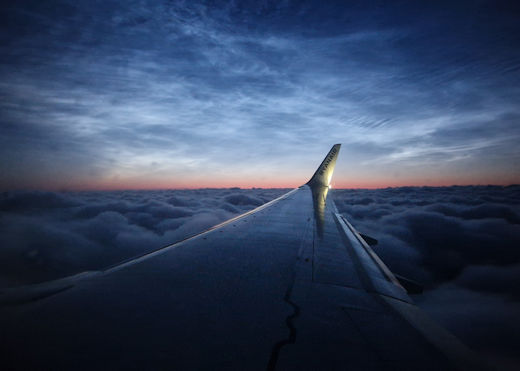
"We had just started our descent to the Gothenburg airport last night when we saw this magnificent display," says Doman-Mócsány. "It was quite an amazing view!"
These are noctilucent clouds (NLCs). They appear every June when summertime wisps of water vapor rise to the edge of space and form rimes of ice around the ash of burned-up meteors. NLCs glow electric-blue in the night sky with fine ripples that distinguish them from ordinary clouds. Look for them after sunset when geometry favors their visibility.

more images: from Peter Paul Hattinga Verschure of Deventer, The Netherlands; from Ian Carstairs of Harleston, Norfolk, UK; from Nigel Wood of Langar, Nottinghamshire, UK
Realtime Noctilucent Cloud Photo Gallery
Free: Spaceweather.com Newsletter
TWO NAKED-EYE NOVA: A person could go a lifetime without seeing a star explode with their own eyes. Right now, people in the southern hemisphere can see two stars exploding at the same time. The first (V462 Lupi) appeared on June 12th in the constellation Lupis, and the second (V572 Velorum) on June 25th in Vela. They're both brighter than 6th magnitude, the threshold for naked-eye visibility.
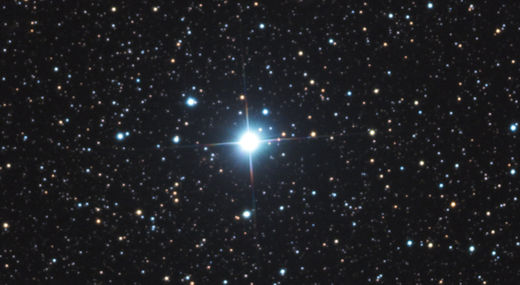
Eliot Herman photographed V572 Velorum on June 28th using a robotic telescope in Chile.
"This is without question an extremely rare event, if not an historical one," says astronomer Stephen O’Meara, who has been scouring historical records for the last time this happened. "I have yet to find an occurrence of two simultaneous nova appearing at the same time."
"I thought I had found a pair in 1936 (V630 Sgr and V368 Aql)," he says. "But I looked at their light curves, and it turns out they were not at maximum brightness at the same time."
These appear to be "classical novas." First documented by Chinese astronomers some 2000 years ago, the explosions occur in binary star systems. White dwarf stars steal gas from a bloated partner until the stolen fuel ignites in a sudden thermonuclear blast. It's less dramatic than a supernova, but still an awesome blast.
Nova V462 Lupi is currently near magnitude +5.9, while V572 Velorum at +4.8 is the brighter of the two. Southern astronomers, this may not happen again for a loooong time. Submit your photos here.
Realtime Space Weather Photo Gallery
Free: Spaceweather.com Newsletter
GOLDEN SAPPHIRE PENDANT: Are you looking for an unforgettable gift? Consider the Golden Sapphire Space Pendent. On Feb. 20, 2025, the students of Earth to Sky Calculus launched it to the stratosphere onboard a cosmic ray research balloon:

You can have it for $199.95. Engraved with the words "I love you always and forever", this 18K gold-plated sterling silver pendant features a heart-shaped sapphire crystal surrounded by a ring of glittering 5A cubic zirconia nuggets. It is a visually striking premium pendant that makes a once-in-a-lifetime anniversary or birthday gift.
The students are selling space pendants to pay the helium bill for their cosmic ray ballooning program. Each one comes with a greeting card showing the jewelry in flight and telling the story of its trip to the stratosphere and back again.
Far Out Gifts: Earth to Sky Store
All sales support hands-on STEM education
Realtime Aurora Photo Gallery
Free: Spaceweather.com Newsletter
Realtime Noctilucent Cloud Photo Gallery
Free: Spaceweather.com Newsletter