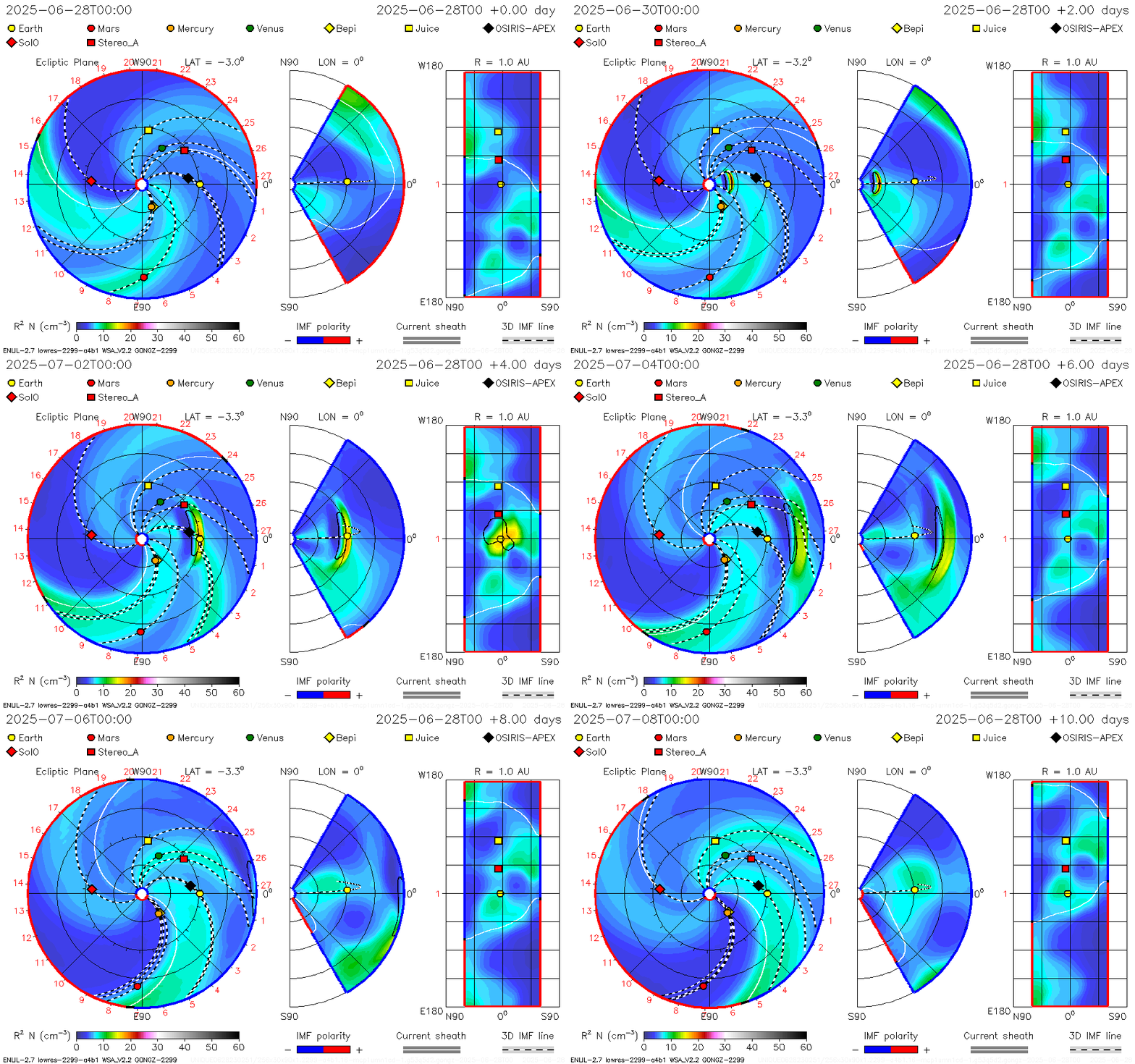
A CME IS COMING: But it's not a big one. A minor CME is expected to strike Earth during the late hours of July 1st, according to a NASA model. The impact could spark G1-class geomagnetic storms with high-latitude auroras on July 2nd. CME impact alerts: SMS Text

"EXTREMELY RARE"--TWO NAKED-EYE NOVA (UPDATED): A person could go a lifetime without seeing a star explode with their own eyes. Right now, people in the southern hemisphere can see two stars exploding at the same time. The first (V462 Lupi) appeared on June 12th in the constellation Lupus, and the second (V572 Velorum) on June 25th in Vela. They're both brighter than 6th magnitude, the threshold for naked-eye visibility.
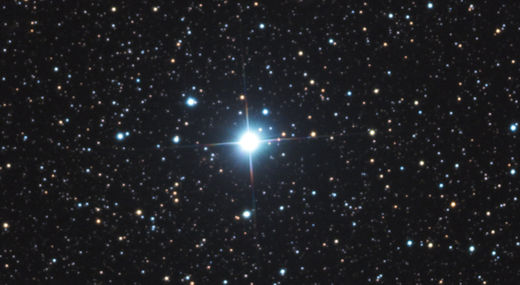
Eliot Herman photographed V572 Velorum on June 28th using a robotic telescope in Chile.
"This is without question an extremely rare event, if not an historical one," says astronomer Stephen O’Meara, who has been scouring historical records for the last time this happened. "I have yet to find an occurrence of two simultaneous nova appearing at the same time."
"I thought I had found a pair in 1936 (V630 Sgr and V368 Aql)," he says. "But I looked at their light curves, and it turns out they were not at maximum brightness at the same time."
These appear to be classical novas. First documented by Chinese astronomers some 2000 years ago, the explosions occur in binary star systems. White dwarf stars steal gas from a bloated partner until the stolen fuel ignites in a sudden thermonuclear blast. It's less dramatic than a supernova, but still an awesome blast.
Nova V462 Lupi is currently near magnitude +5.9, while V572 Velorum, fading from a peak near +4.8, is the brighter of the two. Southern astronomers, this may not happen again for a loooong time. Submit your photos here.
Update: "I have found another event in AAVSO archives about seventeen years ago," says O’Meara. "On March 22, 2018, Nova Circinis 2018 reached a peak brightness of magnitude 5.8 , and on that same day, Nova V906 Carinae peaked at around magnitude 5.9. So these two novae shared a similar naked-eye magnitude albeit briefly. So these are rare events."
Realtime Space Weather Photo Gallery
Free: Spaceweather.com Newsletter
NOCTILUCENT CLOUDS OVER PARIS: Last night, another outbreak of noctilucent clouds (NLCs) spread across Europe. Normally confined to Artic latitudes, the clouds on June 29th were visible as far south as Paris (+49 N):
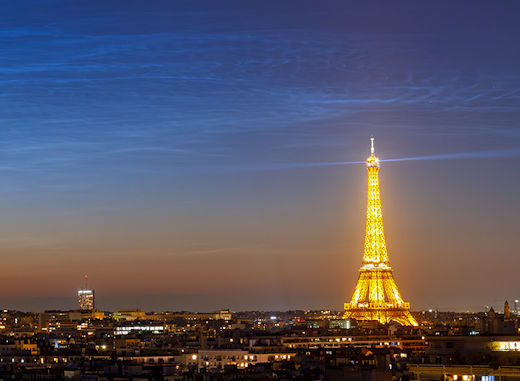
"The clouds were beautiful as they drifted across the sky over the Eiffel Tower," says photographer Bertrand Kulik.
NLCs are Earth's highest clouds. They appear every June when summertime wisps of water vapor rise to the edge of space and form rimes of ice around the ash of burned-up meteors. NLCs glow electric-blue in the night sky with fine ripples that distinguish them from ordinary clouds.
This is the second mid-latitude apparition in the past week. If you live north of Paris, be alert for NLCs. The best time to look is after sunset when geometry favors their visibility.

Realtime Noctilucent Cloud Photo Gallery
Free: Spaceweather.com Newsletter
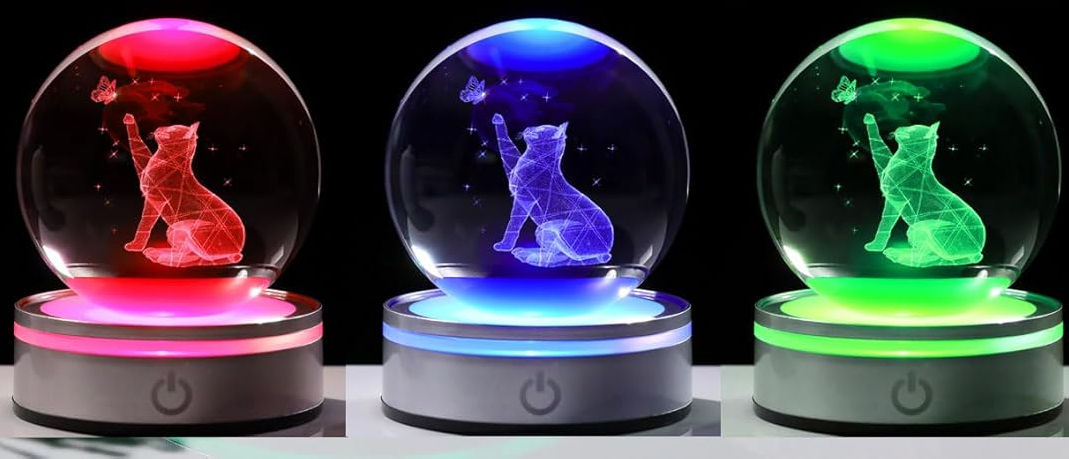
CONSTELLATION CAT NIGHT LIGHT: It's the most far-out feline night light ever--the Constellation Cat Crystal Ball. On April 23, 2025, the students of Earth to Sky Calculus launched it to the stratosphere onboard a giant helium balloon.
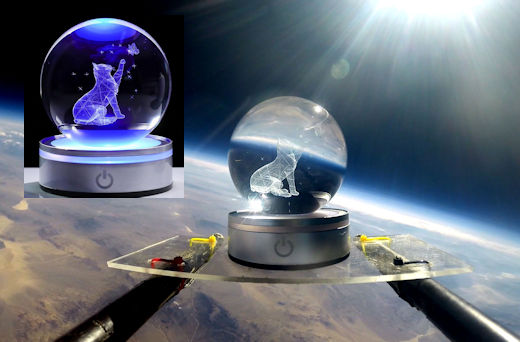
You can have it for $139.95. Outlined by stars in the style of an astronomical constellation, the laser-etched cat comes with an LED stand that produces a soothing glow for your bedside table. Also included: A unique greeting card shows the crystal ball in flight and tells the story of its journey to the edge of space.
Far Out Gifts: Earth to Sky Store
All sales support hands-on STEM education
Realtime Aurora Photo Gallery
Free: Spaceweather.com Newsletter
Realtime Noctilucent Cloud Photo Gallery
Free: Spaceweather.com Newsletter