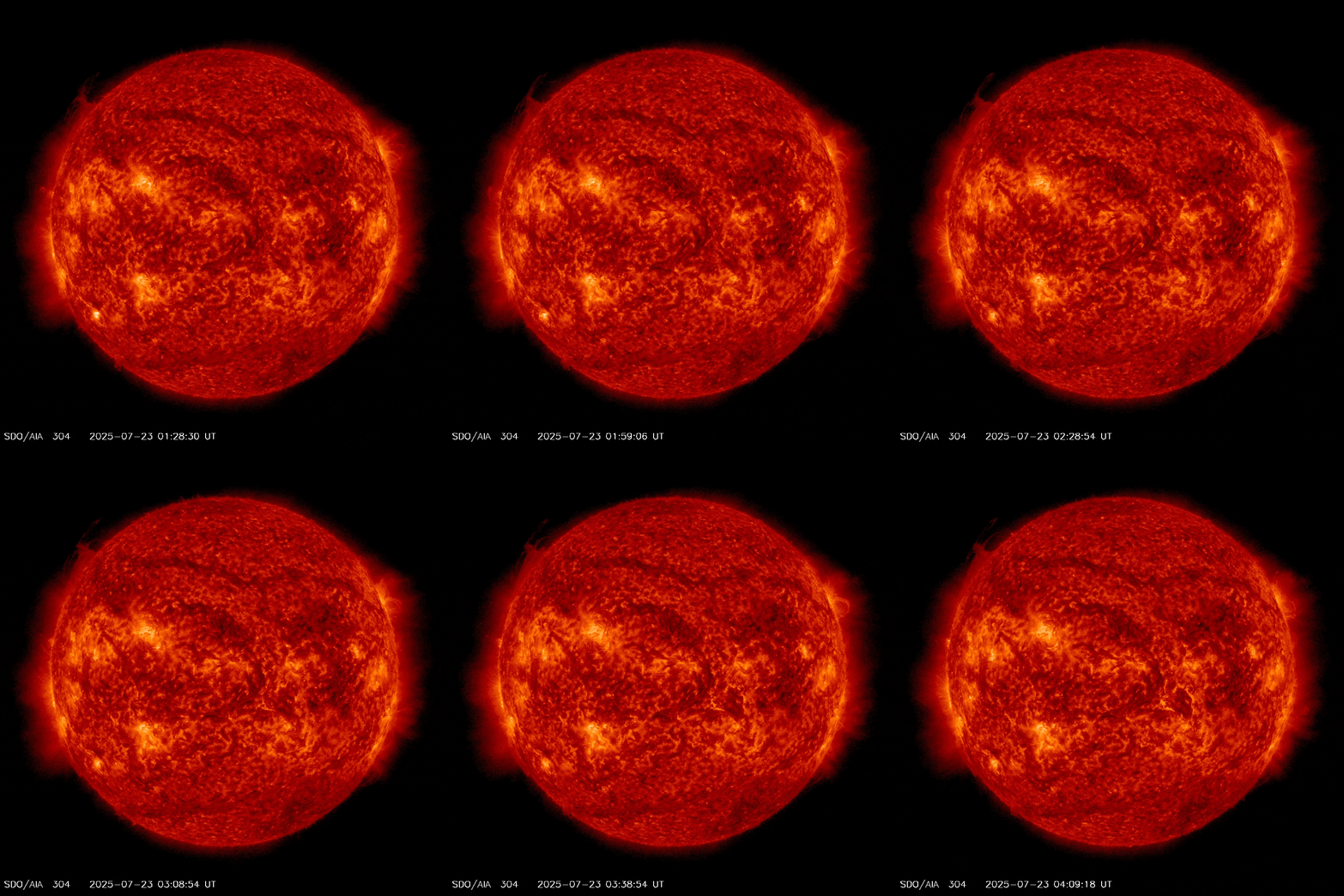
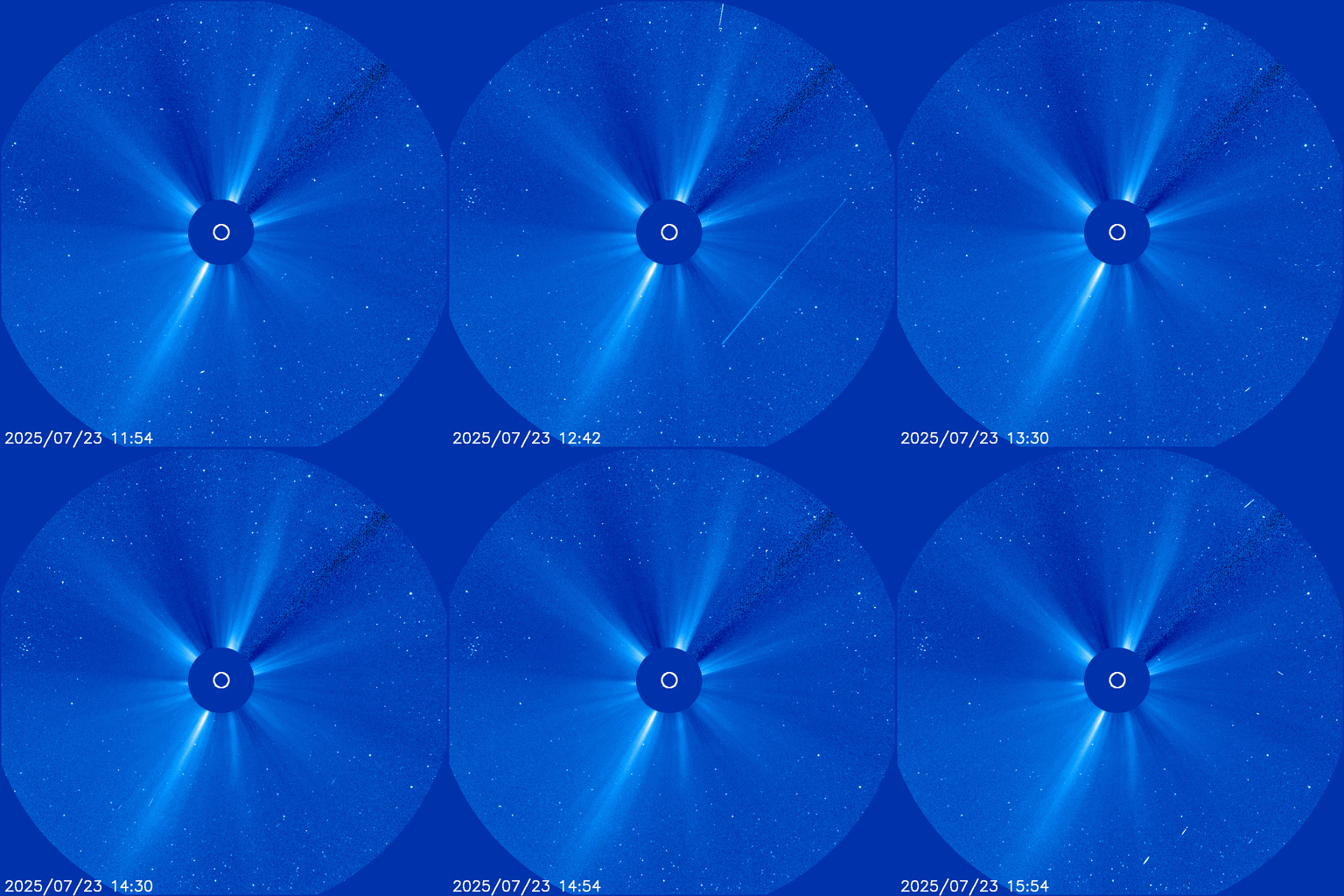
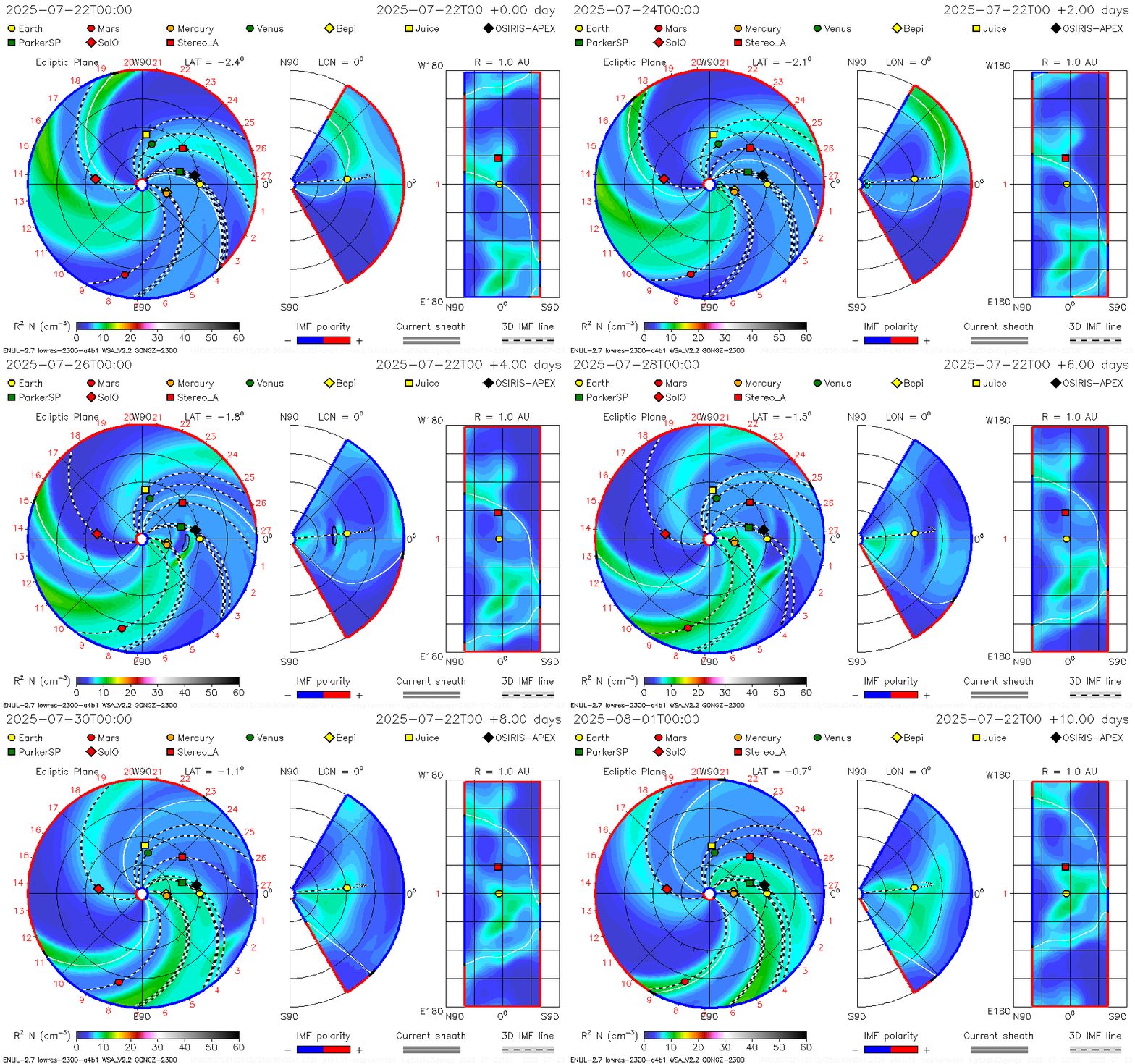
A CME IS COMING: But it's not a big one. The sun launched the CME toward Earth on July 23rd, propelled by an erupting filament of magnetism near disk center. Although it is faint, the CME could still cause a G1-class geomagnetic storm when it arrives on July 27th. Aurora alerts: SMS Text

EQUATORIAL PLASMA BUBBLES ARE COMING FOR YOUR GPS: Earth's ionosphere is a bit like Swiss cheese. It contains holes called "equatorial plasma bubbles." If any of these bubbles drift across your sky--grip the steering wheel--your GPS might go haywire.
That's exactly what happened during a geomagnetic storm in March 2023. A new study published in the research journal Space Weather recounts how GPS radio signals began to rapidly flicker, akin to the twinkling of a star, causing positioning errors across a wide swath of the Americas.
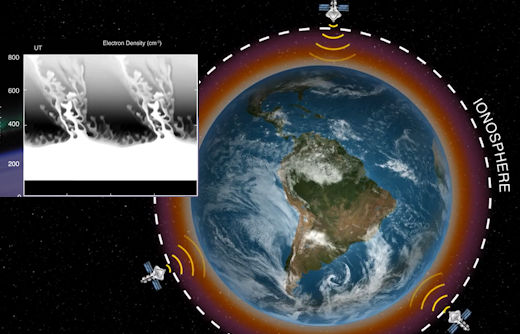
GPS satellites transmitting through a bubbly ionosphere. Inset: a simulation of equatorial plasma bubbles. Video.
"This is the most intense event we have analyzed," says Fabiano Rodrigues, a physics professor at the University of Texas at Dallas and one of the paper's lead authors. "It produced extremely intense disruptions at low latitudes for more than 10 hours and was even detectable by our mid-latitude sensor in Dallas (UTD in the diagram below), which is unusual."
Completely surrounding Earth, the ionosphere is a shell of ionized gas created by the sun. Solar ultraviolet radiation ionizes air near the edge of space, creating a dynamic layer of plasma that varies with solar activity, time of day, and latitude. The ionosphere plays a critical role in GPS systems by reflecting or distorting radio waves passing through it.
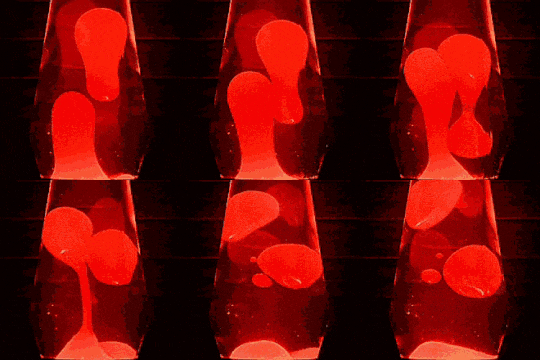 When the sun sets, the ionosphere becomes unstable. This happens because the sun's ionizing radiation suddenly disappears. A Rayleigh-Taylor instability takes hold, and bubbles of low-density plasma begin to rise, much like blobs in a lava lamp.
These structures are especially common near the magnetic equator, where electric and magnetic fields enhance the effect. That's why they're called equatorial plasma bubbles.
The March 23-24, 2023, event was remarkable because the bubbles were so widespread. They are normally confined within +/- 20 degrees of the magnetic equator, but during this storm, they spread at least twice as far, affecting population centers at middle latitudes. Peak position errors were wider than urban roadways.
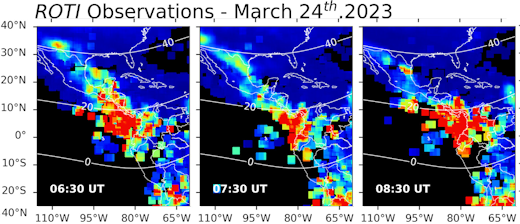
Above: Red-orange-yellow marks where rapid fluctuations were observed during the March 2023 geomagnetic storm. A plume of yellow extends all the way into Texas.
Savvy readers may wonder if something similar happened during the Great Geomagnetic Storm of May 2024. After all, that was the biggest geomagnetic storm in decades (G5+), far more intense than the March 2023 storm (G4). The answer, surprisingly, seems to be "no." The same sensors were running during both storms, yet only the lesser storm produced extraordinary scintillation.
"This is an example of how the ionosphere can respond differently to different magnetic storms," says Rodrigues. "We still have a lot to learn."
Do It Yourself: Rodrigues's team monitors equatorial plasma bubbles using a low-cost sensor called ScintPi, based on the Raspberry Pi computer. You can build one yourself. Hobbyists are using them to observe geomagnetic storms and even solar eclipses.
Realtime Space Weather Photo Gallery
Free: Spaceweather.com Newsletter
CHRISTMAS IN JULY: Are you looking for a far-out gift? Check out the Earth to Sky Store. It's filled with unique items that have flown to the edge of space onboard cosmic ray research balloons.
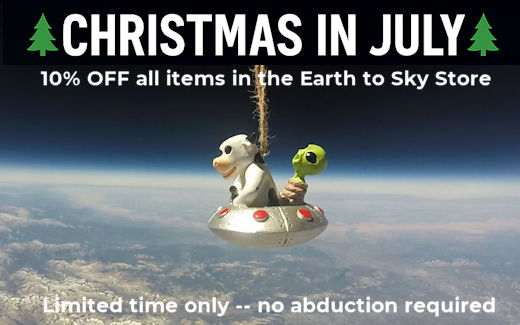
Carried aloft by giant helium balloons, these unique gifts have flown above 99.7% of Earth's atmosphere, experiencing space-like blasts of cosmic rays, extreme cold, and a wild ride parachuting back to Earth after the balloon explodes. Even Amazon doesn't carry items this far out.
Enter coupon code "JULY" at checkout for a 10% Christmas-in-July discount.
Far Out Gifts: Earth to Sky Store
All sales support hands-on STEM education
Realtime Aurora Photo Gallery
Free: Spaceweather.com Newsletter
Realtime Noctilucent Cloud Photo Gallery
Free: Spaceweather.com Newsletter