COMET 3I/ATLAS IS 7 MILES WIDE: Astronomers have been having trouble figuring out the size of interstellar Comet 3I/ATLAS. Its core is hidden by an expanding cometary atmosphere. Not anymore. Researchers using the Vera C. Rubin Observatory have found pre-discovery images of the comet, which provide a better view. The comet's core appears to be about 7 miles wide, making 3I/ATLAS the biggest interstellar object known so far. Original Research.
ASTEROID STRIKE COULD CAUSE A MOONDUST METEOR STORM: Mark your calendar. If asteroid 2024 YR4 hits the Moon on Dec. 22, 2032, Earth could experience a rare meteor storm made entirely of moondust.
Astronomers at the University of Western Ontario have analyzed what might happen if the 60-meter-wide space rock slams into the lunar surface seven years from now. In a new paper, they report that the impact would release as much energy as 6.5 megatons of TNT, blasting out a kilometer-wide crater and ejecting up to 100 million kilograms of lunar debris.
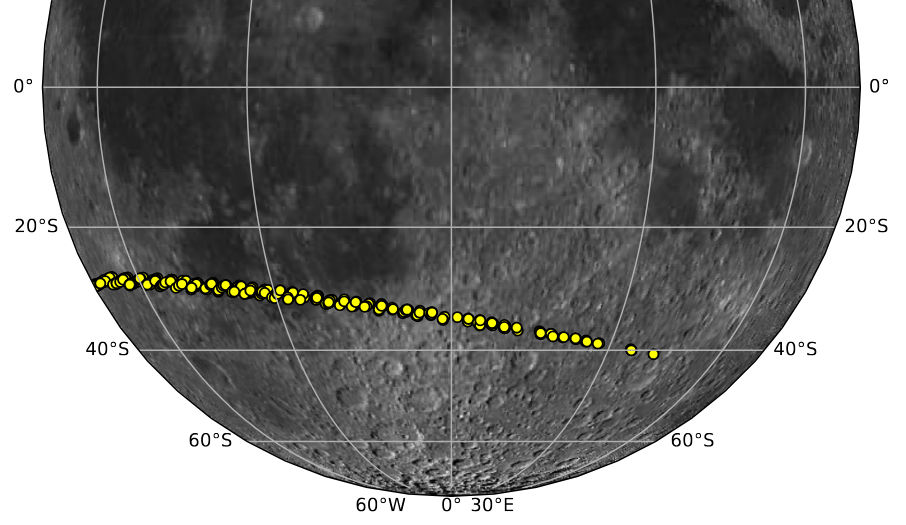
Above: The amount of debris that reaches Earth depends sensitively on where the asteroid strikes. Wiegert's team simulated impacts along the yellow-dotted corridor of possibilities.
"Up to 10% of the lunar ejecta could reach Earth within days," says planetary scientist Paul Wiegert, the leader of the study. "The resulting meteor shower could be eye-catching, with meteor rates orders of magnitude above usual background rates."
Earth's upper atmosphere would be peppered by lunar material arriving at relatively low speeds--about 11 km/s. That's much slower than typical meteors. Perseids, for instance, hit Earth at 59 km/s. As a result, the lunar meteors would appear slower, dimmer, and longer-lasting than usual. Still, they could be visible to the naked eye and quite numerous.
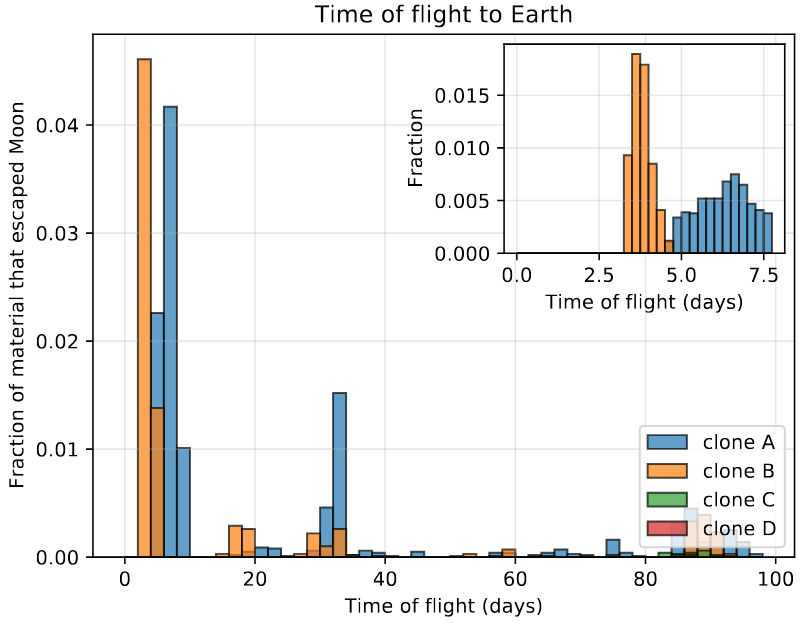
Their simulations suggest that the storm could go on for days:
And here's the kicker: Nearly every visible meteor in this shower would be a piece of the Moon.
The authors estimate a 4% chance of impact. That’s small, but significant. The odds will be updated in 2028, when asteroid 2024 YR4 emerges from the glare of the sun and becomes observable again. If it is on target, the asteroid could deliver the largest lunar impact in approximately 5000 years.
Read the original research here -- and stay tuned for a moondust meteor shower.
Realtime Space Weather Photo Gallery
Free: Spaceweather.com Newsletter
BLACK MOONCAT STUD EARRINGS: For the first time ever, earrings have flown to the edge of space. On July 7, 2025, the students of Earth to Sky Calculus launched a cosmic ray research balloon, and these Black Mooncat Stud Earrings went along for the ride:

You can have a pair for $149.95. Supported by a sterling silver frame, each black cat is curled around a genuine blue moonstone. The stud earrings floated through the stratosphere for almost 3 hours, reaching a peak altitude of 110,555 feet. They're the perfect companion for the Geomagnetic Black Cat Pendant.
Each pair of earrings comes with a greeting card showing the jewelry in flight and telling the story of their trip to the stratosphere and back.
Far Out Gifts: Earth to Sky Store
All sales support hands-on STEM education
Realtime Aurora Photo Gallery
Free: Spaceweather.com Newsletter
Realtime Noctilucent Cloud Photo Gallery
Free: Spaceweather.com Newsletter