SET YOUR ALARM FOR DAWN: Venus and Jupiter are converging in the eastern dawn sky for a spectacular conjunction. At closest approach on Aug. 11-13, the two planets will shine like a bright double star--easy to see even from brightly-lit cities. As a bonus, the Perseid meteor shower peaks at the same time, so you might catch a bright fireball, too. Set your alarm and step outside before sunrise. This is worth waking up for! Sky maps: Aug. 11, 12, 13.
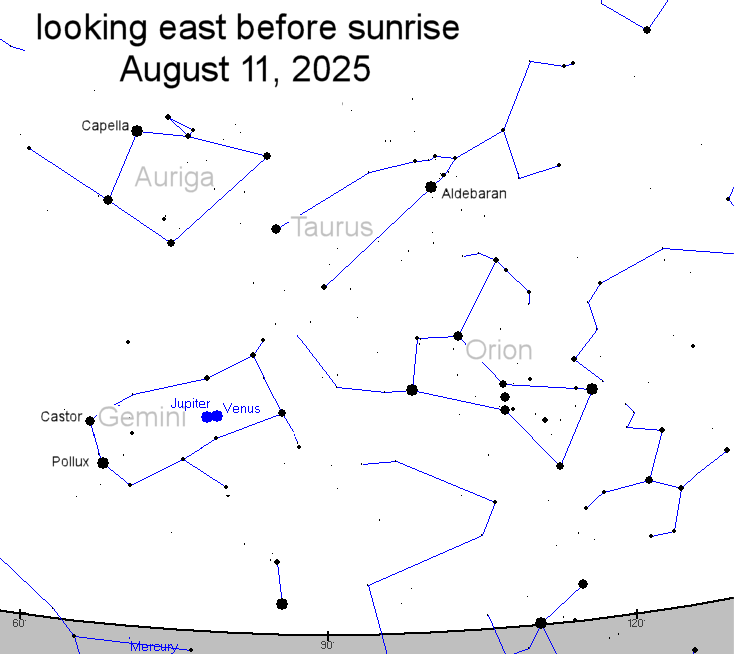
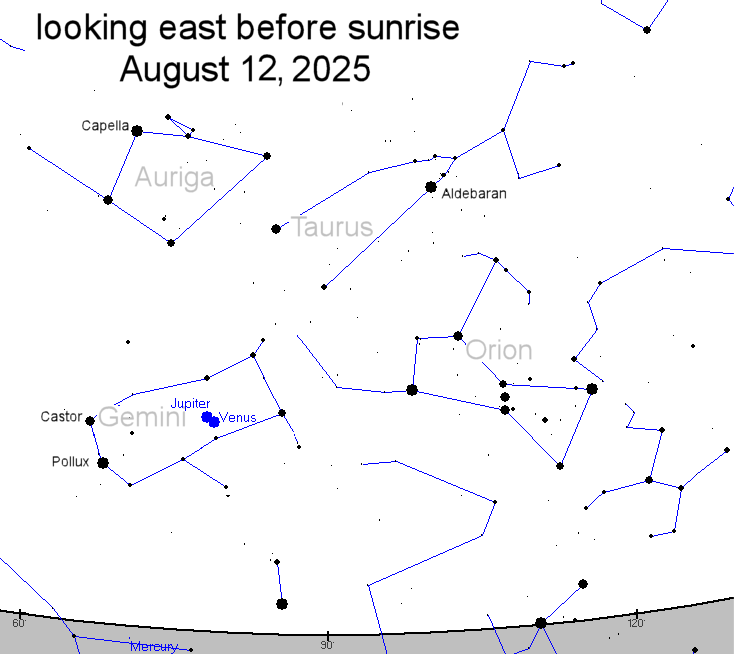
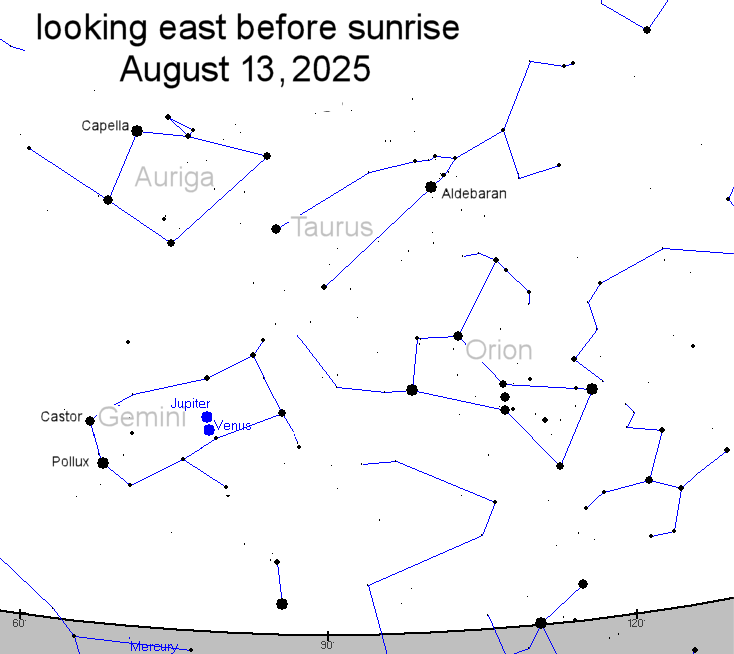
At daybreak on Aug. 8th, Georg Klingersberger of Kobernaußen, Austria, photographed the pair just above the waxing twilight:
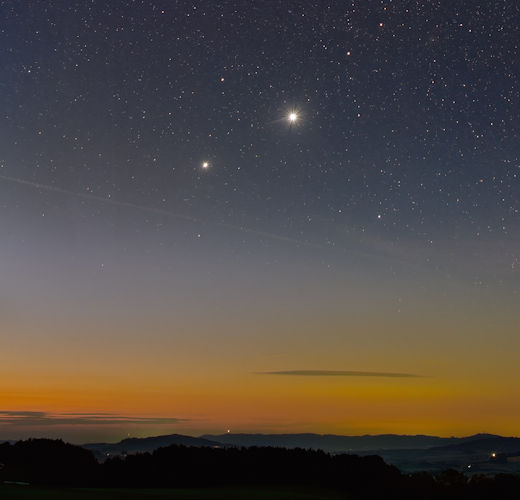
Above: Venus and Jupiter converging over Austria on Aug. 8th. Photo credit: Georg Klingersberger
The two planets are even closer now, their beauty increasing in inverse proportion to the distance between them. Submit your photos here!
more images: from Eric G David of Fredericksburg, Virginia; from Les Brooks of Seaham, Durham, UK; from Keith Warner of Ucluelet, British Columbia, Canada
Realtime Space Weather Photo Gallery
Free: Spaceweather.com Newsletter
WHAT DOES A PERSEID METEOR SOUND LIKE? The Perseid meteor shower is underway and, although the peak is not until next week, already dozens of meteors may be seen gliding silently across the night sky. Emphasis on silently. However, Heiko Ulbricht of Freital, Germany, has found a way to hear them. Click to listen:
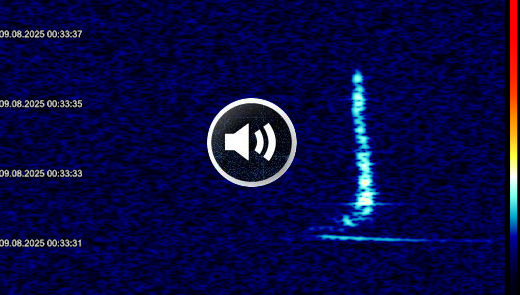
"This is an echo from the GRAVES space surveillance radar in France," explains Ulbricht. "I recorded on Aug. 8th when a Perseid meteor passed over Europe."
GRAVES is a radar France uses to monitor the space around Earth for satellites and space debris. While GRAVES is monitoring the heavens, Ulbricht is monitoring GRAVES. He uses a 143 MHz Yagi antenna and receiver to listen in to "pings" as objects pass over the radar site in neighboring France.
"The Perseids are already active," he says, "and I plan to continue listening throughout the shower's peak on August 12-13." Stay tuned for more echoes.
Realtime Perseid Meteor Photo Gallery
Free: Spaceweather.com Newsletter
"ALWAYS AND FOREVER" METEOR CRATER PENDANT: Have you heard of Moissanite? It's a very rare mineral discovered by 19th-century chemist Henri Moissan in Arizona's Meteor Crater. At first, he thought it was diamond, but later realized it was even more rare. It's a diamond lookalike that, until the 1950s, was found naturally only in meteorites.
On Aug. 2nd, the students of Earth to Sky Calculus launched this Moissanite pendant to the stratosphere onboard a cosmic ray research balloon:

You can have it for $229.95. Engraved with the words "I love you always and forever," the sterling silver frame bends around the Moissanite in a heart-shaped curve--all highlighted by glittering 5A cubic zirconia nuggets.
The students are selling space pendants to pay the helium bill for their cosmic ray ballooning program. Each one comes with a greeting card showing the jewelry in flight and telling the story of its trip to the stratosphere and back again.
Far Out Gifts: Earth to Sky Store
All sales support hands-on STEM education
Realtime Comet ATLAS Photo Gallery
Free: Spaceweather.com Newsletter
Realtime Aurora Photo Gallery
Free: Spaceweather.com Newsletter
Realtime Noctilucent Cloud Photo Gallery
Free: Spaceweather.com Newsletter