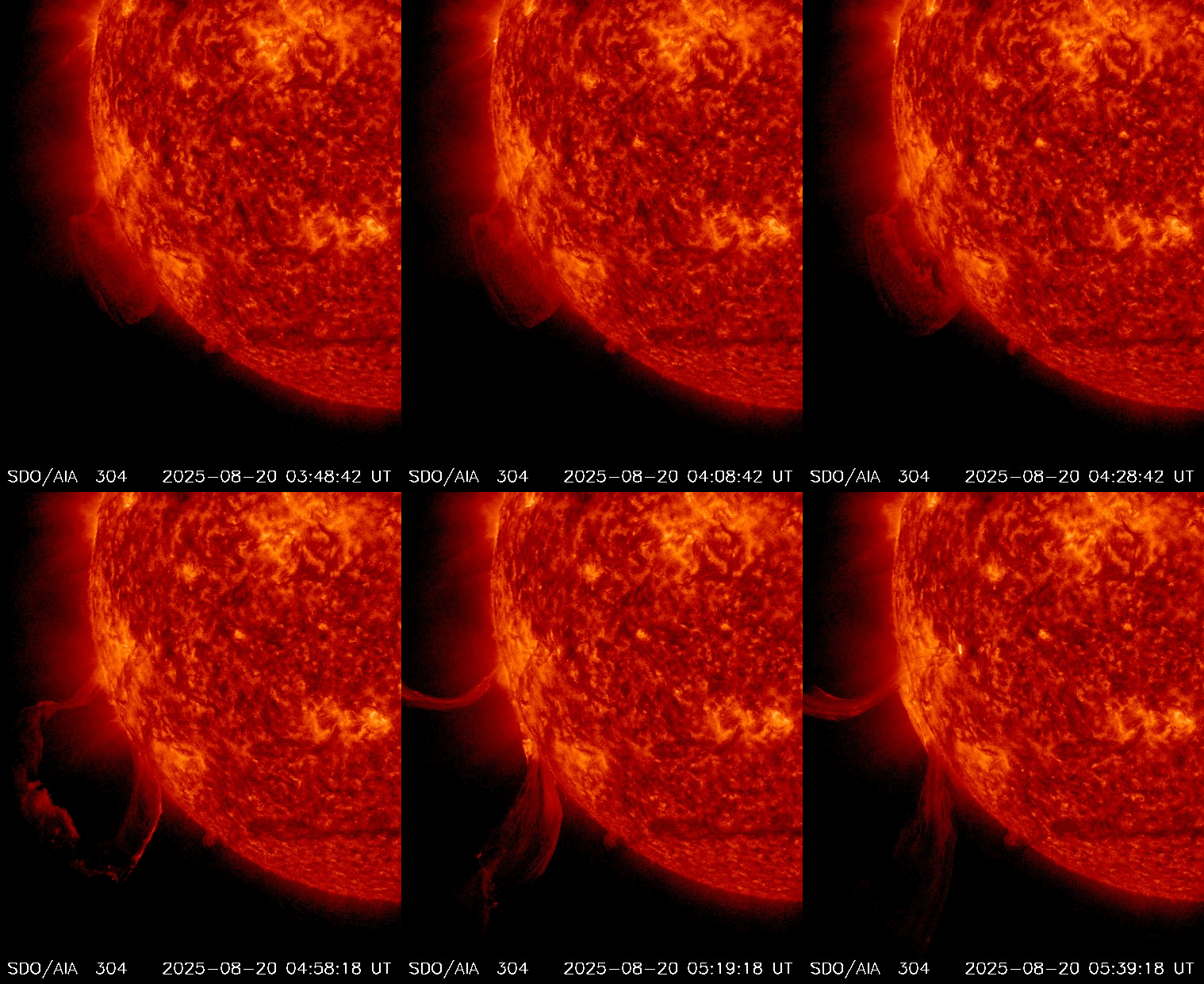
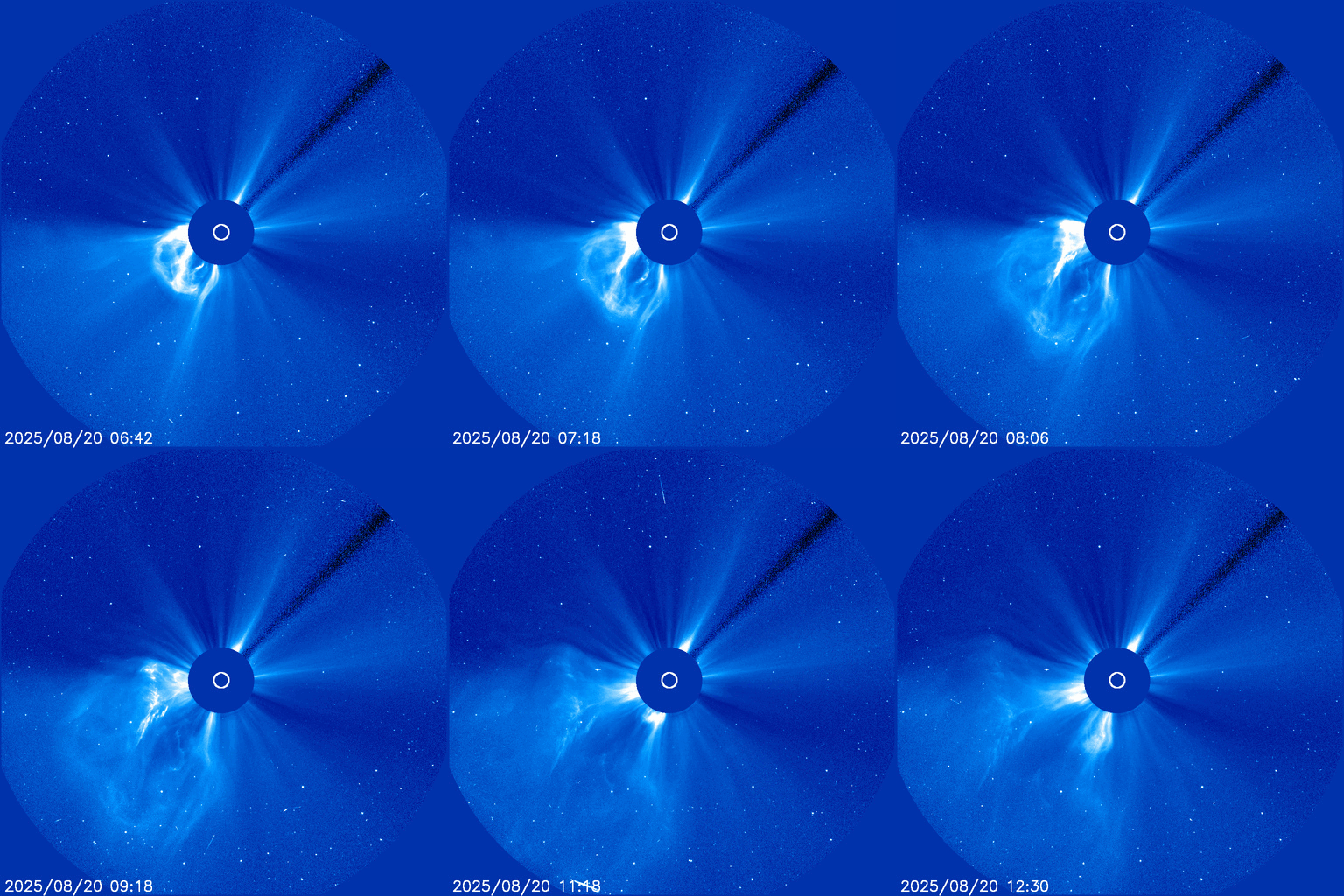
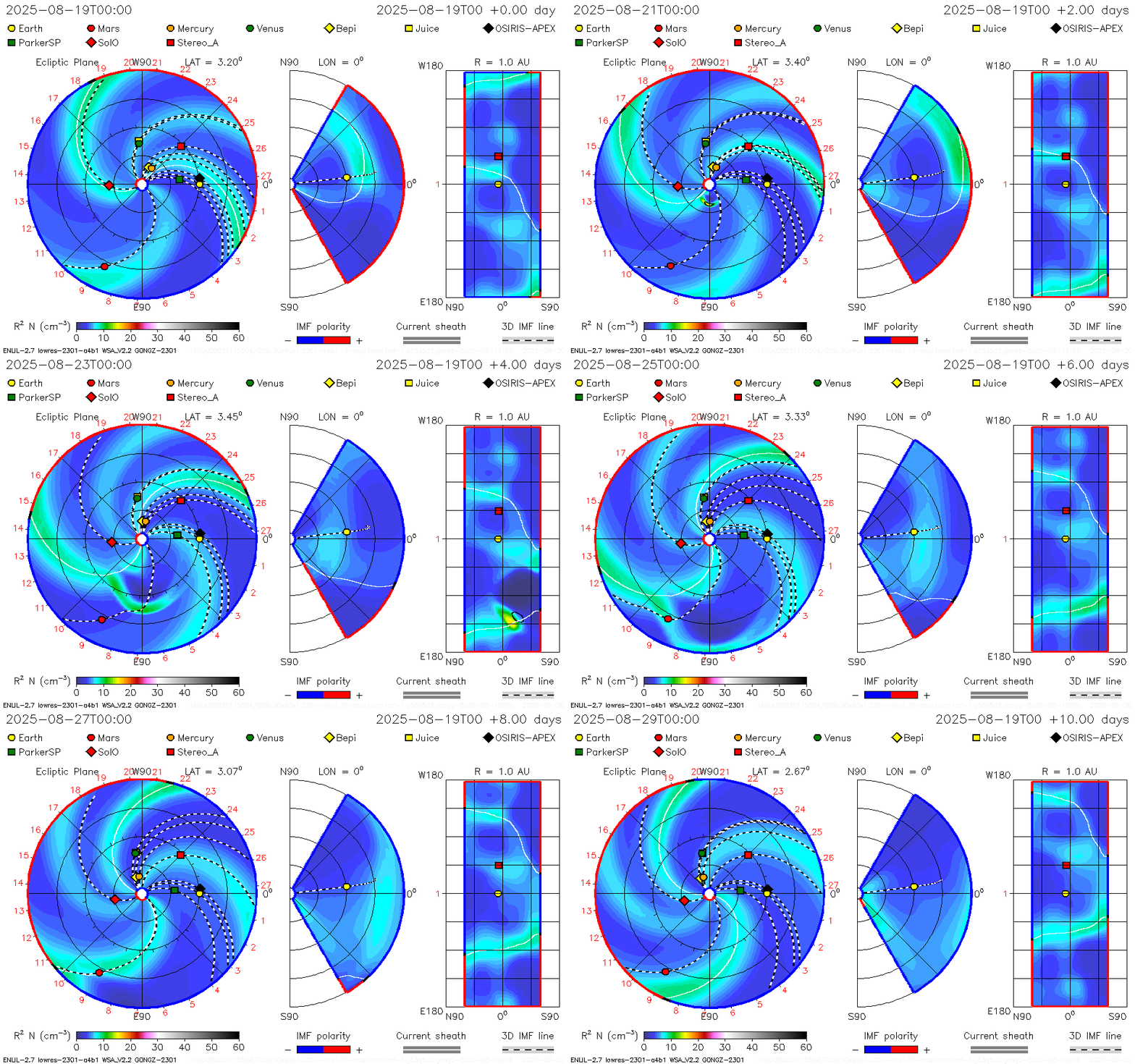
A LARGE CORONAL MASS EJECTION: A filament of magnetism erupted from the sun's southern hemisphere today, and it hurled a big bright CME into space. First-look models suggest the CME will miss Earth but hit Mars later this week. Aurora alerts: SMS Text
THE BACKWARD TAIL OF COMET 3I/ATLAS: Last month, when astronomers used the Hubble Space Telescope to photograph 3I/ATLAS, they had a "Eureka!" moment. The mysterious interstellar visitor had a fuzzy atmosphere and a growing tail. Clearly, it was a comet.
However, something was not quite right. Take a look, and see if you can spot the problem:
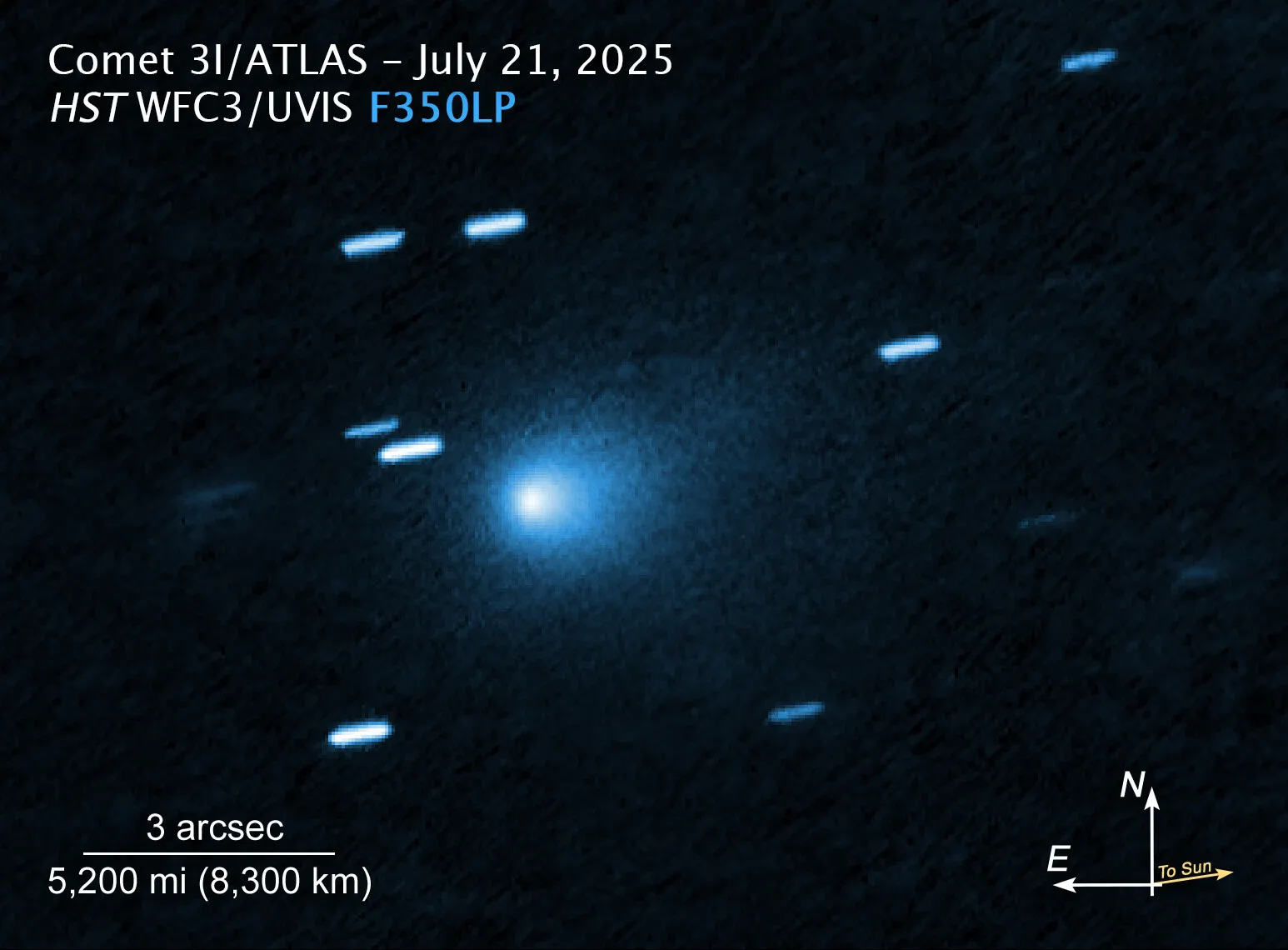
The tail of 3I/ATLAS points almost straight toward the sun. Normally, comet dust tails are pushed away from the sun by radiation pressure. 3I/ATLAS is doing the opposite—it's backwards.
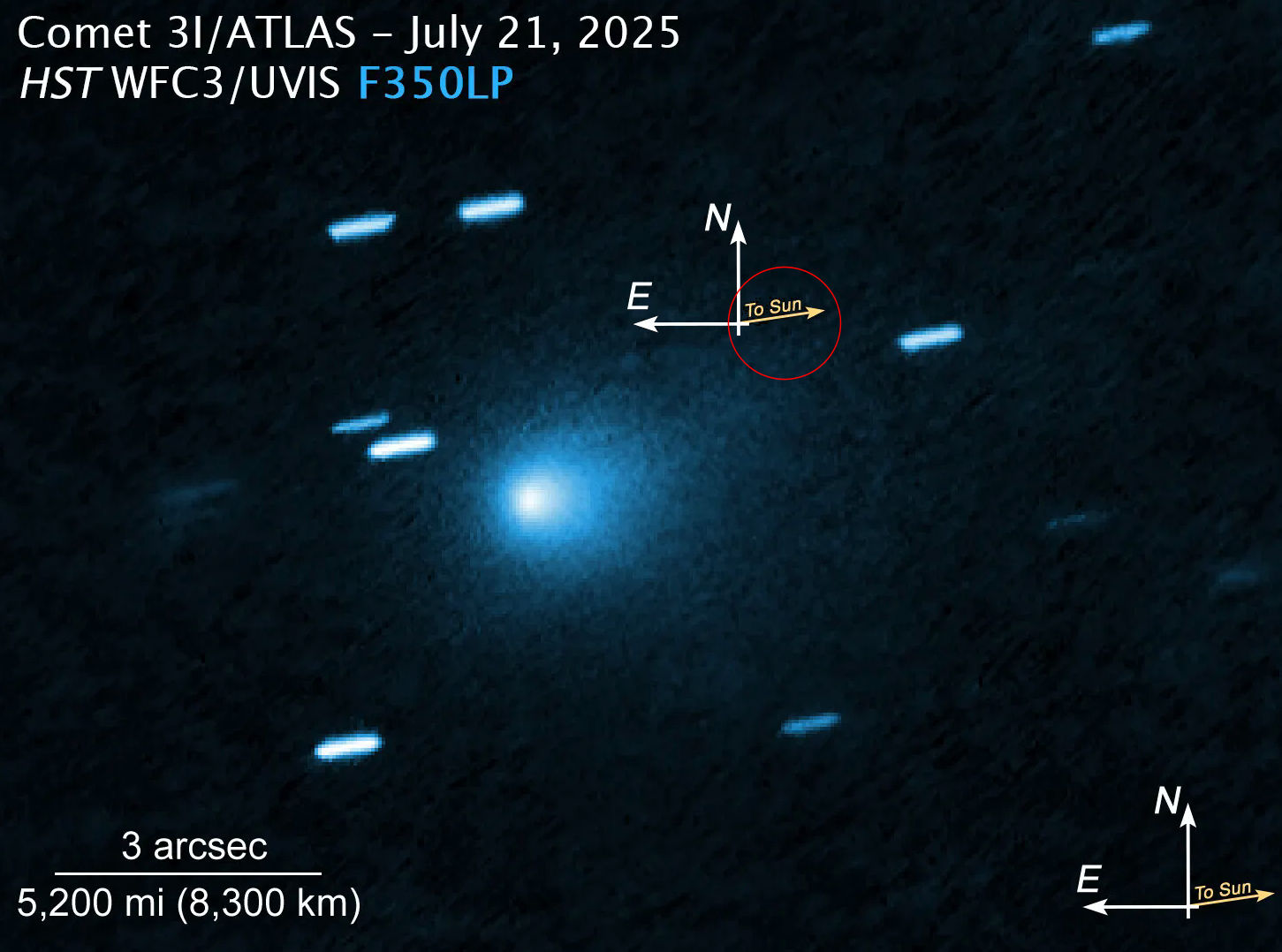
Why? Researchers led by David Jewitt of UCLA believe they have an explanation: "It is due to the preferential sublimation of ice on the hot day side of the nucleus and the near absence of sublimation on the night side," they wrote in a paper reporting the observations.
In other words, 3I/ATLAS *is* a comet, but only the sun-heated side is producing lots of dust. The emerging dust particles are too big for radiation pressure to bend them back into an ordinary tail.
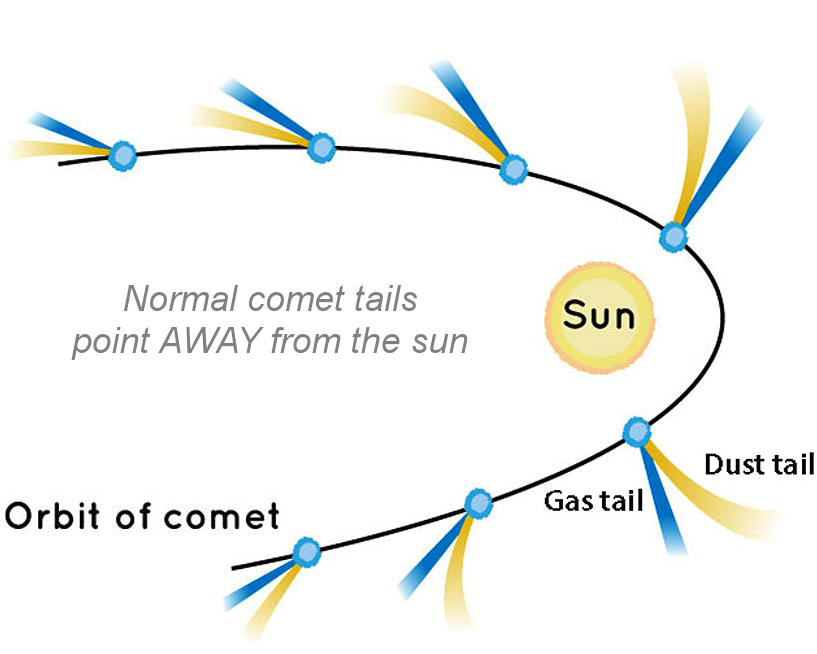 This is unusual, but not unheard of. Solar system comets have been known to produce sunward fans or jets, typically from localized "hot spots" on their rotating nuclei. What makes 3I/ATLAS different is the dominance of its sunward plume, dwarfing a barely visible anti-solar tail behind it.
If 3I/ATLAS is indeed a comet, it may have been wandering through the galaxy for longer than our Solar System has existed. Billions of years of cosmic ray bombardment will have altered its surface--knocking hydrogen atoms out while heavier molecules remained behind. This process could create a hardened crust that might not sputter dust and gas like fresher comets from the Solar System.
Researchers will be very interested to see how the tail of 3I/ATLAS evolves as it approaches the sun for a close encounter in October 2025. Will it remain backward? Or will the crust crumble and allow smaller particles to escape, forming a more normal anti-solar tail?
Of course, if it is a spaceship as Harvard professor Avi Loeb suggests, something completely different may occur. Either way, stay tuned.
Realtime 3I/ATLAS Photo Gallery
Free: Spaceweather.com Newsletter
MOON CRYSTAL NIGHT LIGHT: This crystal night light comes from the edge of space, and it has a message: "I Love You to the Moon and Back." On April 23, 2025, the students of Earth to Sky Calculus launched it to the stratosphere onboard a giant helium balloon:

You can have it for $135.99. Made of high-quality K9 crystal, the rectanglar mini-monolith contains a 3D laser-etched full Moon floating above the text "I Love You to the Moon and Back." It also comes with an LED base, which allows the crystal to be used as a red, green or blue night light.

The students are selling space crystals to pay the helium bill for their high altitude ballooning program. Each one comes with a greeting card showing the item in flight and telling the story of its journey to the stratosphere and back again.
Far Out Gifts: Earth to Sky Store
All sales support hands-on STEM education
AURORA SEASON BEGINS: Around the Arctic Circle, it's been a long summer of bright nights and no auroras. Now the seasons are changing. Jónína Óskarsdóttir sends this picture from Fáskrúðsfjörður, Iceland:
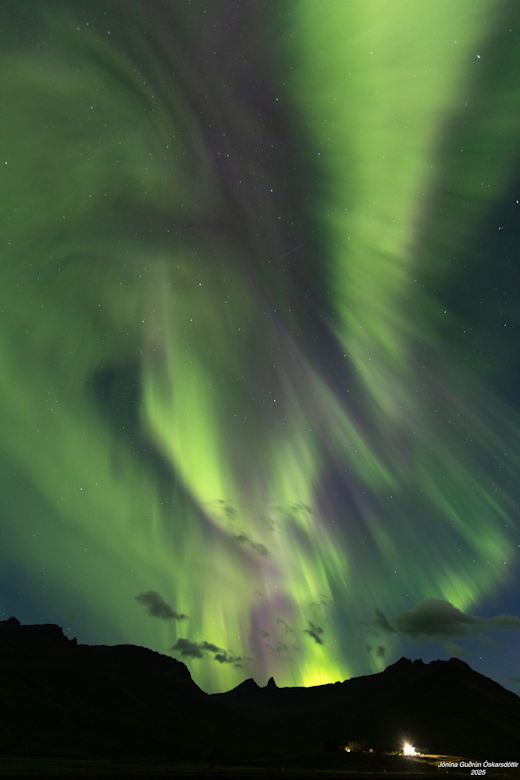
"Just after 1 am on Aug. 20th, the sky filled with enormous green auroras," says Óskarsdóttir. "What a wonderful start of the new season!"
The auroras she photographed were sparked by a stream of solar wind blowing faster than 600 km/s. Earth is still inside the stream today, and the darkness will be a little deeper. As a result, the second day of the new season could be even better than the first. Submit your photos here.
more images: from John David McKinnon of Fort Smith/Tthebacha, Northwest Territories, Canada; from Todd Salat of Mat-Su Valley, Alaska
Realtime Aurora Photo Gallery
Free: Spaceweather.com Newsletter
Realtime Space Weather Photo Gallery
Free: Spaceweather.com Newsletter
Realtime Noctilucent Cloud Photo Gallery
Free: Spaceweather.com Newsletter