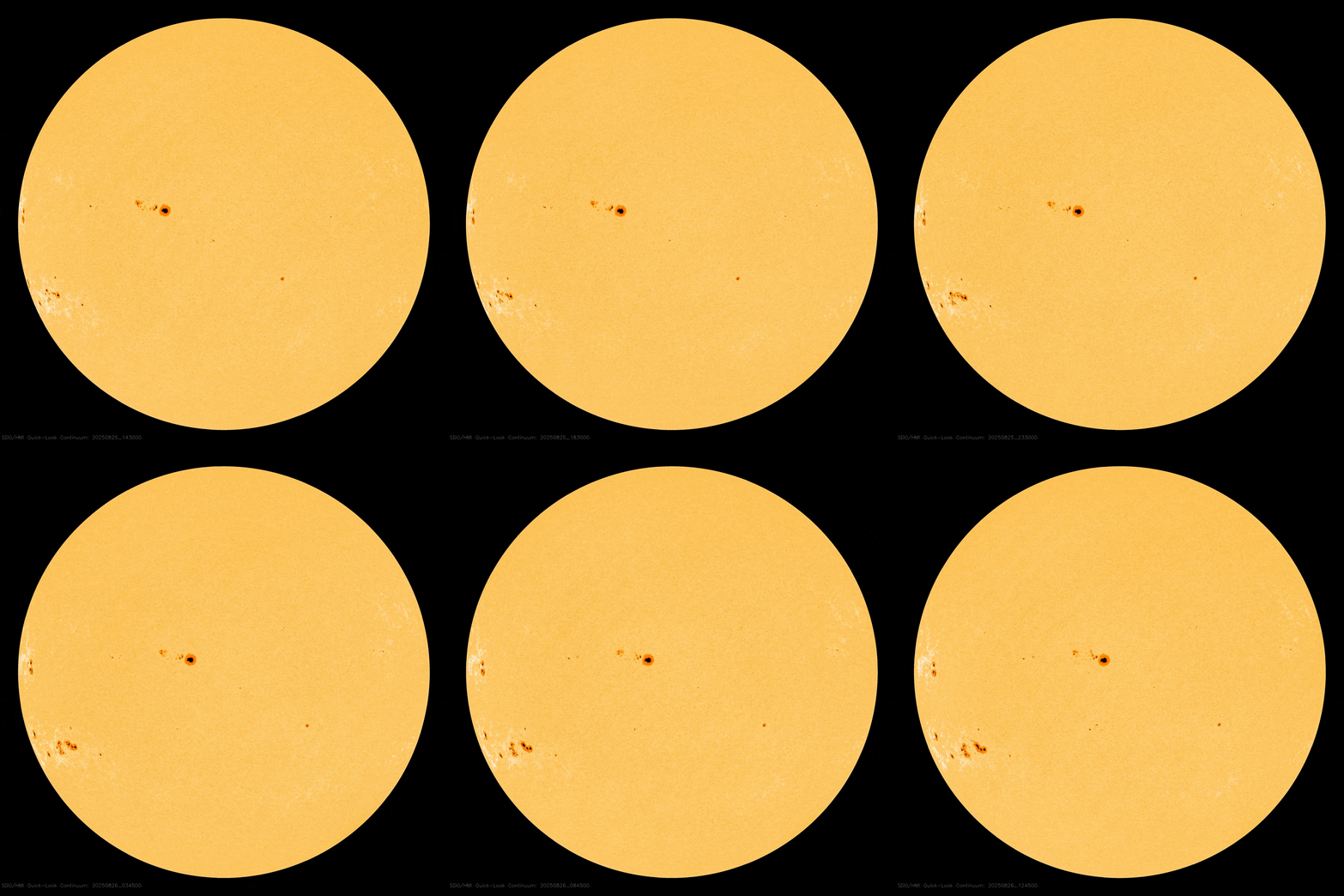
INCREASING CHANCE OF FLARES: A phalanx of large sunspots is turning toward Earth: movie. Among them, sunspot 4199 is crackling with M-class flares, while big sunspot 4197 has a delta-class magnetic field that harbors energy for even stronger X-flares. Earth is entering the strike zone of these active regions, and we will soon be in the bulls eye. Geoeffective solar flares are in the offing. Solar flare alerts: SMS Text
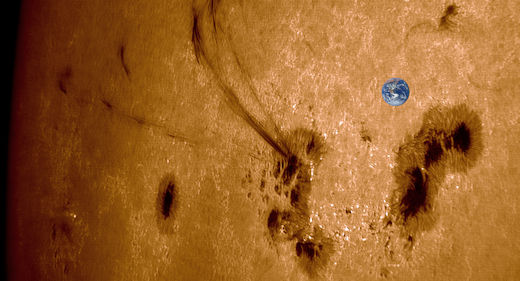
Above: Growing sunspot 4197 dwarfs Earth. Photo credit: Philippe Tosi of Nîmes, France
Realtime Space Weather Photo Gallery
Free: Spaceweather.com Newsletter
PLANETARY WAVE SPARKS LATE-SEASON NLCs: Usually the summer season for noctilucent clouds (NLCs) is over by now. Instead, Arctic sky watchers have been seeing some very bright NLCs:
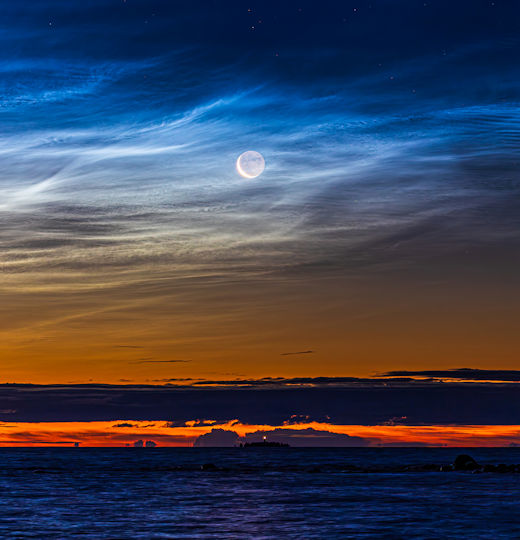
"I caught these late-season NLCs drifting in front of the crescent Moon on Aug. 21st," reports Sebastian Sainio of Björköby, Finland. Almost a thousand kilometers away in Kiruna, Sweden, the clouds were so bright, they "seemed like sunrise," while polar air travelers witnessed dramatic displays from the window seat.
What's going on? Lynn Harvey of the Laboratory for Atmospheric and Space Physics (CU Boulder) found the answer. "There is a beautiful 5-day planetary wave that is driving temperatures over Scandinavia to be ~10 K colder than in other longitude sectors in the last few days," she explains.
This Hovmöller diagram from NASA's microwave limb sounder (MLS) shows the cold wave:
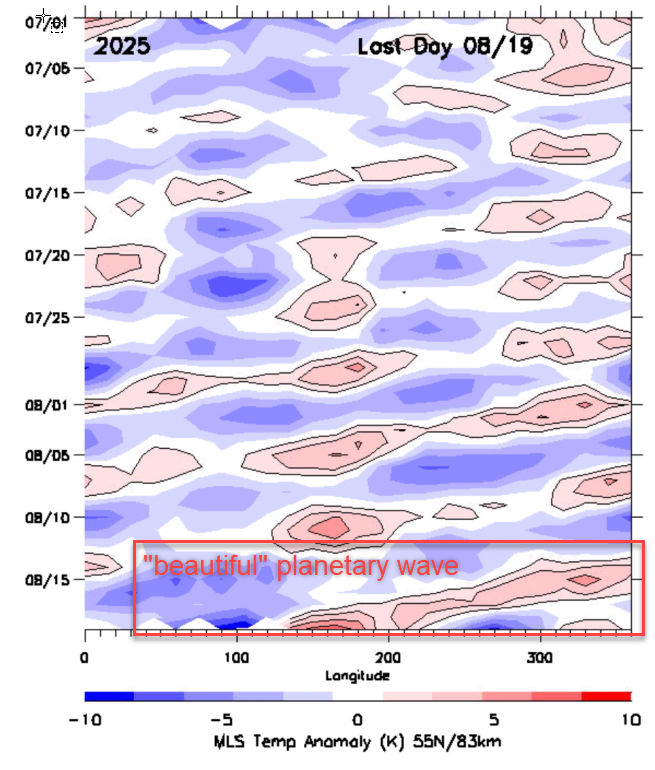
Normally, late August warmth melts away icy NLCs in the mesosphere. The planetary wave, however, has reversed that trend. Cold troughs in the wave freeze water vapor around meteoric dust, seeding these unseasonal night-shining clouds.
The NLCs could reappear at 5-day intervals. That’s because planetary waves--giant atmospheric ripples with natural periods of 2, 5, 10, and 16 days--are the drivers. The 5-day mode is the strongest, a fundamental global oscillation of Earth's atmosphere.
If you live around the Arctic Circle, please be alert for these late-season clouds, and submit your photos here
Realtime Noctilucent Cloud Photo Gallery
Free: Spaceweather.com Newsletter
LITTLE GREEN SANTA ORNAMENT: You can't buy this on Amazon: The Little Green Santa Christmas Ornamant is only available from the Earth to Sky Store. On Aug. 22, 2025, it flew to the stratosphere onboard a cosmic ray research balloon:
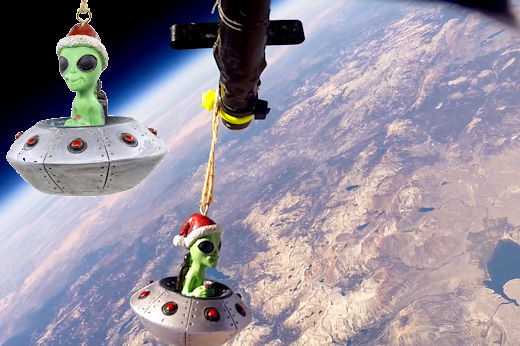
You can have it for $99.95. Hand-sculpted in the USA, this humorous ornament shows Santa arriving from the North Pole of a distant planet. Durable polyresin construction makes it lightweight enough to hang on any tree, but sturdy enough to last for many Christmases to come.
The students are selling space ornaments to pay the helium bill for their cosmic ray ballooning program. Each one comes with a greeting card showing the ornament in flight and telling the story of its trip to the stratosphere and back again.
Far Out Gifts: Earth to Sky Store
All sales support hands-on STEM education
Realtime Space Weather Photo Gallery
Free: Spaceweather.com Newsletter
Realtime Aurora Photo Gallery
Free: Spaceweather.com Newsletter