STARSHIP 10 LAUNCH SUCCESS: First, Starship 10 didn't explode. Then, it accomplished almost all of its mission objectives. SpaceX's massive Starship, combined with its Super Heavy booster, lifted off from Starbase, Texas on Aug. 26th at 6:30 PM CDT. For the first time, Starship successfully deployed eight extra-large Starlink satellite simulators into orbit, paving the way for future expansion of the megaconstellation. Then it landed (a soft splashdown) in the Indian Ocean. [Launch Video] [Landing Video]
IS 3I/ATLAS REALLY A COMET? The most intriguing mystery in astronomy today is the nature of interstellar object 3I/ATLAS. Most astronomers believe it is a comet. However, iconoclast Avi Loeb of Harvard University makes the case that it might be something else--like alien tech.
Into this debate comes new data from the James Webb Space Telescope. A paper just submitted to the Astrophysical Journal Letters reports that 3I/ATLAS looks like a comet, albeit a strange one. Here are the images from JWST:
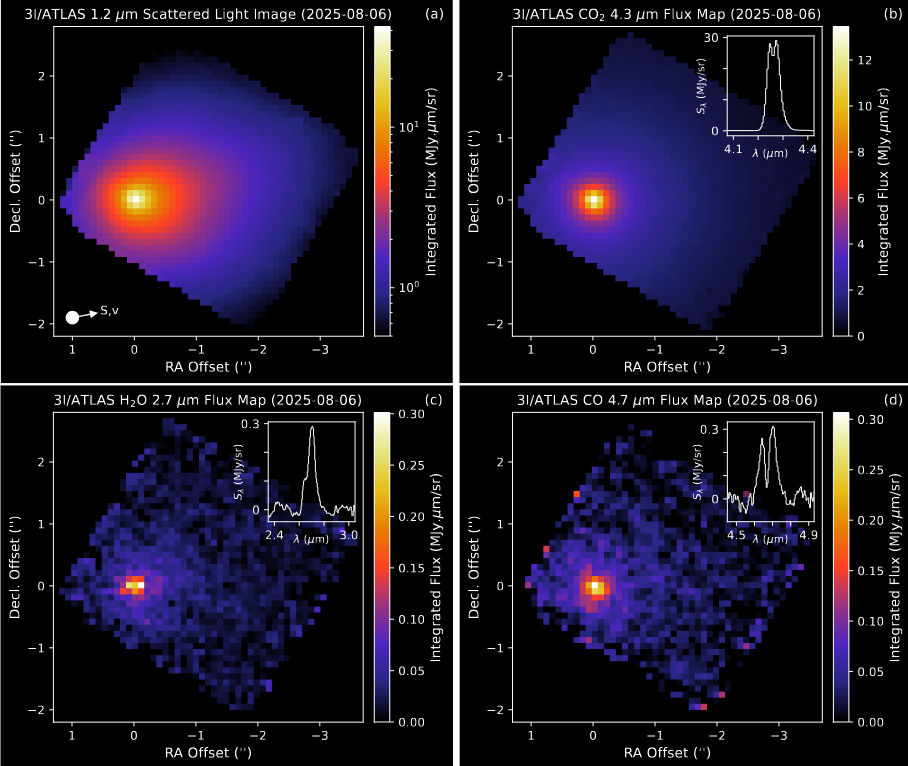
Above: These JWST images show the distribution of carbon dioxide (panel b), water (panel c) and carbon monoxide (panel d). Most of the light is coming from CO2.
The infrared space telescope found most of the ingredients we expect to find in comets. There's a fuzzy coma, volatile ices, and all the usual molecules: water (H20), carbon dioxide (CO2), carbon monoxide (CO). If 3I/ATLAS is a spacecraft, it has an uncanny disguise.
However, there's also something strange. The ratios of the different molecules are quite unexpected and don't match what we see in Solar System comets. In particular, the CO2/H20 ratio of 8 ± 1 is extremely high. Only one other comet, C/2016 R2, is known to have similar chemistry, and astronomers have long considered it to be a "freak."
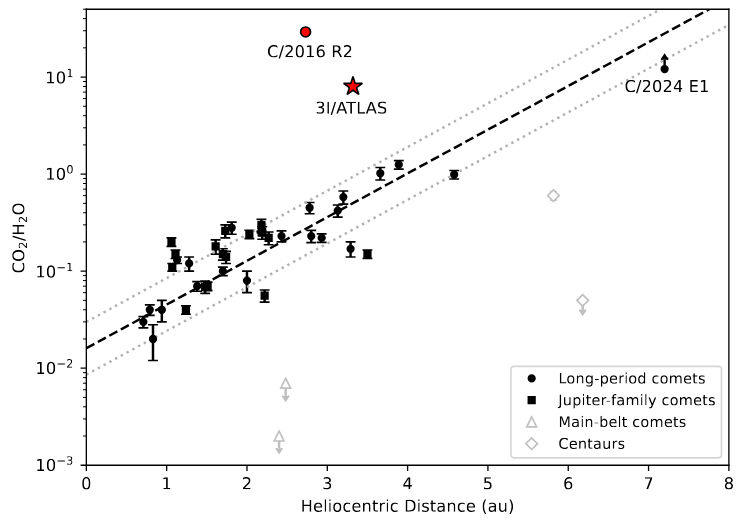
Above: Carbon dioxide-to-water ratios in known comets. 3I/ATLAS does not fit the trend.
Typical comets have a lot more water in their atmospheres, with H20 almost always outnumbering CO2. It could be that water production in 3I/ATLAS has not yet fully "turned on" because it is still too cold. If so, solar heating could restore ratios to normal. 3I/ATLAS will reach its closest point to the sun (1.36 AU) on Oct. 29, 2025, potentially bringing forth a geyser of water vapor to mix with the other gases.
Or, maybe, 3I/ATLAS is just strange--like it came from another star system. Stay tuned for updates.
Realtime Space Weather Photo Gallery
Free: Spaceweather.com Newsletter
LITTLE GREEN SANTA ORNAMENT: You can't buy this on Amazon: The Little Green Santa Christmas Ornamant is only available from the Earth to Sky Store. On Aug. 22, 2025, it flew to the stratosphere onboard a cosmic ray research balloon:
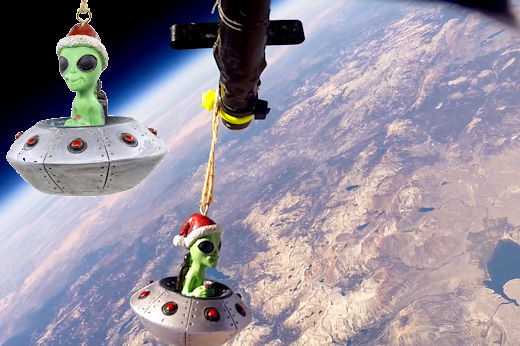
You can have it for $99.95. Hand-sculpted in the USA, this humorous ornament shows Santa arriving from the North Pole of a distant planet. Durable polyresin construction makes it lightweight enough to hang on any tree, but sturdy enough to last for many Christmases to come.
The students are selling space ornaments to pay the helium bill for their cosmic ray ballooning program. Each one comes with a greeting card showing the ornament in flight and telling the story of its trip to the stratosphere and back again.
Far Out Gifts: Earth to Sky Store
All sales support hands-on STEM education
Realtime Noctilucent Cloud Photo Gallery
Free: Spaceweather.com Newsletter
Realtime Aurora Photo Gallery
Free: Spaceweather.com Newsletter