BIG SUNSPOT ALERT: In the sun's southern hemisphere, a large sunspot is turning toward Earth: movie. Sunspot 4197 is about 1/3rd the size of Carrington's sunspot. It looks even bigger though, because it is surrounded by a coterie of smaller spots. The crowd has a complex magnetic field that poses a threat for X-class solar flares. Solar flare alerts: SMS Text
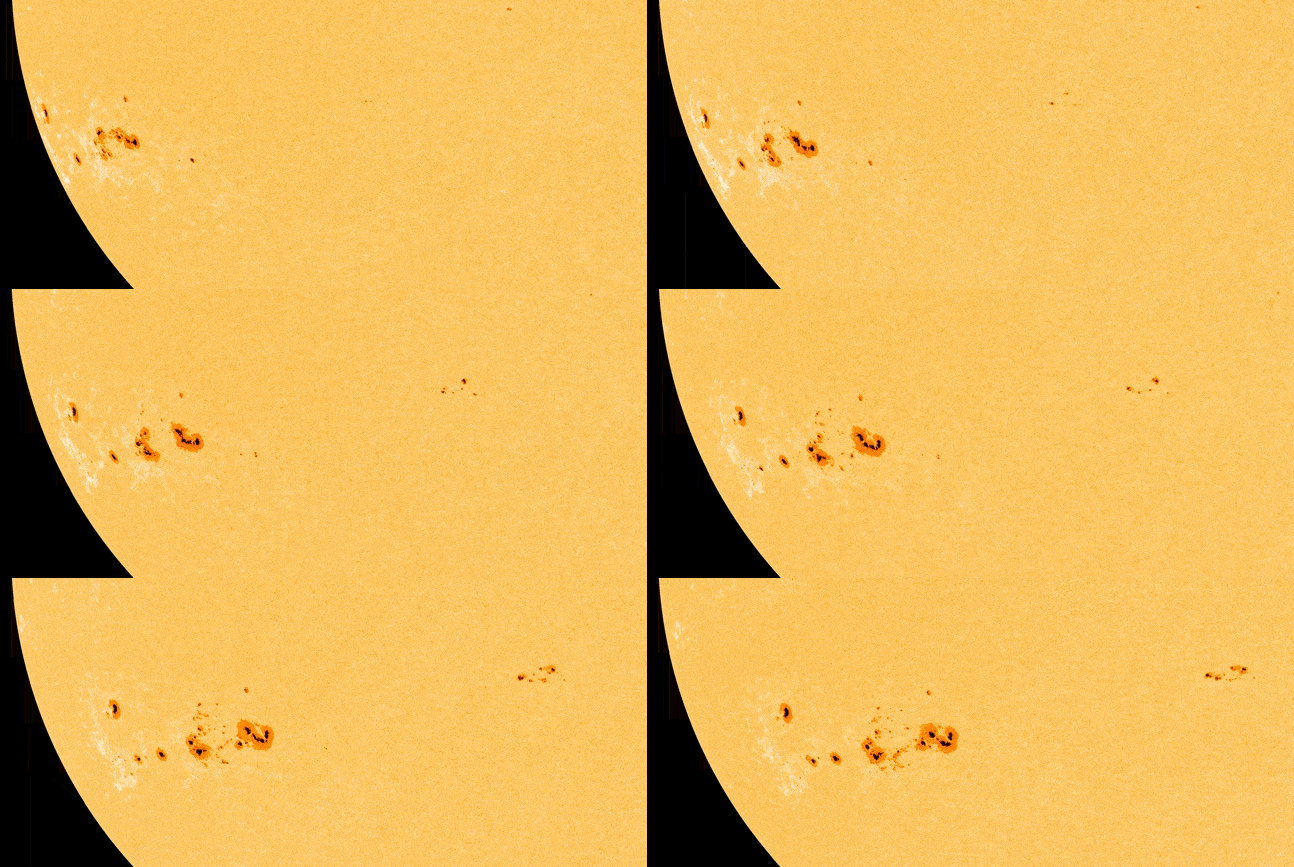
SUNSPOTS AT SUNSET: Sunspot 4197 is so large, it's altering the appearance of the setting sun. On Aug. 27th, Wolfgang Ott photographed the phenomenon as the sun dipped into the North Sea near St. Peter Ording, Germany:
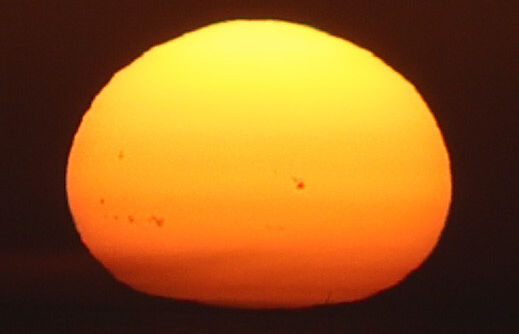
"We were treated to a beautiful sunset this evening," says Ott. "The individual sunspot groups were easy to recognize."
The solar disk itself looks unusual--slightly squashed, almost egg-shaped. This is an effect of refraction. Thick layers of air near the horizon bend sunlight unevenly, distorting the sun’s outline.
The same thick air that deforms the sun also dims it, making the sunspots easier to see. However, don't let that lure you into staring. Even a dim sun can hurt your eyes, especially when it is magnified by optics. If you want to photograph the sunset as Ott did, please use the camera's LCD screen for safe viewfinding.
Realtime Space Weather Photo Gallery
Free: Spaceweather.com Newsletter
IS 3I/ATLAS REALLY A COMET? The most intriguing mystery in astronomy today is the nature of interstellar object 3I/ATLAS. Most astronomers believe it is a comet. However, Avi Loeb of Harvard University famously makes the case that it might be something else--like alien tech.
Into this debate comes new data from the James Webb Space Telescope. A paper just submitted to the Astrophysical Journal Letters reports that 3I/ATLAS looks like a comet, albeit a strange one. Here are the images from JWST:
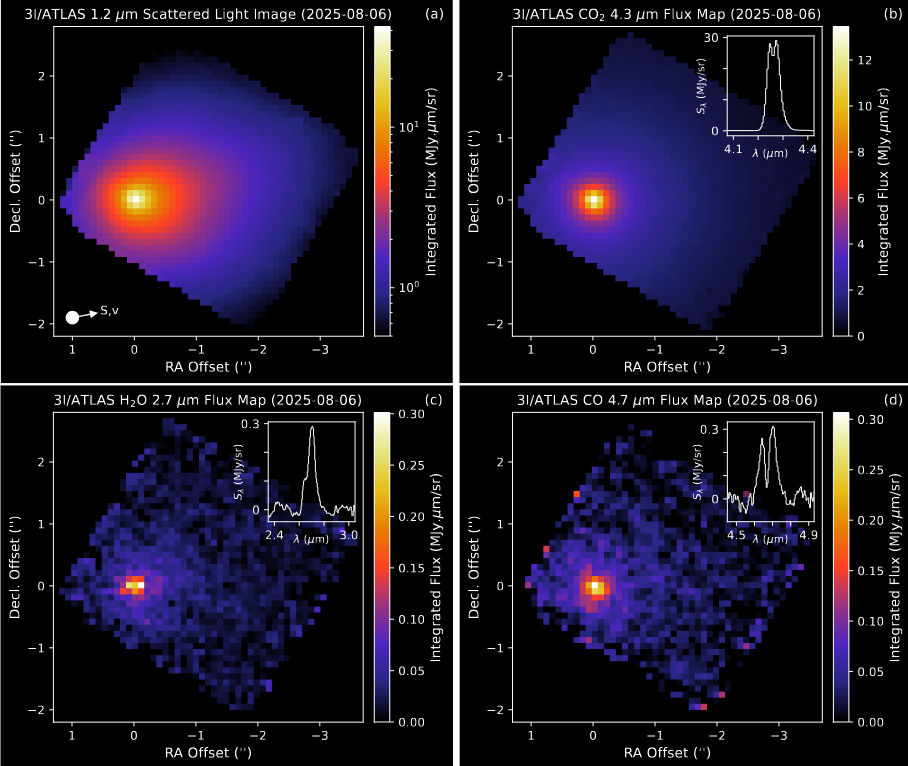
Above: These JWST images show the distribution of carbon dioxide (panel b), water (panel c) and carbon monoxide (panel d). Most of the light is coming from CO2.
The infrared space telescope found most of the ingredients we expect to find in comets. There's a fuzzy coma, volatile ices, and all the usual molecules: water (H20), carbon dioxide (CO2), carbon monoxide (CO). If 3I/ATLAS is a spacecraft, it has an uncanny disguise.
However, there's also something strange. The ratios of the different molecules are quite unexpected and don't match what we see in Solar System comets. In particular, the CO2/H20 ratio of 8 ± 1 is extremely high. Only one other comet, C/2016 R2, is known to have similar chemistry, and astronomers have long considered it to be a "freak."
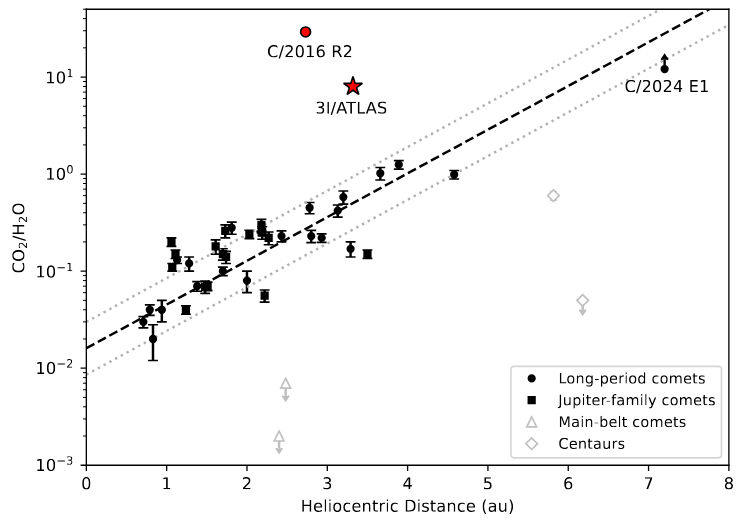
Above: Carbon dioxide-to-water ratios in known comets. 3I/ATLAS does not fit the trend.
Typical comets have a lot more water in their atmospheres, with H20 almost always outnumbering CO2. It could be that water production in 3I/ATLAS has not yet fully "turned on" because it is still too cold. If so, solar heating might restore ratios to normal. 3I/ATLAS will reach its closest point to the sun (1.36 AU) on Oct. 29, 2025, potentially bringing forth a geyser of water vapor to mix with the other gases.
Or, maybe, 3I/ATLAS is just strange--like it came from another star system. Stay tuned for updates.
Realtime Space Weather Photo Gallery
Free: Spaceweather.com Newsletter
AMBER DRAGONFLY SPACE PENDANT: This dragonfly has touched space. On Aug. 22, 2025, the students of Earth to Sky Calculus launched it to the stratosphere onboard a cosmic ray research balloon, 105,108 feet above California's Sierra Nevada mountains:

You can have it for $179.95. Made of genuine Baltic Amber with a sterling silver exoskeleton, the rich Cognac-colored pendant measures 3/4 inch and comes with a matching 18-inch sterling silver chain.
The students are selling space pendants to pay the helium bill for their cosmic ray ballooning program. Each one comes with a greeting card showing the ornament in flight and telling the story of its trip to the stratosphere and back again.
Far Out Gifts: Earth to Sky Store
All sales support hands-on STEM education
Realtime Noctilucent Cloud Photo Gallery
Free: Spaceweather.com Newsletter
Realtime Aurora Photo Gallery
Free: Spaceweather.com Newsletter