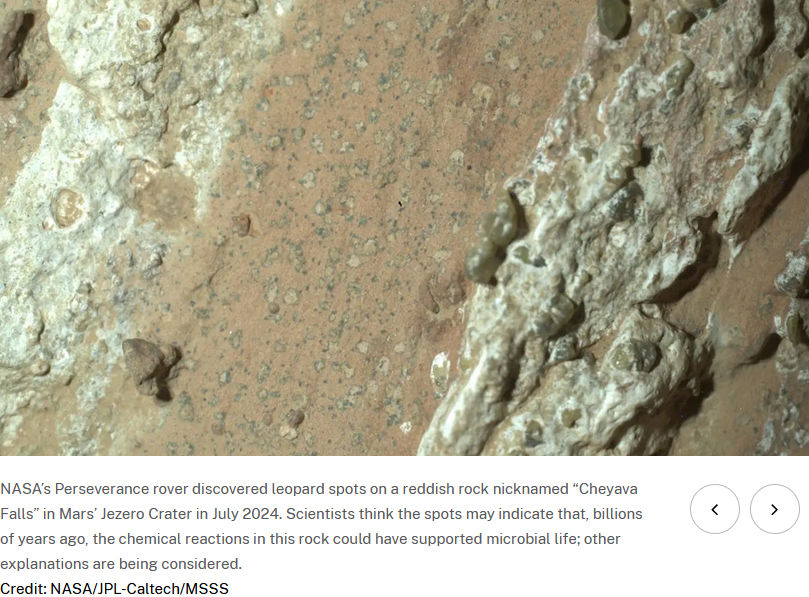
ANOTHER AMBIGUOUS RESULT FROM MARS: At a press briefing today, NASA announced a new maybe/maybe-not detection of ancient life on Mars. Last year, the space agency's Perseverance rover found a rock in an ancient lake bed with unusual markings nicknamed "leopard spots" and "poppy seeds." The minerals Perseverance found inside those markings can be produced by microbes. However, the same mineral textures could arise through nonbiological geochemical reactions. So .... shrug? NASA would like to bring a sample home for a closer look.
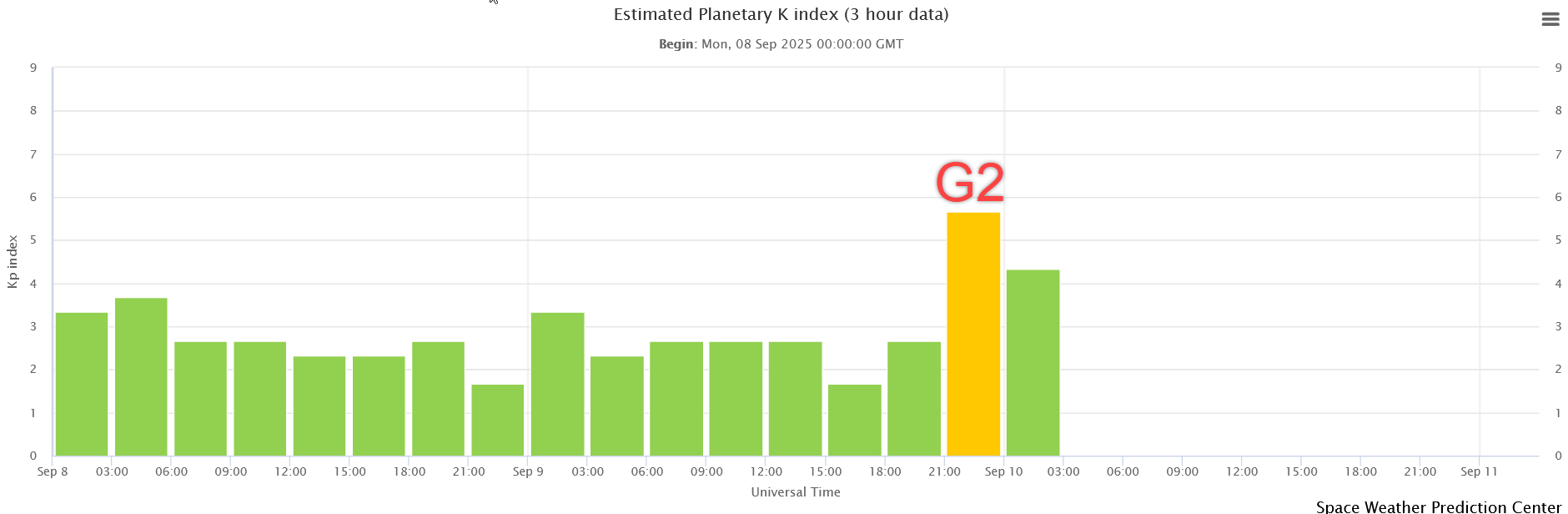
SURPRISE GEOMAGNETIC STORM: This wasn't in the forecast. A G2-class geomagnetic storm broke out during the late hours of Sept. 9th. Why? It's the "Russell-McPherron effect." At this time of year, around the northern autumnal equinox, the sun's magnetic field can become connected to Earth's, sparking unpredictable geomagnetic storms. Happy Equinox! Aurora alerts: SMS Text.

"I saw the auroras tap dancing through the stars of Ursa Major and above the 800-mile-long petroleum Trans-Alaska Pipeline System (TAPS) outside of Delta Junction, Alaska," reports Todd Salat, who photographed the display:
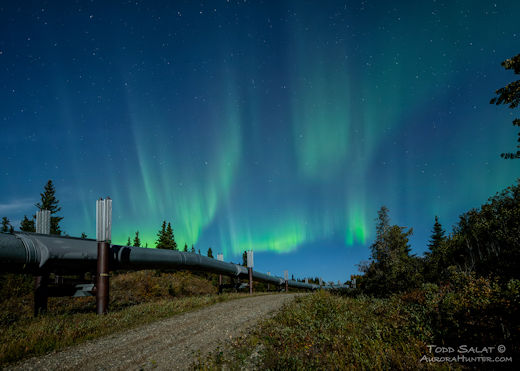
"During aurora-generating solar storms, long metal structures like this are also conductors of geomagnetically induced currents which cause corrosion of pipeline walls," he adds.
Realtime Aurora Photo Gallery
Free: Spaceweather.com Newsletter
INTERSTELLAR COMET IMAGED DURING LUNAR ECLIPSE: On Sept 7th, darkness fell across the Kalahari Desert as Earth's shadow enveloped the full Moon. It was a total lunar eclipse--and the perfect time to photograph an interstellar comet. "We took advantage of the total lunar eclipse to take a deep image of Comet 3I/ATLAS under the dark skies of Namibia," says amateur astronomers Michael Jäger and Gerald Rhemann. Here is what they saw:

The comet was green. "Our images show a gas-rich coma of 2 arcminutes for the first time," says Jäger "It was clearly visible in both the blue and green filters."
The sight is familiar to astronomers: Comets in our own Solar System often glow green. Their emerald hue comes from diatomic carbon (C2), which fluoresces at 518 nanometers when energized by sunlight.
Is that why 3I/ATLAS is green? The jury's still out. In August, spectroscopy by astronomers at Kitt Peak showed that 3I/ATLAS was strongly depleted in C2. Indeed, it was one of the most carbon-chain poor comets ever observed. Perhaps C2 production turned on in September. Or the green glow might come from some other mix of gases or dust, mimicking a classic cometary color with unfamiliar chemistry.
Stay tuned for updates. Its passage is far from over. Each week could bring new chemistry from another star system.
Realtime Space Weather Photo Gallery
Free: Spaceweather.com Newsletter
COFEE TASTES BETTER IN A CUP FROM SPACE: Find out for yourself. On July 16th, the students of Earth to Sky Calculus launched the 'I Need My Space' Snoopy cup to the stratosphere onboard a cosmic ray research balloon. Here it is floating more than 105,315 feet above Earth's surface:
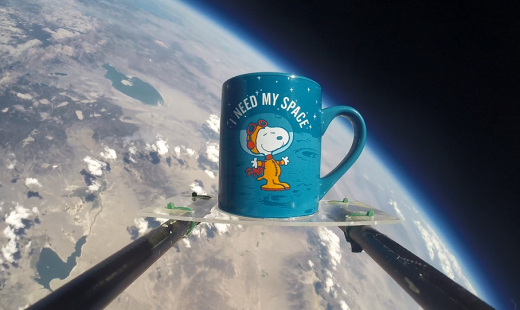
You can have it for $99.95. It's Peanuts for a cup from space! The students are selling Snoopy cups to support their cosmic ray monitoring program. Each one comes with a greeting card showing the cup in flight and telling the story of its trip to the stratosphere and back again.
Far Out Gifts: Earth to Sky Store
All sales support hands-on STEM education
Realtime Aurora Photo Gallery
Free: Spaceweather.com Newsletter
Realtime Space Weather Photo Gallery
Free: Spaceweather.com Newsletter