PERFECT TIMING FOR A CIR: A co-rotating interaction region (CIR) could hit Earth on Sept. 22nd. If so, it would be perfect timing. Sept. 22nd is the northern autumnal equinox. Thanks to the "Russell-McPherron effect," even small distrbances in the solar wind can spark equinox geomagnetic storms. Stay tuned for fall colors. Aurora alerts: SMS Text.
INTERSTELLAR COMET ATLAS IS BRIGHTENING RAPIDLY: The forecasts are officially broken. Since September began, interstellar comet 3I/ATLAS has brightened 40-fold, far more than standard models would predict.
"We can confirm the the significant increase in brightness," report Gerald Rhemann and Michael Jäger. "Our images taken in Namibia on Sept. 17th show the comet already at 12th magnitude." Here is their latest photo:
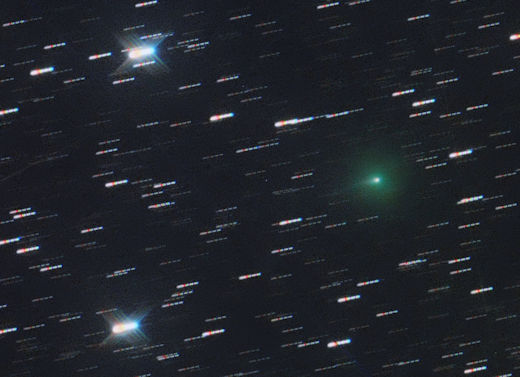
"The comet has a green atmosphere (coma) about 5 arcminutes in diameter, and a tail that continues to point toward the sun--the opposite of the usual direction," they say.
Marshall Eubanks of Space Initiatives Inc. created this plot showing how 3I/ATLAS is over-performing compared to standard models:
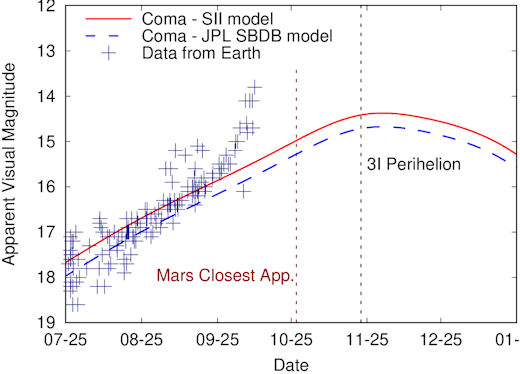
The sudden increase in brightness might be a temporary outburst, or it could be a sign that the comet will become much brighter than initially estimated. Indeed, there is no true "standard model" for an interstellar comet. It might evolve in ways totally unlike comets from our own solar system.
If this trend continues, Comet ATLAS could put on a good show as it passes Mars on Oct. 3rd at a distance of 29 million kilometers. Multiple Mars orbiters will turn to look at the comet including the Mars Reconnaissance Orbiter (NASA), the Trace Gas Orbiter (ESA) and Mars Express (ESA). Astronomers on Earth are encouraged to monitor the comet on this date, too, to support the Martian campaign.
Realtime Comet ATLAS Photo Gallery
Free: Spaceweather.com Newsletter
AMBER SPACE DRGONFLY: This dragonfly has touched space. On Sep. 15, 2025, the students of Earth to Sky Calculus launched it to the stratosphere onboard a cosmic ray research balloon, 101,148 feet above California's Sierra Nevada mountains:
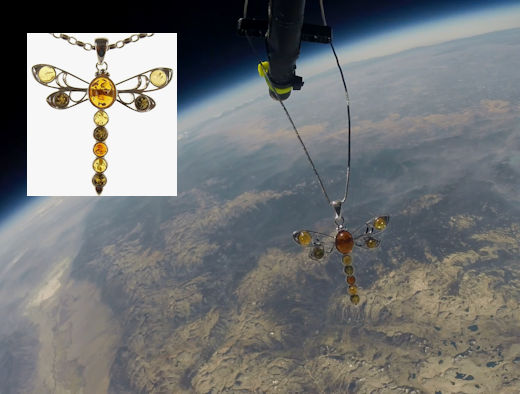
You can have it for $169.95. Made of genuine Baltic Amber with a sterling silver exoskeleton, the rich Cognac-colored pendant measures 3/4 inch and comes with a matching 18-inch sterling silver chain.
The students are selling space pendants to pay the helium bill for their cosmic ray ballooning program. Each one comes with a greeting card showing the ornament in flight and telling the story of its trip to the stratosphere and back again.
Far Out Gifts: Earth to Sky Store
All sales support hands-on STEM education
Realtime Aurora Photo Gallery
Free: Spaceweather.com Newsletter
Realtime Space Weather Photo Gallery
Free: Spaceweather.com Newsletter