HAPPY EQUINOX: Today is the northern autumnal equinox. That's good news for sky watchers because auroras love equinoxes. Around this time of year, the magnetic fields of Earth and sun can link together, setting the stage for geomagnetc storms. Researchers call it the "Russell-McPherron effect," but you can just think of it as "fall colors." Happy equinox! Aurora alerts: SMS Text
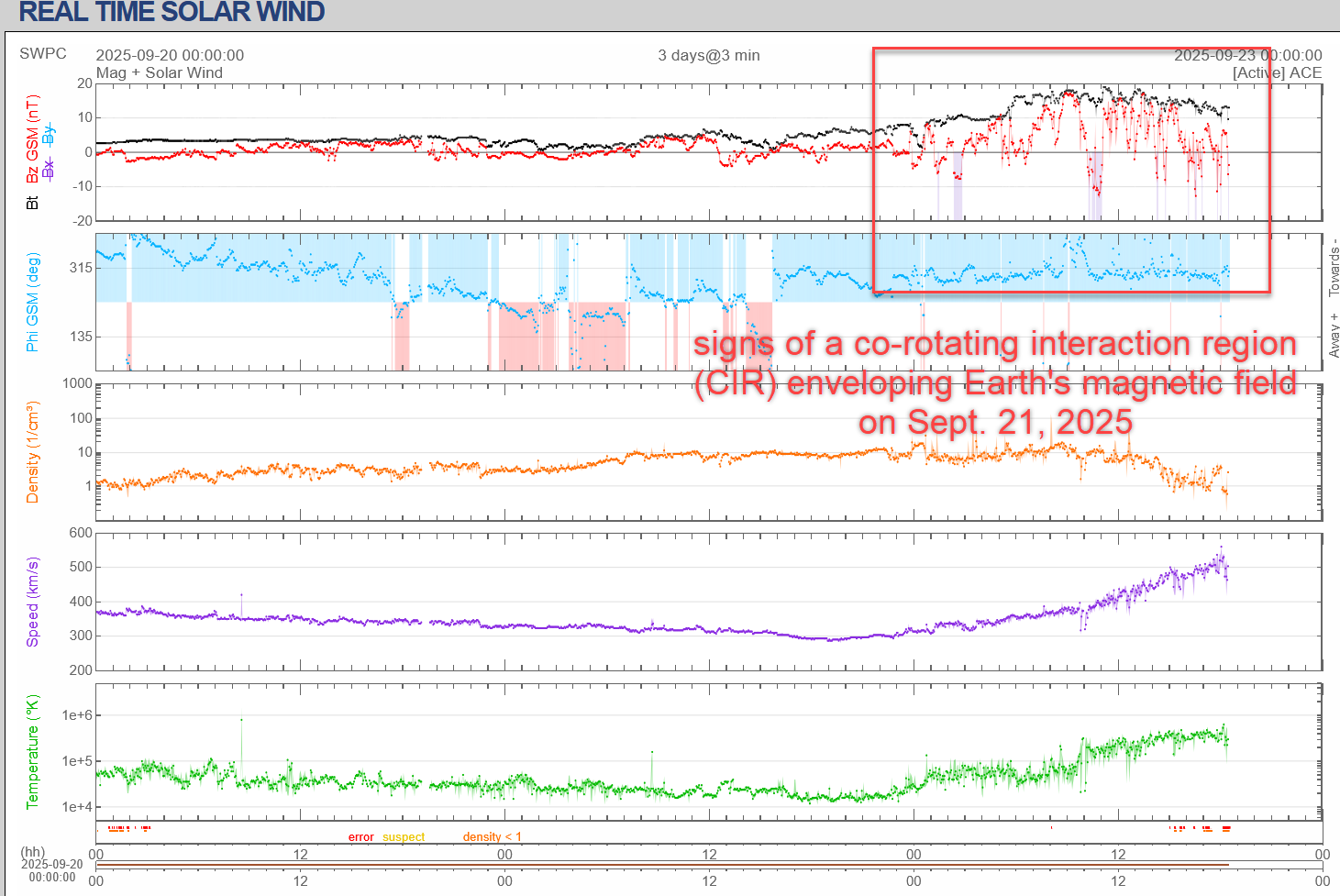
A CIR HIT EARTH YESTERDAY: On Sept. 21st, a co-rotating interaction region (CIR) struck Earth's magnetic field. The impact did not spark a full-fledged geomagnetic storm, but it did ignite auroras around the Arctic Circle. Pilot Matt Melnyk photographed the display 35,000 feet above Baffin Island:
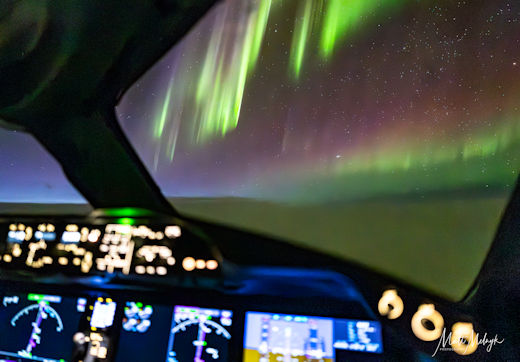
"What an amazing view!" says Melnick. "We watched the auroras from the cockpit while flying the Dreamliner from Calgary to Paris. Auroras always seem to peak around the Fall equinox, and it sure didn't disappoint last night."
Earth s now entering a stream of solar wind following behind the CIR. (This stream is one side of the fast/slow solar wind sandwich that created the CIR in the first place.) Elevated solar wind speeds will probably spark more equinox auroras tonight. High-latitude photographer, submit your images here.
Realtime Aurora Photo Gallery
Free: Spaceweather.com Newsletter
SOLAR ECLIPSE OBSERVED FROM SPACE: This could be a first. On Sept. 21st, NOAA's CCOR-1 coronagraph onboard GOES-19 observed a solar eclipse from Earth orbit. Watch the lights go out as the Moon zig zags between the satellite and the sun:
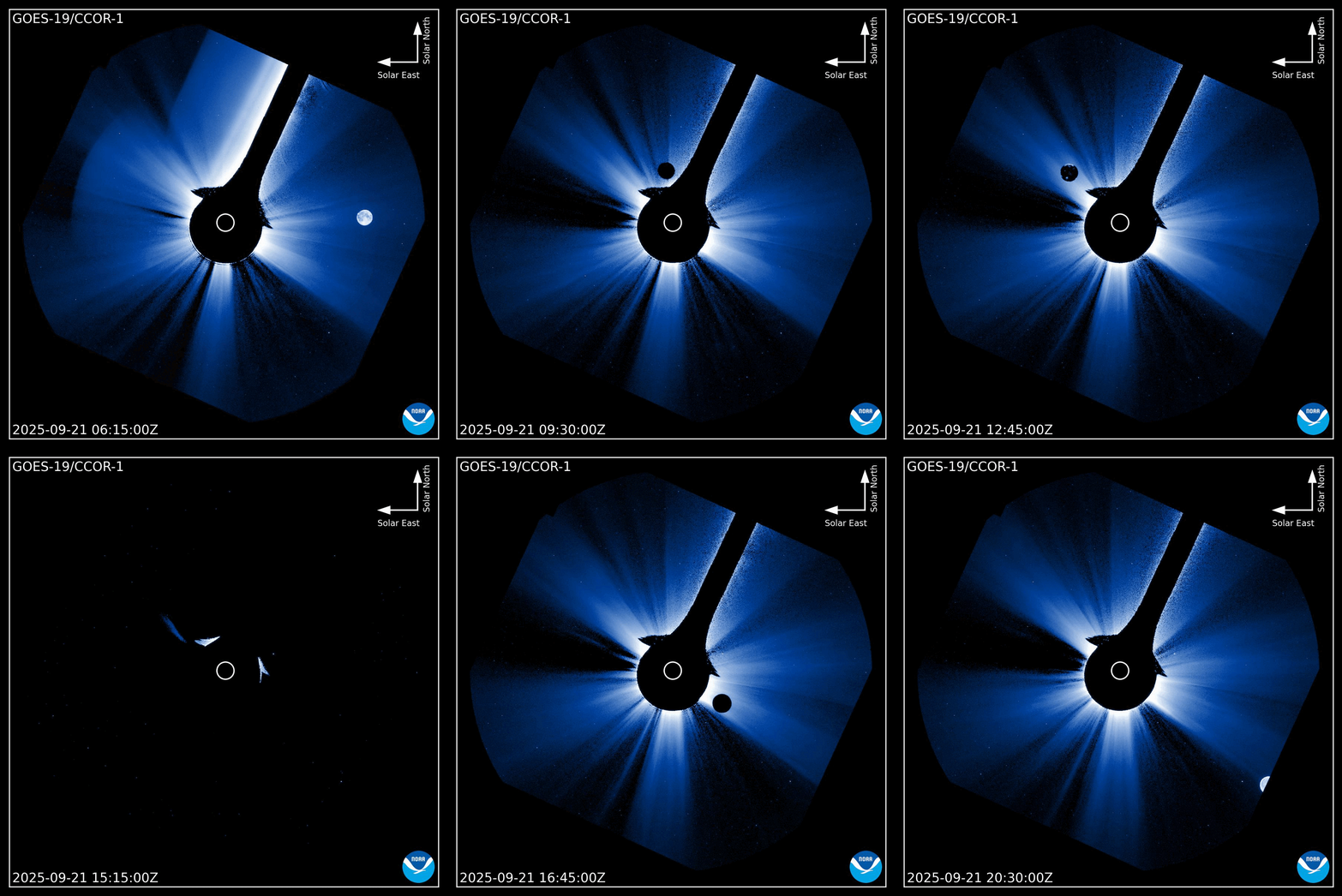
To our knowledge, this is the first natural solar eclipse ever observed by a space-based coronagraph. CCOR-1 is the first coronagraph in Earth's orbit, where such an event could be seen.
Coronagraphs are designed to create artificial eclipses, blocking the glare of the sun so that space weather forecasters can see faint CMEs. That makes yesterday's event an eclipse of an eclipse.
Regular readers of spaceweather.com may know that the Moon zips through CCOR's field of view once a month. Usually it crosses in a straight line. We're not sure why it zig-zagged this time, but it may be related to a yaw flip maneuver scheduled on Sept. 22nd to help calibrate the coronagraph.
Meanwhile on Earth, people in New Zealand saw the eclipse, too, although it was only partial. Browse the solar eclipse gallery for some beautiful shots.
Realtime Solar Eclipse Photo Gallery
Free: Spaceweather.com Newsletter
AMBER SPACE DRGONFLY: This dragonfly has touched space. On Sep. 15, 2025, the students of Earth to Sky Calculus launched it to the stratosphere onboard a cosmic ray research balloon, 101,148 feet above California's Sierra Nevada mountains:
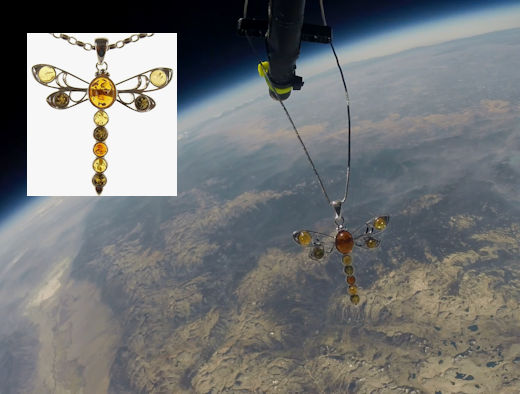
You can have it for $169.95. Made of genuine Baltic Amber with a sterling silver exoskeleton, the rich Cognac-colored pendant measures 3/4 inch and comes with a matching 18-inch sterling silver chain.
The students are selling space pendants to pay the helium bill for their cosmic ray ballooning program. Each one comes with a greeting card showing the ornament in flight and telling the story of its trip to the stratosphere and back again.
Far Out Gifts: Earth to Sky Store
All sales support hands-on STEM education
Realtime Space Weather Photo Gallery
Free: Spaceweather.com Newsletter
Realtime Comet ATLAS Photo Gallery
Free: Spaceweather.com Newsletter