A CME IS HEADING FOR INTERSTELLAR COMET ATLAS: How often does a CME from our sun strike a comet from interstellar space? Almost never--so tomorrow’s collision is worth watching. According to a NASA forecast model, a CME launched on Sept. 19th will reach Comet 3I/ATLAS on Sept. 24th or 25th. CMEs hitting Solar System comets have been known to kink or even disconnect their tails. What happens to an interstellar comet is anyone’s guess.
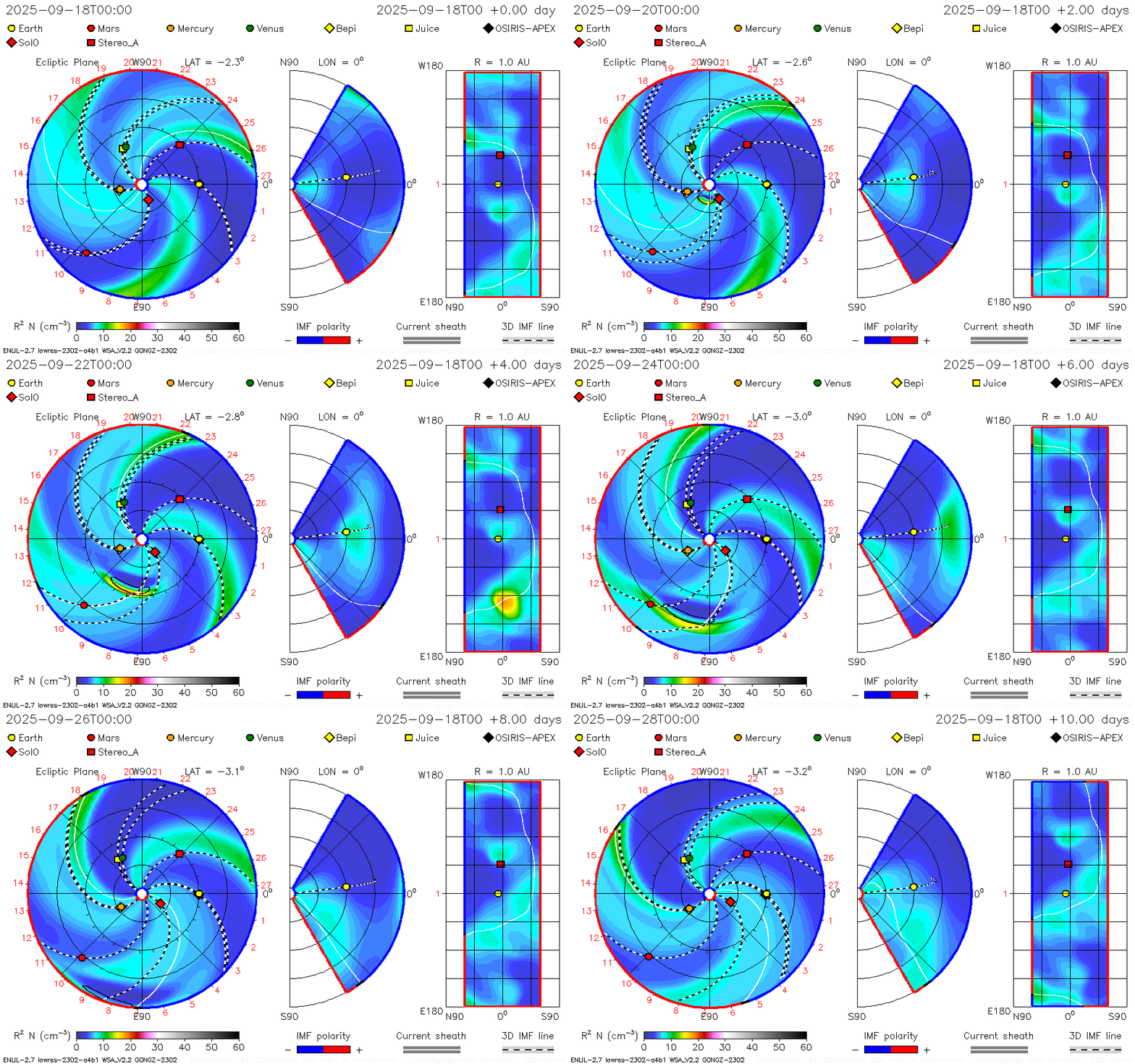
The timing is fortuitous. The potential impact comes only a week before the comet disappears into the sun’s glare, giving astronomers a narrow window to record the event. It also coincides with the comet’s recent brightening--a 40-fold increase since the beginning of September.
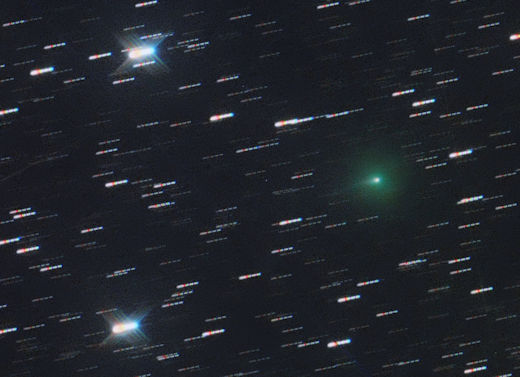
Gerald Rhemann and Michael Jäger took this picture of the comet on Sept. 17th. "We can confirm Thomas Lehmann’s recent detection of the comet’s increase in brightness," says Jäger. Since September began, it has jumped in magnitude from +16 to +12.
Most of the brightness increase is in one color: green. This suggests a surge of gas production as the comet nears the sun. The key compound is diatomic carbon (C2), which glows emerald when energized by solar UV radiation.
This plot from Marshall Eubanks of Space Initiatives, Inc. shows what is probably happening:
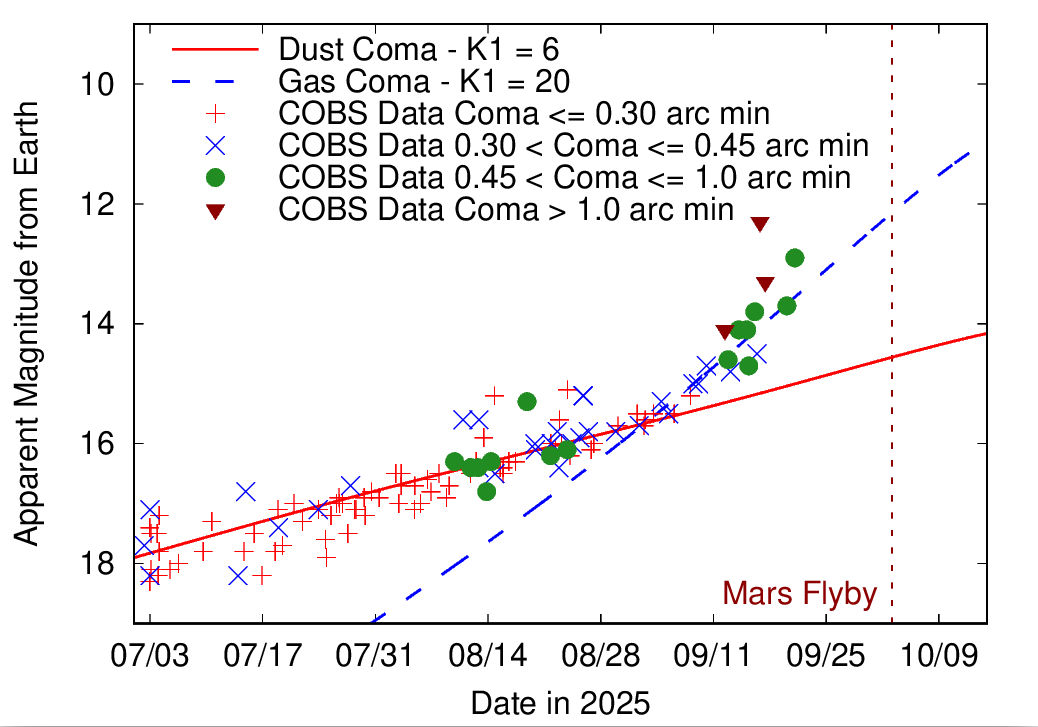
His model breaks the comet's brightness into two pieces--a contribution from dust (red line) and a contribution from gas (blue dashed line). The surging gas component is making the comet bright just in time for its early-October encounter with Mars and a fleet of spacecraft orbiting the Red Planet. We will cover *that* later this week. Stay tuned!
Thanks! To Marshall Eubanks for noticing and pointing out the CME-comet encounter.
Realtime Comet ATLAS Photo Gallery
Free: Spaceweather.com Newsletter
SOLAR ECLIPSE OBSERVED FROM SPACE (UPDATED): This could be a first. On Sept. 21st, NOAA's CCOR-1 coronagraph onboard GOES-19 observed a solar eclipse from Earth orbit. Watch the lights go out as the Moon zig zags between the satellite and the sun:
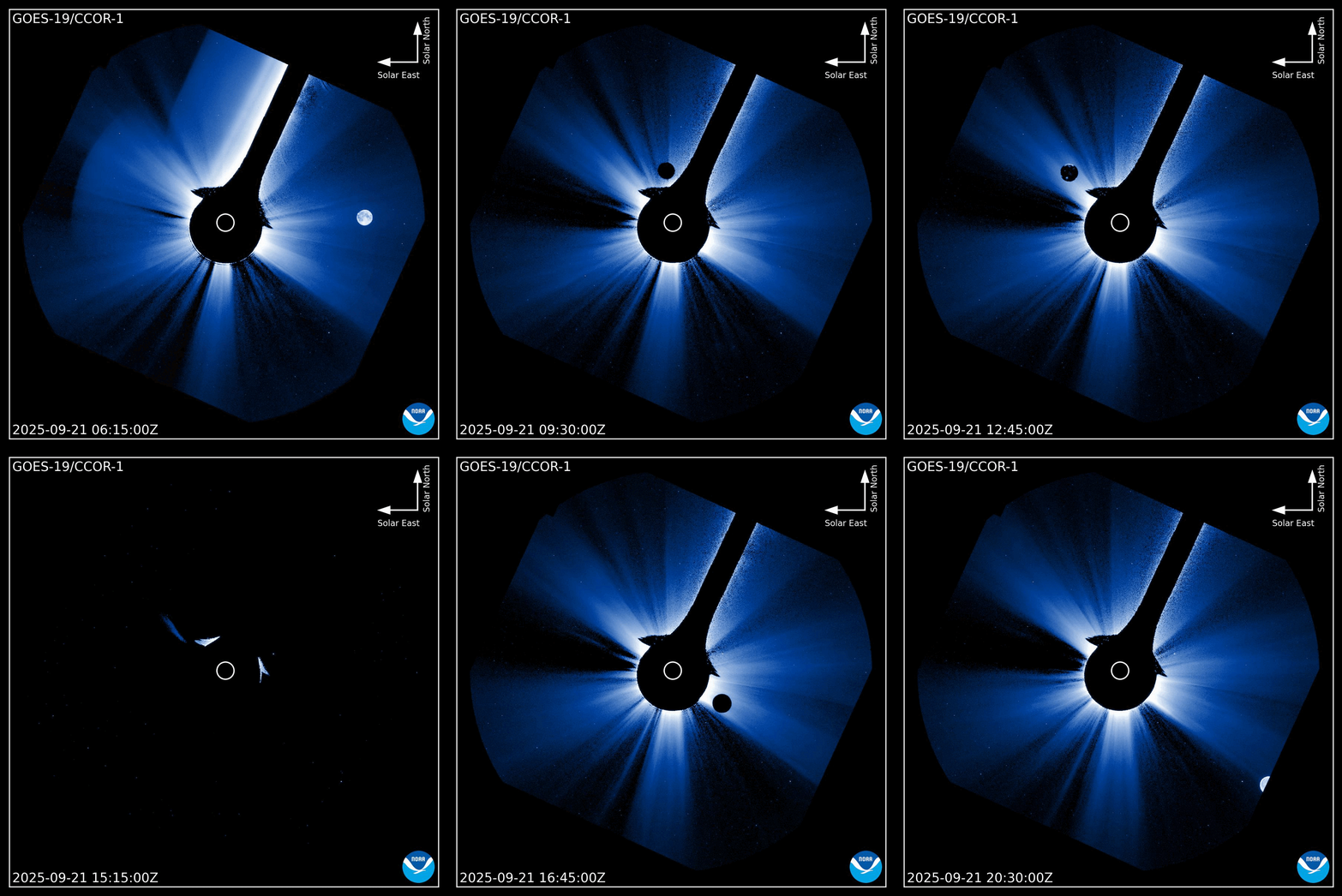
To our knowledge, this is the first natural solar eclipse ever observed by a space-based coronagraph. CCOR-1 is the first coronagraph in Earth's orbit, where such an event could be seen.
Coronagraphs are designed to create artificial eclipses, blocking the glare of the sun so that space weather forecasters can see faint CMEs. That makes Sunday's event an eclipse of an eclipse.
Regular readers of spaceweather.com may know that the Moon zips through CCOR-1's field of view once a month. Usually it crosses in a straight line. We're not sure why it zig-zagged this time, but it may be related to a yaw flip maneuver scheduled on Sept. 22nd to help calibrate the coronagraph.
Update: During the eclipse, the Moon covered only the disk of the sun, yet the entire corona vanished. If you're wondering why, Bill Thompson of the Goddard Space Flight Center has the answer: "It's a result of image processing," he explains. "Normally, each image seen by CCOR-1's detector is a combination of the corona and bright sunlight scattered within the telescope. A model of the scattered light is subtracted to reveal the corona. During the eclipse, the scattered light went away, but the subtraction proceded as if it hadn't. It ended up subtracting too much."
Realtime Solar Eclipse Photo Gallery
Free: Spaceweather.com Newsletter
AMBER SPACE DRGONFLY: This dragonfly has touched space. On Sep. 15, 2025, the students of Earth to Sky Calculus launched it to the stratosphere onboard a cosmic ray research balloon, 101,148 feet above California's Sierra Nevada mountains:
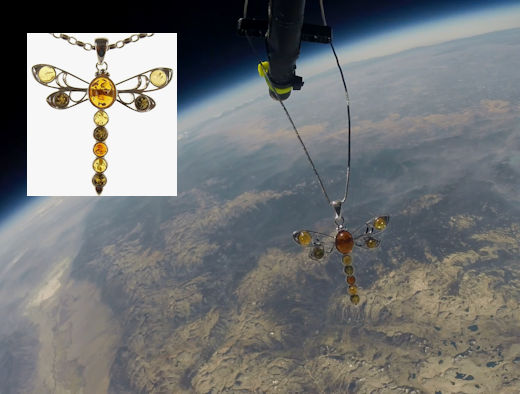
You can have it for $169.95. Made of genuine Baltic Amber with a sterling silver exoskeleton, the rich Cognac-colored pendant measures 3/4 inch and comes with a matching 18-inch sterling silver chain.
The students are selling space pendants to pay the helium bill for their cosmic ray ballooning program. Each one comes with a greeting card showing the ornament in flight and telling the story of its trip to the stratosphere and back again.
Far Out Gifts: Earth to Sky Store
All sales support hands-on STEM education
Realtime Space Weather Photo Gallery
Free: Spaceweather.com Newsletter
Realtime Aurora Photo Gallery
Free: Spaceweather.com Newsletter