MULTIPLE CMEs COULD SPARK AURORAS TOMORROW: All week long, active sunspot 4246 has been puffing CMEs toward Earth--at least three of them. Although the CMEs are individually faint and relatively slow, they could combine to cause a G2-class geomagnetic storm when they arrive on Oct. 16th. If such a storm materializes, auroras could descend into a dozen or more northern-tier US states. CME impact alerts: SMS Text.

WHY IS THIS PROMINENCE *SO* RED? In fact, all solar prominences are red. French astronomer Francois Rouviere photographed this magnificent speciment on Oct. 12th:
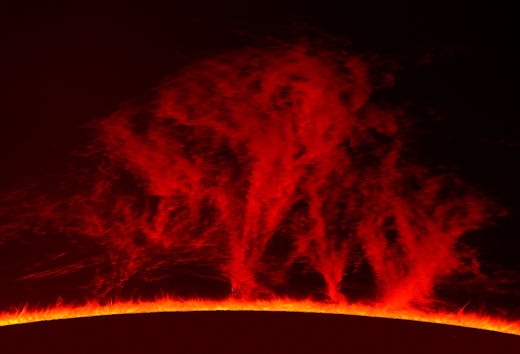
It's red because red is the color of hot hydrogen gas. At temperatures typical of the sun's lower atmosphere, hydrogen atoms transition between their 2nd and 3rd quantum energy states. The process releases photons of wavelength 656.3 nm--pure red to the human eye. It's called "hydrogen alpha" light.
Prominences are masses of hydrogen held above the surface of the sun by magnetic fields. In this case, the magnetic topology resembles a giant tree. The prominence became unstable and erupted on Oct. 13th, so this red forest has vanished.
Another has taken its place. David Wilson photographed this one on Oct. 15th:
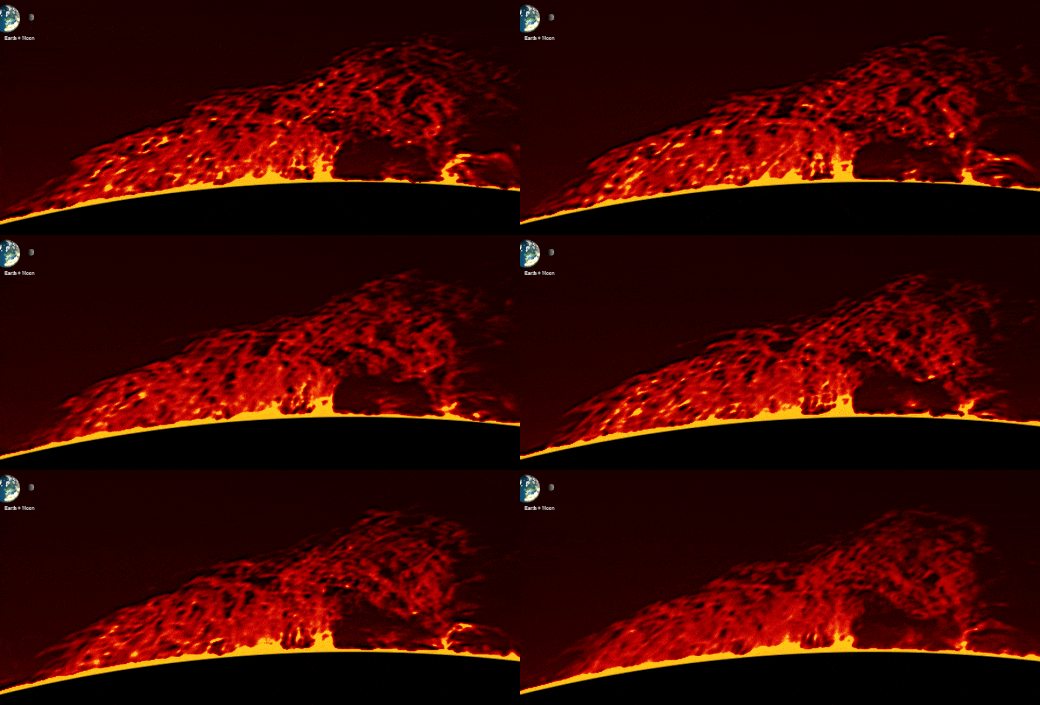
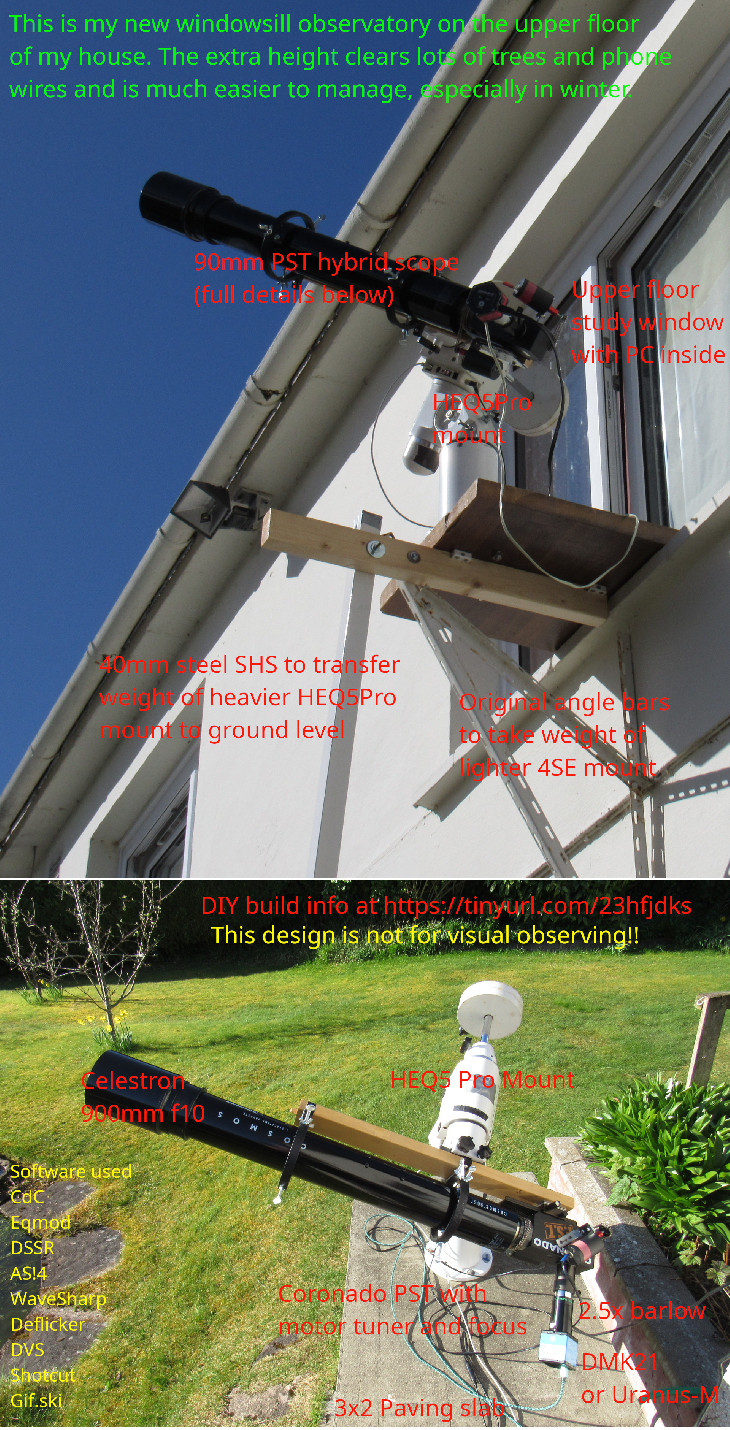
"This nice prominence is seething on the western limb of the sun today," says Wilson, a frequent photographer of the sun. "I've just built a new windowsill mount for my hydrogen-alpha scope. No more trailing kit into the garden in midwinter for me - just open the window, set up and observe in warmth!"
more images: from Philippe Tosi of Nîmes, France; from Maximilian-Vlad Teodorescu of the Institute of Space Science, Romania; from Richard Schrantz of Nicholasville, Kentucky;
Realtime Space Weather Photo Gallery
Free: Spaceweather.com Newsletter
MARTIAN SPACE SEED EXPERIMENT: This is a student science project--and you can participate. On Oct. 4, 2025, the young scientists of Earth to Sky Calculus launched six test tubes of garden seeds into the stratosphere, where they floated as high as 100,676 feet for almost three hours:
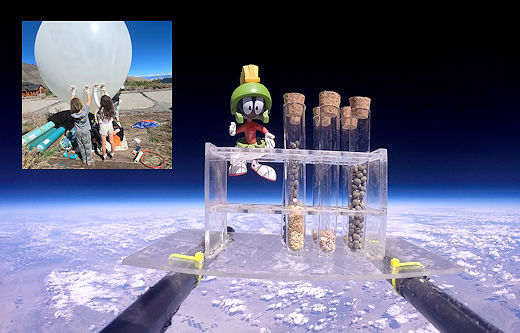
Supervised by Marvin the Martian, these okra, tomato, and jalapeño pepper seeds were exposed to temperatures as low as -63 C and cosmic ray fluxes 100x Earth-normal. In the Spring, the students will plant these seeds alongside control samples to discover the difference space travel makes.
You can do the same experiment! For $99, you can have a test tube of flown seeds and a packet of control seeds that remained on Earth. We'll be eager to hear what happens in your own space garden.
Far Out Gifts: Earth to Sky Store
All sales support hands-on STEM education
Realtime Aurora Photo Gallery
Free: Spaceweather.com Newsletter