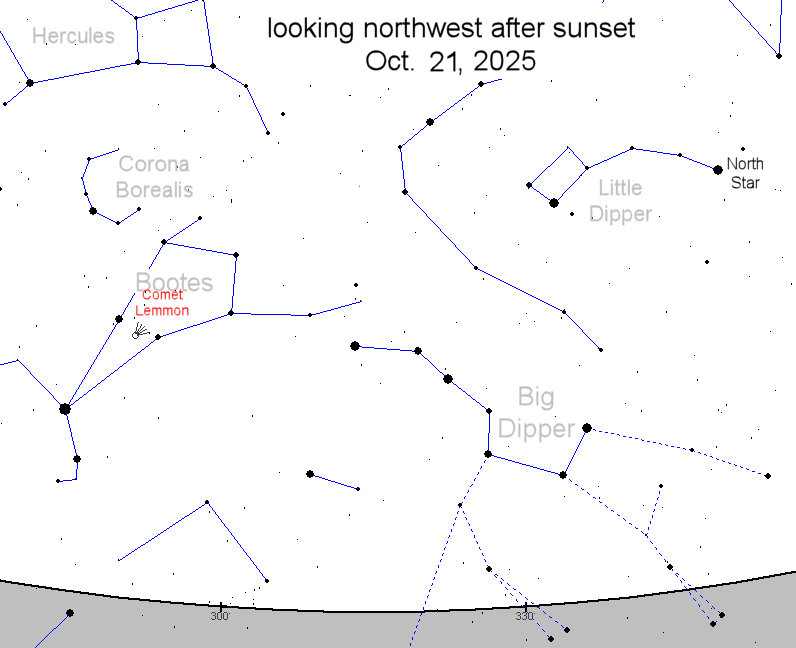
COMET LEMMON'S CLOSEST APPROACH TO EARTH: It's happening tonight. Comet Lemmon (C/2025 A6) is making its closest approach to Earth, only 0.6 AU away. The comet is about as bright as a 4th magnitude star, making it a borderline naked-eye object that looks terrific through small telescopes. Look northwest after sunset: sky map.
EARTH'S ELECTRICAL RINGS JUST SPRUNG A LEAK: This story shows how little we know. On Oct. 18th, a routine G2-class geomagnetic storm broke out when a CME passed close to Earth. What happened next was not routine. An extremely bright SAR arc cut across the night sky, stretching from the USA to Europe.
"My son and I were surprised by this red bow in the south," reports P-M Hedén, who photographed the display from Norrtälje, Sweden. It was so bright, he even captured its reflection in a local pond:
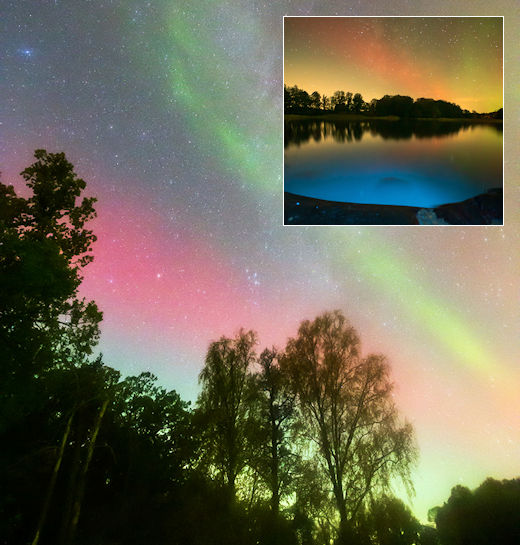
"Only a few times in a solar cycle do we get an SAR arc this bright," says Jeff Baumgardner, who has been studying the phenomenon for decades at Boston University's Center for Space Physics. "It nearly saturated our detectors."
SAR arcs appear when Earth’s ring current system springs a leak. Yes, Earth has rings. They are made of electricity, a donut-shaped circuit carrying millions of amps around our planet. The ring system is created by opposing motions of electrons and ions in Earth’s rotating magnetic field.
During strong geomagnetic storms, thermal energy from the ring current can leak into the atmosphere below, creating red lights in the sky. The ring-shaped arcs were discovered in 1956 at the dawn of the Space Age. At first, researchers didn’t know what they were and gave them a misleading name: "Stable Auroral Red arcs," or SAR arcs for short. However, they are not auroras.
This super SAR arc appeared over Maine on Oct. 18th
The storm on Oct. 18th was not strong. Nevertheless, it created one of the biggest and brightest SAR arcs in years. Some sky watchers could see it even though the human eye is famously insensitive to the arc's pure red color (630.0 nm).
Baumgardner doesn’t know why the arc was so bright. He says it was 10 to 30 times brighter than a G2 storm would typically produce. "We need to gather more information."
Meanwhile, sky watchers should remain alert for SAR arcs. Apparently, we don’t know when a bright one will appear.
more images: from Bengt Flodqvist of southern Öland, Sweden; from Carla Sanders of Searsport, Maine; from Janne-Kalle Räsänen of southern Finland;
Realtime Space Weather Photo Gallery
Free: Spaceweather.com Newsletter
DARK MATTER COINS FROM SPACE: These coins are not actually made of Dark Matter, but they are inscribed with the words "Dark Matter" -- and you can spend them. The US Mint has created a series of quarters honoring astronomer Vera Rubin, who discovered dark matter in galaxies. On Sept. 6, 2025, the students of Earth to Sky Calculus flew them to the edge of space:
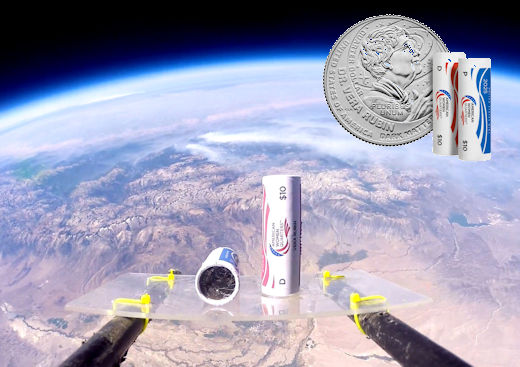
You can have two unbroken rolls for $199.95. The coin's design features a profile of Dr. Vera Rubin gazing upward, smiling as she contemplates the cosmos. She is surrounded by a spiral galaxy and other celestial bodies.
One of the rolls is D Mint, the other P Mint, so you'll have a complete set. You'll also receive a greeting card showing the coins in flight and telling the story of its journey to the edge of space.
Don't need a whole roll? You can buy a single coin for only $39.95.
Far Out Gifts: Earth to Sky Store
All sales support hands-on STEM education
HYDROGEN TRACER FIRE: Magnetic fields on the sun are strong. Yesterday, amateur astronomer David Wilson caught them effortlessly holding a trillion kilograms of hydrogen 50,000 km above the surface of the sun:
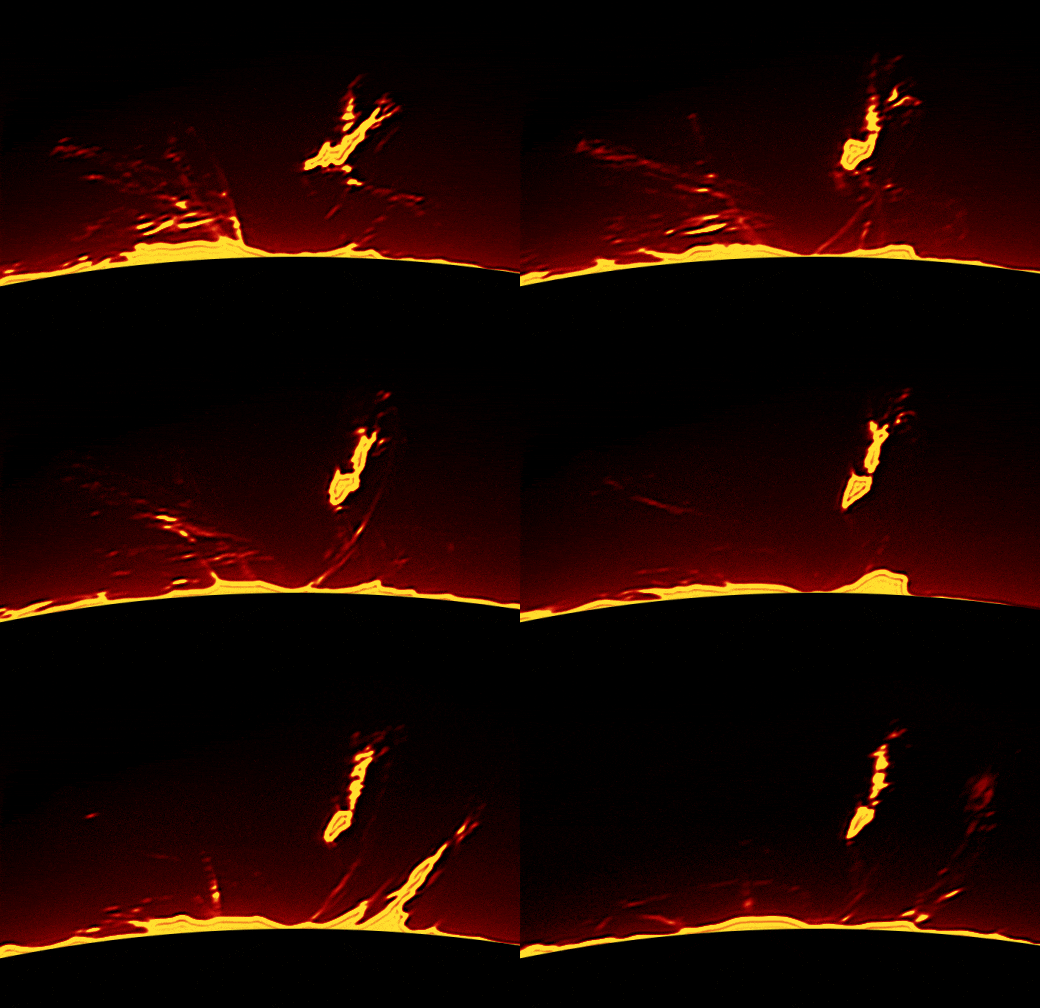
"This was a strange prominence on the western limb," says Wilson. "It had a very bright plasma blob suspended in space with lots of fainter streamers writhing around it. The colors reminded me of tracer fire over a city in WW2."
The glowing globule Wilson photographed was about the same size as Earth, but vastly lighter. A trillion kilograms (1012) is roughly the mass of a small comet. It is a vivid reminder of how tenuous the sun’s outer atmosphere really is.
Still, have you ever tried to lift a trillion kilograms?
Realtime Space Weather Photo Gallery
Free: Spaceweather.com Newsletter
Realtime Aurora Photo Gallery
Free: Spaceweather.com Newsletter