AURORAS SURROUND COMET LEMMON--AGAIN: Comet Lemmon's close approach to Earth on Oct. 21st coincided with the onset of autumnal aurora season. The resulting photo-ops have been superb. Here's the comet surrounded by red oxygen auroras over Germany, and purple nitrogen auroras over Alaska. Photographers, submit your images here.
MAJOR FARSIDE EXPLOSION: Something exploded on the farside of the sun yesterday (late on Oct. 21st). The blast produced an exceptionally fast and potent CME, shown here in an animation from the Solar and Heliospheric Observatory (SOHO):
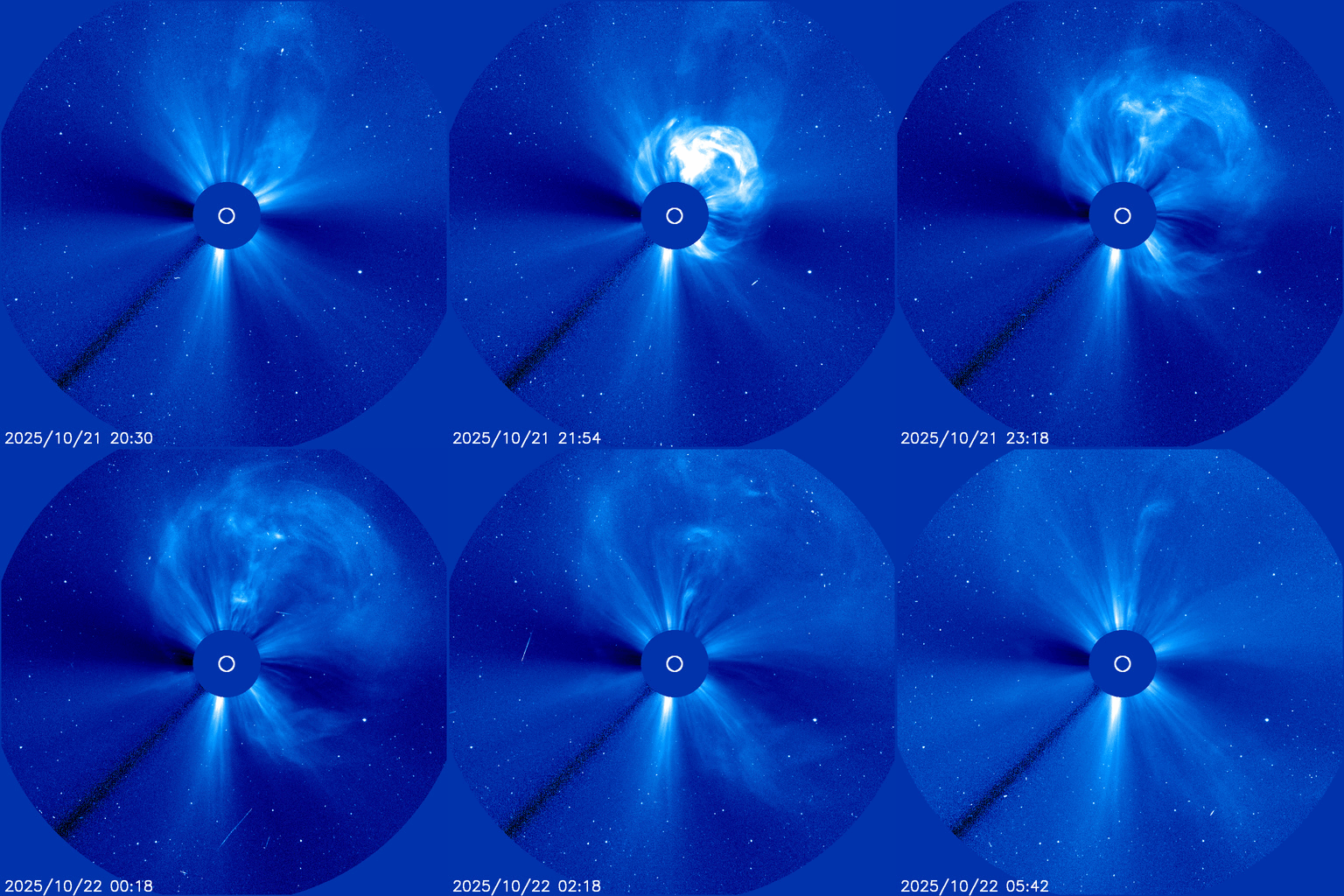
The USAF reported Type II radio emissions from this CME with high-velocity drift rates: 2474 km/s--a sign of fast-moving shocks inside the CME. Only a handful of CMEs in the Space Age have moved significantly faster, such as the great CME of Aug. 1972 (2850 km/s) and a CME propelled by an X8 flare in Sept. 2017 (2600–3300 km/s).
If the CME hit Earth, we would almost certainly experience a strong geomagnetic storm. Instead, it is going to hit Venus (as early as Oct. 23rd according to this NASA model). Venus does not have an internally generated global magnetic field to protect it, so the impact will erode some gas from the planet's cloudtops. Venus's crushingly-thick atmosphere won't notice.
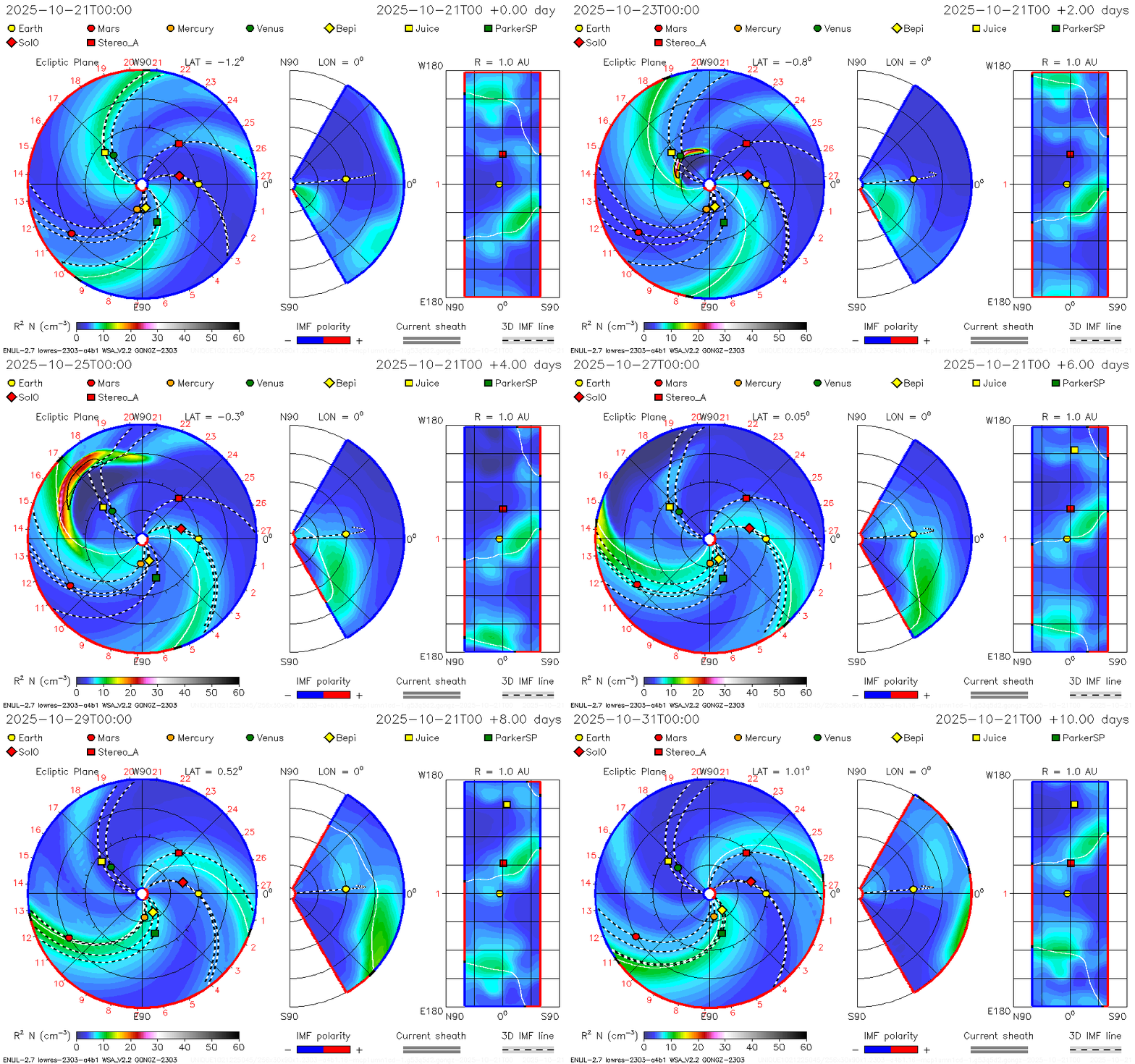
The source of this explosion approximately matches the location of old sunspot 4246, currently transiting the farside of the sun. Only a week ago, that dangerous sunspot was facing Earth. ==> We have dodged a bullet. Solar flare alerts: SMS Text.
Realtime Space Weather Photo Gallery
Free: Spaceweather.com Newsletter
MILKY WAY IN A CRYSTAL BALL: Are you looking for a big gift? How about the entire Milky Way? The students of Earth to Sky Calculus have launched our own galaxy to the stratosphere onboard a cosmic ray research balloon. Here it is 113,517 feet above the Sierra Nevada mountains of central California:
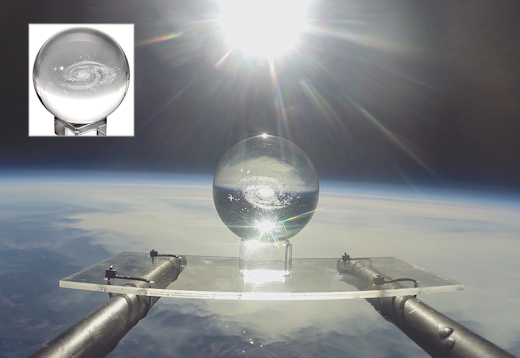
You can have it for $119.95. The galaxy is laser etched inside a 60 mm crystal sphere. You can turn it in your hands, inspecting the spiral star system from any angle. The gift-boxed sphere comes with a greeting card showing the item in flight and telling the story of its journey to the edge of space.
Far Out Gifts: Earth to Sky Store
All sales support hands-on STEM education
EARTH'S ELECTRICAL RINGS JUST SPRUNG A LEAK: This story shows how little we know. On Oct. 18th, a routine G2-class geomagnetic storm broke out when a CME passed close to Earth. What happened next was not routine. An extremely bright SAR arc cut across the night sky, stretching from the USA to Europe.

"My son and I were surprised by this red bow in the south," reports P-M Hedén, who photographed the display from Norrtälje, Sweden. It was so bright, he even captured its reflection in a local pond:
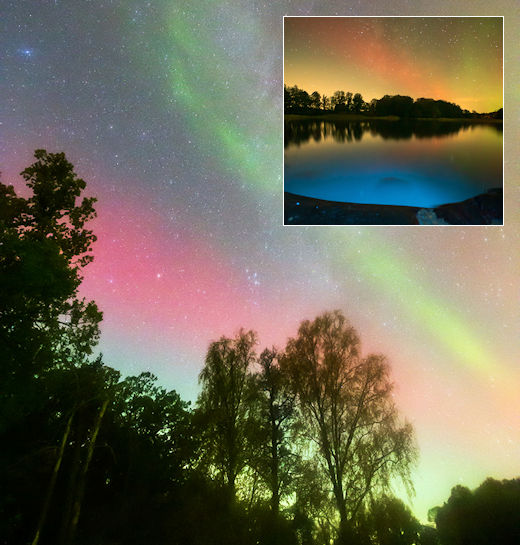
"Only a few times in a solar cycle do we get an SAR arc this bright," says Jeff Baumgardner, who has been studying the phenomenon for decades at Boston University's Center for Space Physics. "It nearly saturated our detectors."
SAR arcs appear when Earth’s ring current system springs a leak. Yes, Earth has rings. They are made of electricity, a donut-shaped circuit carrying millions of amps around our planet. The ring system is created by opposing motions of electrons and ions in Earth’s rotating magnetic field.
During strong geomagnetic storms, thermal energy from the ring current can leak into the atmosphere below, creating red lights in the sky. The ring-shaped arcs were discovered in 1956 at the dawn of the Space Age. At first, researchers didn’t know what they were and gave them a misleading name: "Stable Auroral Red arcs," or SAR arcs for short. However, they are not auroras.
This super SAR arc appeared over Maine on Oct. 18th
The storm on Oct. 18th was not strong. Nevertheless, it created one of the biggest and brightest SAR arcs in years. Some sky watchers could see it even though the human eye is famously insensitive to the arc's pure red color (630.0 nm).
Baumgardner doesn’t know why the arc was so bright. He says it was 10 to 30 times brighter than a G2 storm would typically produce. "We need to gather more information."
Meanwhile, sky watchers should remain alert for SAR arcs. Apparently, we don’t know when a bright one will appear.
more images: from Bengt Flodqvist of southern Öland, Sweden; from Carla Sanders of Searsport, Maine; from Janne-Kalle Räsänen of southern Finland; from Laura Kranich near Berlin, Germany
Realtime Space Weather Photo Gallery
Free: Spaceweather.com Newsletter
Realtime Aurora Photo Gallery
Free: Spaceweather.com Newsletter