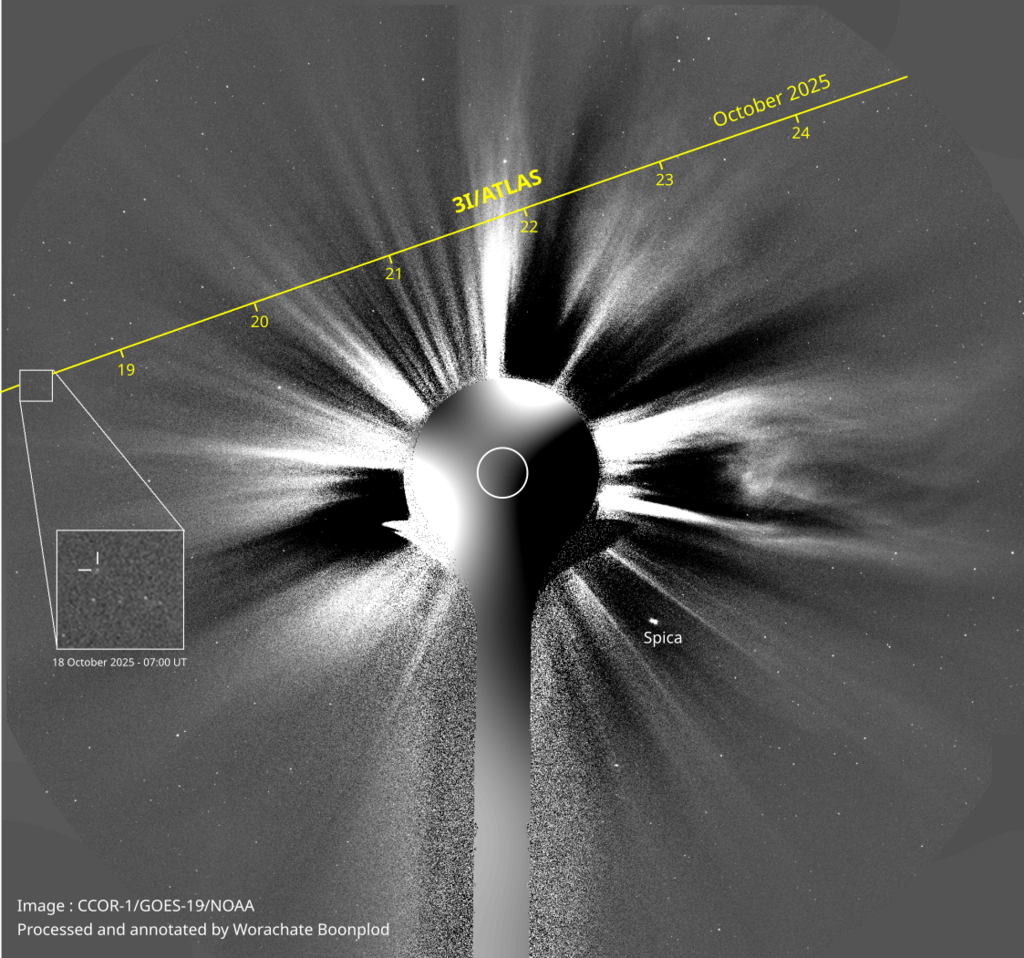
INTERSTELLAR COMET ATLAS *IS* VISIBLE FROM EARTH: Supposedly, Comet 3I/ATLAS cannot be seen from Earth as it passes behind the sun this month. However, Thai amateur astronomer Worachate Boonplod realized that it is visible, after all. Boonplod found it in daily images from NOAA's CCOR-1 coronagraph. The Earth-orbiting instrument will be able to track the comet and monitor its brightness as it approaches perihelion.
DID YOU CATCH COMET LEMMON? On Oct. 21st, Comet Lemmon (C/2025 A6) made its closest approach to Earth. Did you catch it? Wioleta Gorecka did:
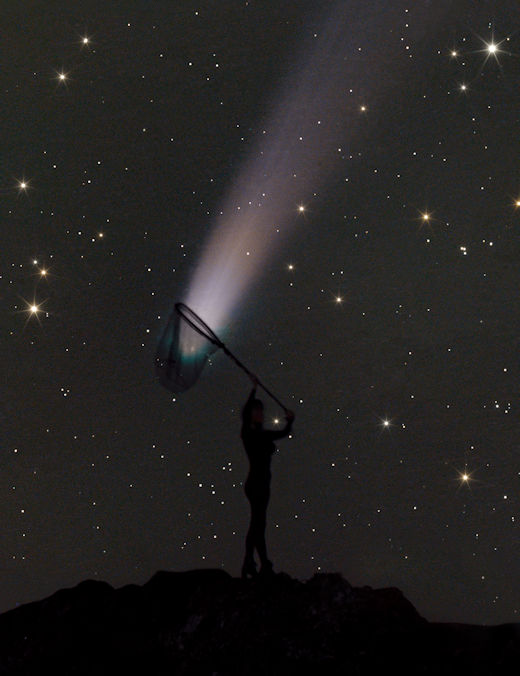
"This photo was taken in Iceland near Reykjavik," says Gorecka. "I like to tell short stories through photos. This time it was a fisher(wo)man's attempt to catch a comet."
The comet is receding from Earth now, but good news: It is still brightening. Multiple observers reporting to the Comet Observation Database estimate it is near m=+3.8. This is because the comet is approaching the sun for a 0.53 AU perihelion Nov. 8th. Solar heat is boosting its brightness. The comet will therefore remain a splendid target for astrophotographers for weeks to come.
Realtime Comet Photo Gallery
Free: Spaceweather.com Newsletter
FARSIDE EXPLOSION (UPDATED): Late on Oct. 21st, something exploded on the farside of the sun. The blast produced a fast and potent CME, shown here in an animation from the Solar and Heliospheric Observatory (SOHO):
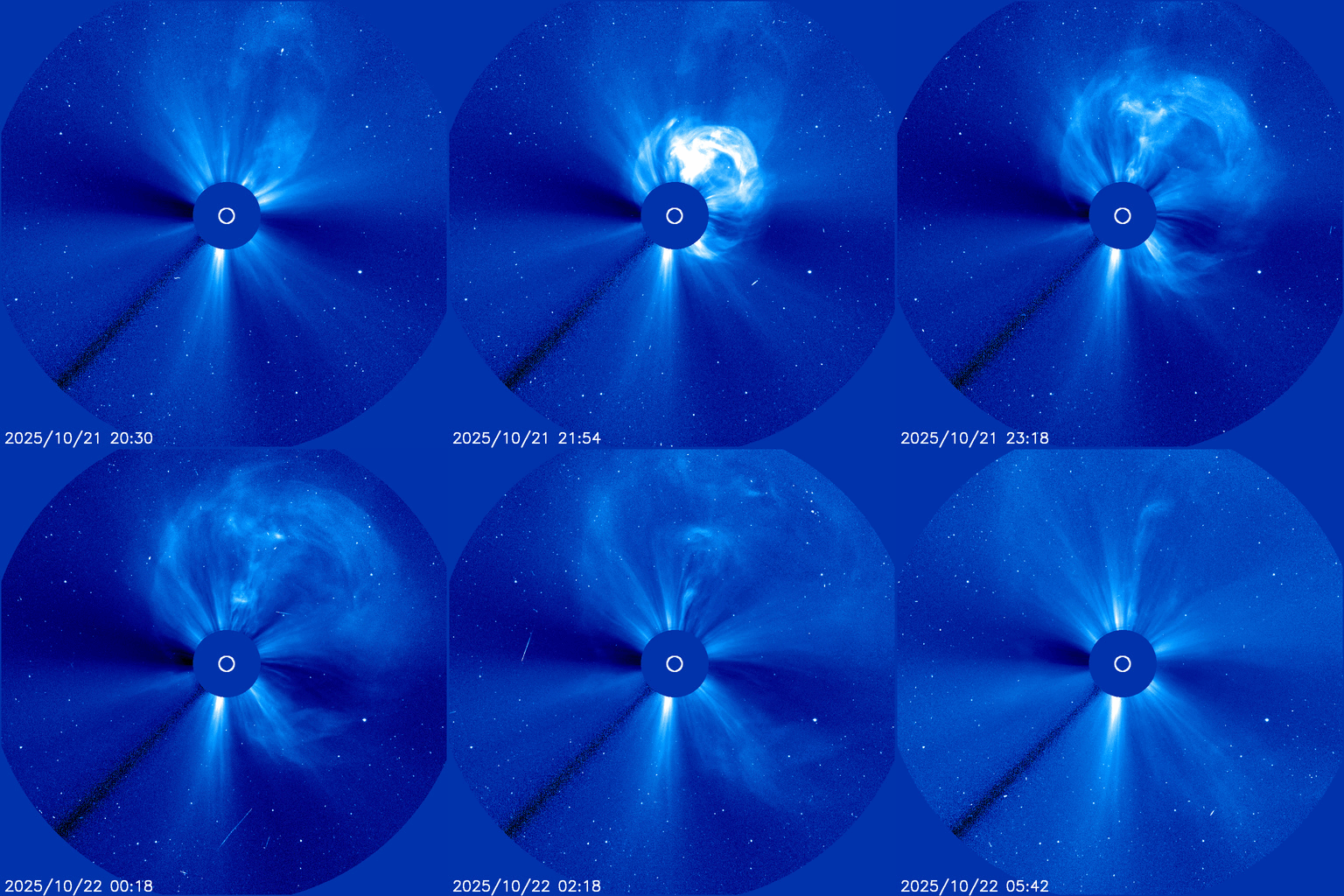
The USAF reported Type II radio emissions from this CME with high-velocity drift rates: 2474 km/s--a sign of fast-moving shocks inside the CME. Only a handful of CMEs in the Space Age have moved significantly faster, such as the great CME of Aug. 1972 (2850 km/s) and a CME propelled by an X8 flare in Sept. 2017 (2600--3300 km/s).
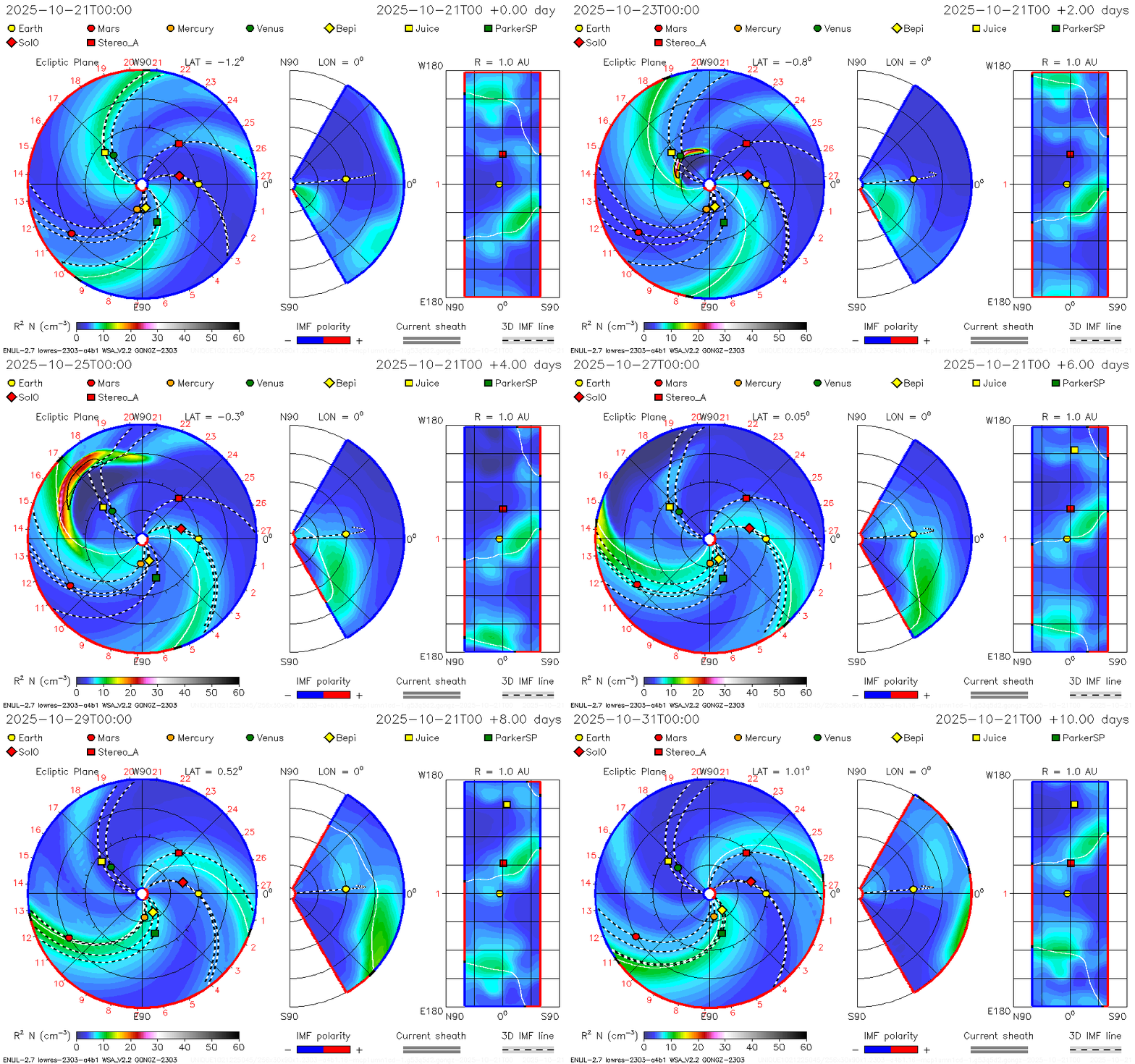
Update: New 3D models of this CME from NASA's Moon to Mars Space Weather Analysis Office suggest a lower speed, around 1320 km/s. This is still very fast, but not the record-setter indicated by Type II solar radio emissions.
According to a NASA model, the CME just hit Venus. Venus does not have an internally generated global magnetic field to protect it, so the impact probably eroded some gas from the planet's cloudtops. Venus's crushingly-thick atmosphere won't notice.
The source of the explosion approximately matches the location of old sunspot 4246, currently transiting the farside of the sun. Only a week ago, that dangerous sunspot was facing Earth. ==> We dodged a bullet. Solar flare alerts: SMS Text.
Realtime Space Weather Photo Gallery
Free: Spaceweather.com Newsletter
MILKY WAY IN A CRYSTAL BALL: Are you looking for a big gift? How about the entire Milky Way? The students of Earth to Sky Calculus have launched our own galaxy to the stratosphere onboard a cosmic ray research balloon. Here it is 113,517 feet above the Sierra Nevada mountains of central California:
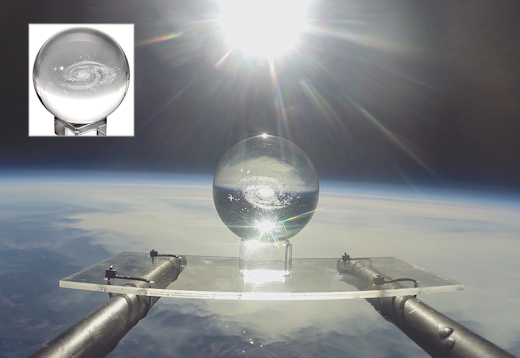
You can have it for $119.95. The galaxy is laser etched inside a 60 mm crystal sphere. You can turn it in your hands, inspecting the spiral star system from any angle. The gift-boxed sphere comes with a greeting card showing the item in flight and telling the story of its journey to the edge of space.
Far Out Gifts: Earth to Sky Store
All sales support hands-on STEM education
Realtime Aurora Photo Gallery
Free: Spaceweather.com Newsletter