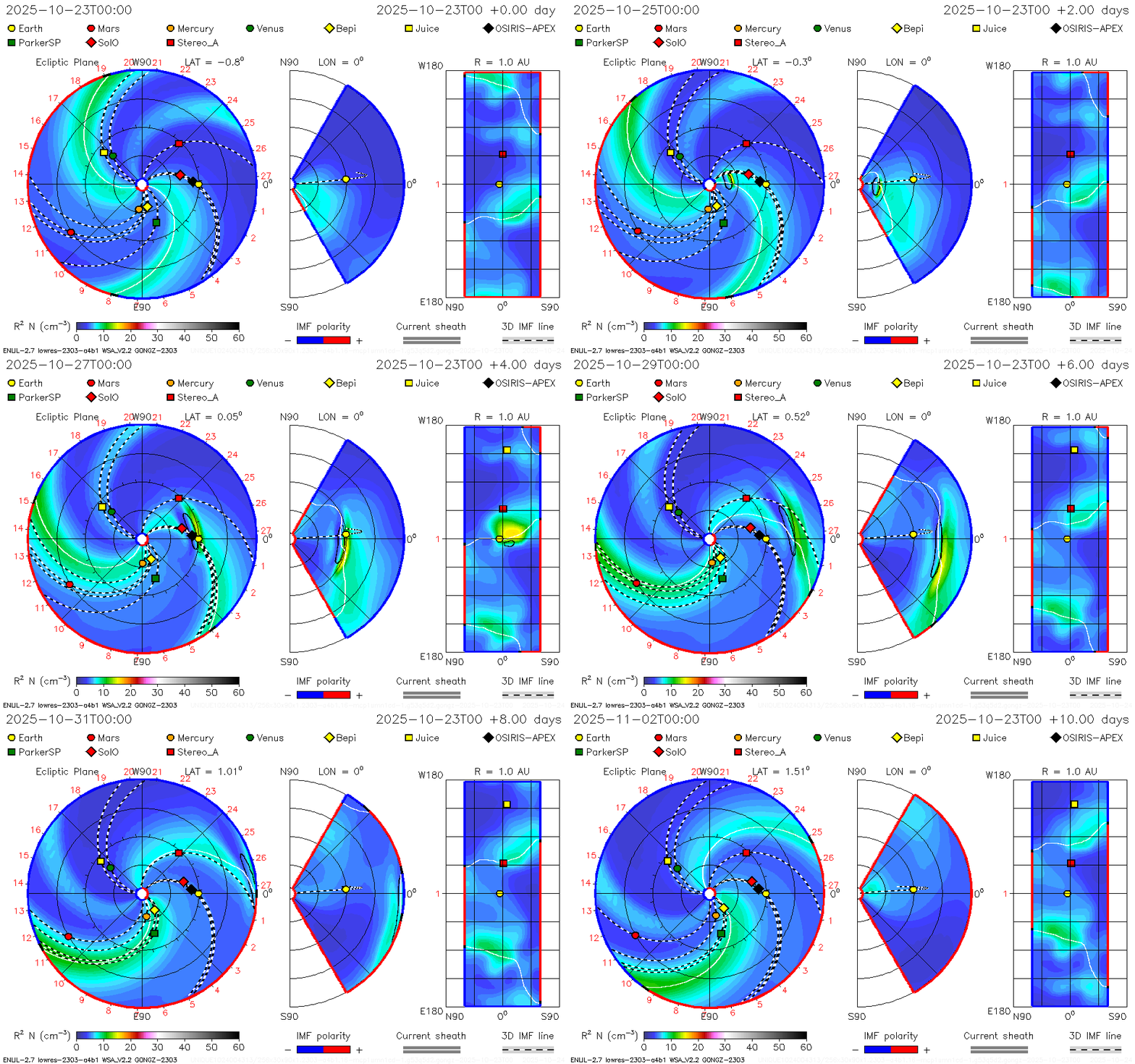
POSSIBLE EARTH-DIRECTED CME: A CME that left the sun during the late hours of Oct. 23rd might reach Earth this weekend. NASA models suggest a direct hit on Oct. 26/27, bringing a chance of minor G1-class geomagnetic storms. This is a low confidence forecast. Several overlapping CMEs left the sun on Oct 23rd, and they were tricky to untangle. CME impact alerts: SMS Text.

COMET 3I/ATLAS IS NOT HIDING FROM EARTH: This week the internet is buzzing with headlines like "Mysterious Object Is Up to No Good While It’s Hidden Behind the Sun." They're referring to interstellar Comet 3I/ATLAS. Harvard astronomer Avi Loeb and others have suggested it might be a spaceship deliberately hiding from humans. There's just one problem with this argument: We can still see it from Earth.
For example, the CCOR-1 coronagraph onboard NOAA's GOES-19 satellite is tracking the comet and monitoring its brightness:
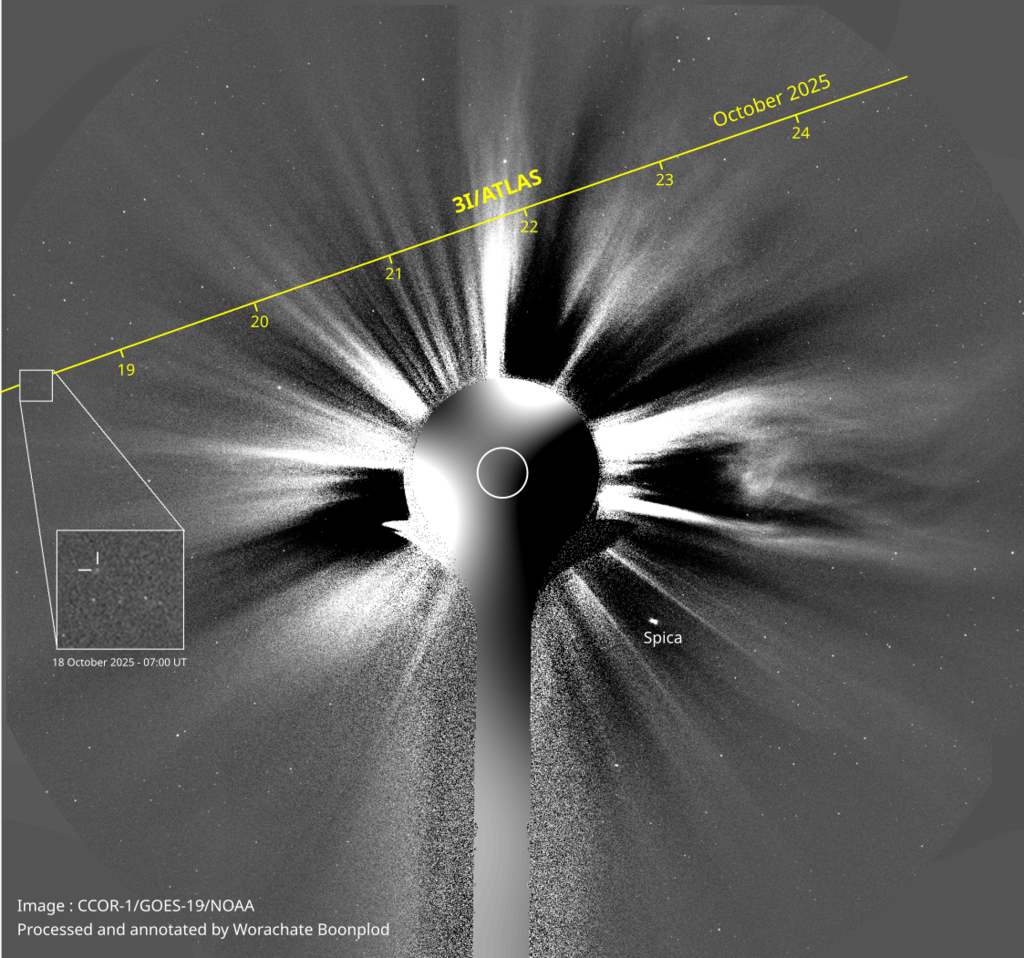
Thai amateur astronomer Worachate Boonplod found the comet in CCOR-1 data
So is NASA's quartet of PUNCH spacecraft, and coronagraphs onboard the Solar and Heliospheric Observatory (SOHO, not far from Earth). Comet 3I/ATLAS is under constant surveillance.
"Unless 3I/ATLAS fades substantially in the next couple of days, we should be able to keep eyeballs on it right through its perihelion (closest approach to the sun)," says coronagraph expert Karl Battams.
Tracking the comet is not easy because it is so faint. Battams explains how it is done: "Objects at the threshold of detection like 3I/ATLAS are a challenge for coronagraphs. We often have to employ image stacking techniques. For this to work, we have to have a very precise understanding of the pointing and distortion of the telescopes so that we can find the exact pixels that correspond to the comet. It gets fiddly, but we make it work."
If 3I/ATLAS changes direction or surges in brightness, we will know. So far, it's acting like a comet. T. Marshall Eubanks from Space Initiatives Inc assembled this light curve, including recent data from CCOR-1 and PUNCH:

These data confirm that 3I/ATLAS is following a fairly standard model of comet brightness with contributions from gas and dust. If this is a spacecraft, it is wearing an uncanny disguise.
In December, 3I/ATLAS will emerge from the glare of the sun. Telescopes on Earth's surface can then rejoin the monitoring effort. Our bet: They will see a comet, not a spaceship. Stay tuned.
Realtime Space Weather Photo Gallery
Free: Spaceweather.com Newsletter
MILKY WAY IN A CRYSTAL BALL: Are you looking for a big gift? How about the entire Milky Way? The students of Earth to Sky Calculus have launched our own galaxy to the stratosphere onboard a cosmic ray research balloon. Here it is 113,517 feet above the Sierra Nevada mountains of central California:
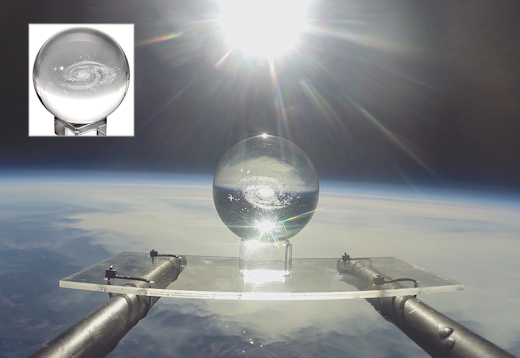
You can have it for $119.95. The galaxy is laser etched inside a 60 mm crystal sphere. You can turn it in your hands, inspecting the spiral star system from any angle. The gift-boxed sphere comes with a greeting card showing the item in flight and telling the story of its journey to the edge of space.
Far Out Gifts: Earth to Sky Store
All sales support hands-on STEM education
Realtime Aurora Photo Gallery
Free: Spaceweather.com Newsletter