3I/ATLAS AT PERIHELION: Is Comet 3I/ATLAS really a spaceship? We’re about to find out. On Oct. 29th, the interstellar object will make its closest approach to the sun. Perihelion is the perfect time to perform a Solar Oberth maneuver or to deploy stealthy probes. If we see any unexpected non-gravitational acceleration, artificial lights, or excess heat (engine activity), it could point to alien tech. Otherwise, 3I/ATLAS is what it appears to be--a comet. Contrary to widespread reports, we can see 3I/ATLAS from Earth, so this will be a legitimate "acid test" of the spaceship hypothesis.
WHAT HAPPENED 22 YEARS AGO? Answer: A history-making solar storm. This excerpt from the Oct. 28, 2003, edition of Spaceweather.com says it all:
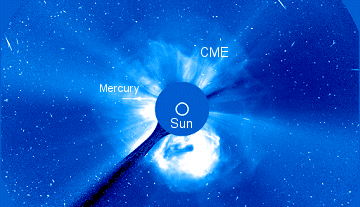
"One of the most powerful solar flares in years erupted from giant sunspot 486 this morning at approximately 1110 UT. The blast measured X17 on the Richter scale of solar flares. As a result of the explosion, a strong S3-class solar radiation storm is underway. The explosion also hurled a coronal mass ejection (CME) toward Earth. When it left the sun, the cloud was traveling 2125 km/s (almost 5 million mph). This CME could trigger bright auroras when it sweeps past our planet perhaps as early as tonight.
Above: This SOHO coronagraph image captured at 12:18 UT shows the coronal mass ejection of Oct. 28th billowing directly toward Earth. Such clouds are called halo CMEs. The many speckles are solar protons striking the coronagraph's CCD camera.
Where will the auroras appear? High-latitude sites such as New Zealand, Scandinavia, Alaska, Canada and US northern border states from Maine to Washington are favored, as usual, but auroras could descend to lower latitudes when the CME pictured above sweeps past Earth."
The prediction that "auroras could descend to lower latitudes" was one of the truest things ever said on this web site. Only 24 hours later, people in Georgia, Texas, and California were photographing an historic display of Northern Lights.
Thus, the Halloween Storms of 2003 began. Stay tuned for continuing coverage of this event as Halloween 2025 approaches.
Realtime Space Weather Photo Gallery
Free: Spaceweather.com Newsletter
VOYAGER GOLDEN RECORD: This is a must-have Christmas ornament for space fans: The Voyager Golden Record. On Oct. 31, 2023, the students of Earth to Sky Calculus launched it to the stratosphere onboard a cosmic ray research balloon:
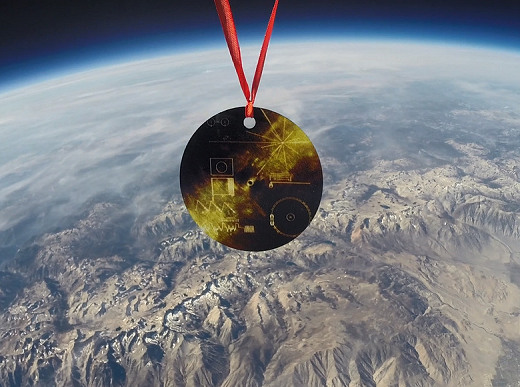
You can have it for $99.95. The 3-inch aluminum disk is imprinted with instructions for extraterrestrials, telling ET how to play the sounds of Earth. The original phonograph records are sailing through interstellar space onboard NASA's Voyager probes. Having touched the edge of space, this is the closest thing on Earth to an actual Golden Record. The ornament comes with extra materials decoding the markings on the disk.
The students are selling space ornaments to support their cosmic ray ballooning program. Each one comes with a greeting card showing the ornament in flight and telling the story of its journey to the edge of space.
Far Out Gifts: Earth to Sky Store
All sales support hands-on STEM education
Realtime Aurora Photo Gallery
Free: Spaceweather.com Newsletter