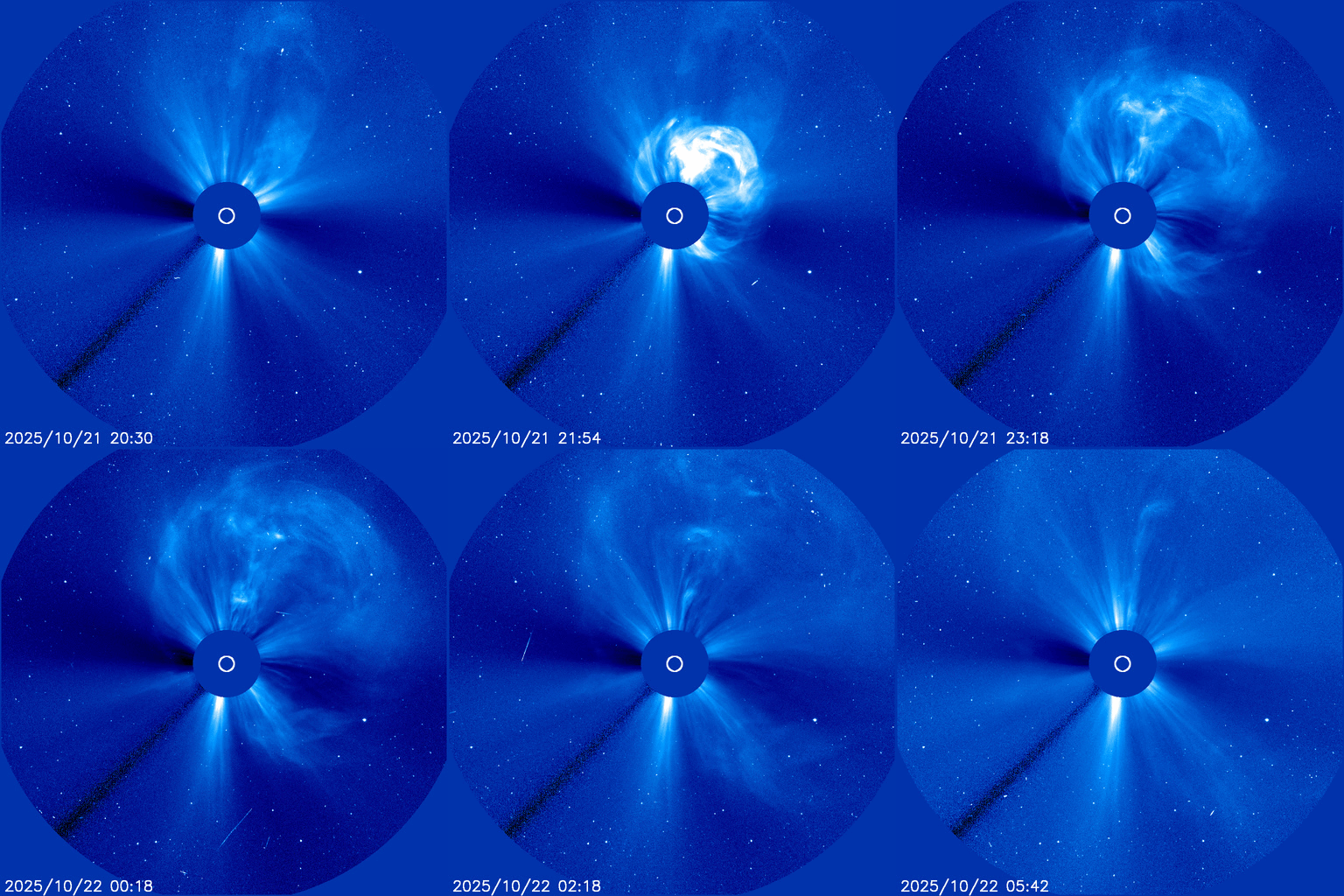
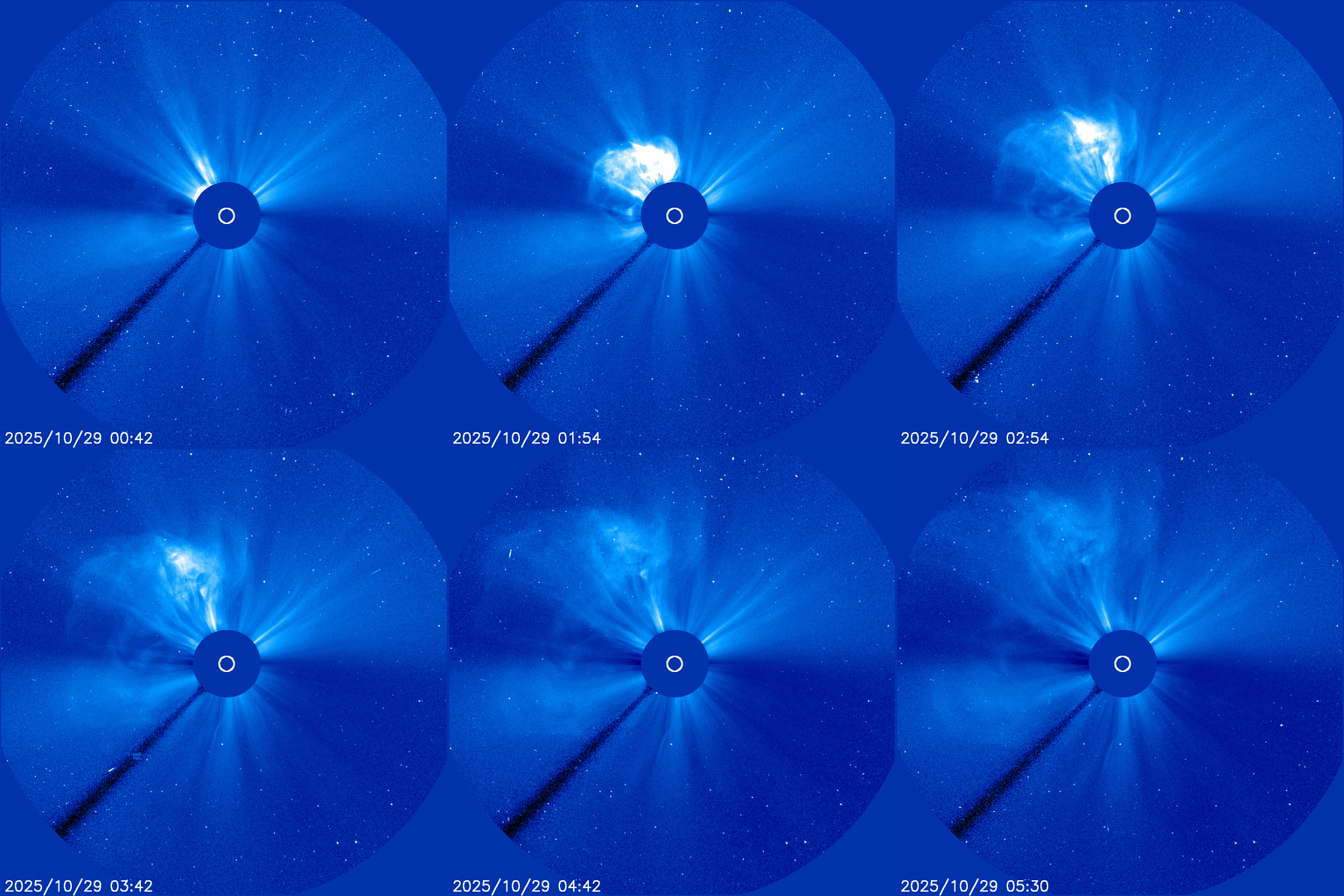
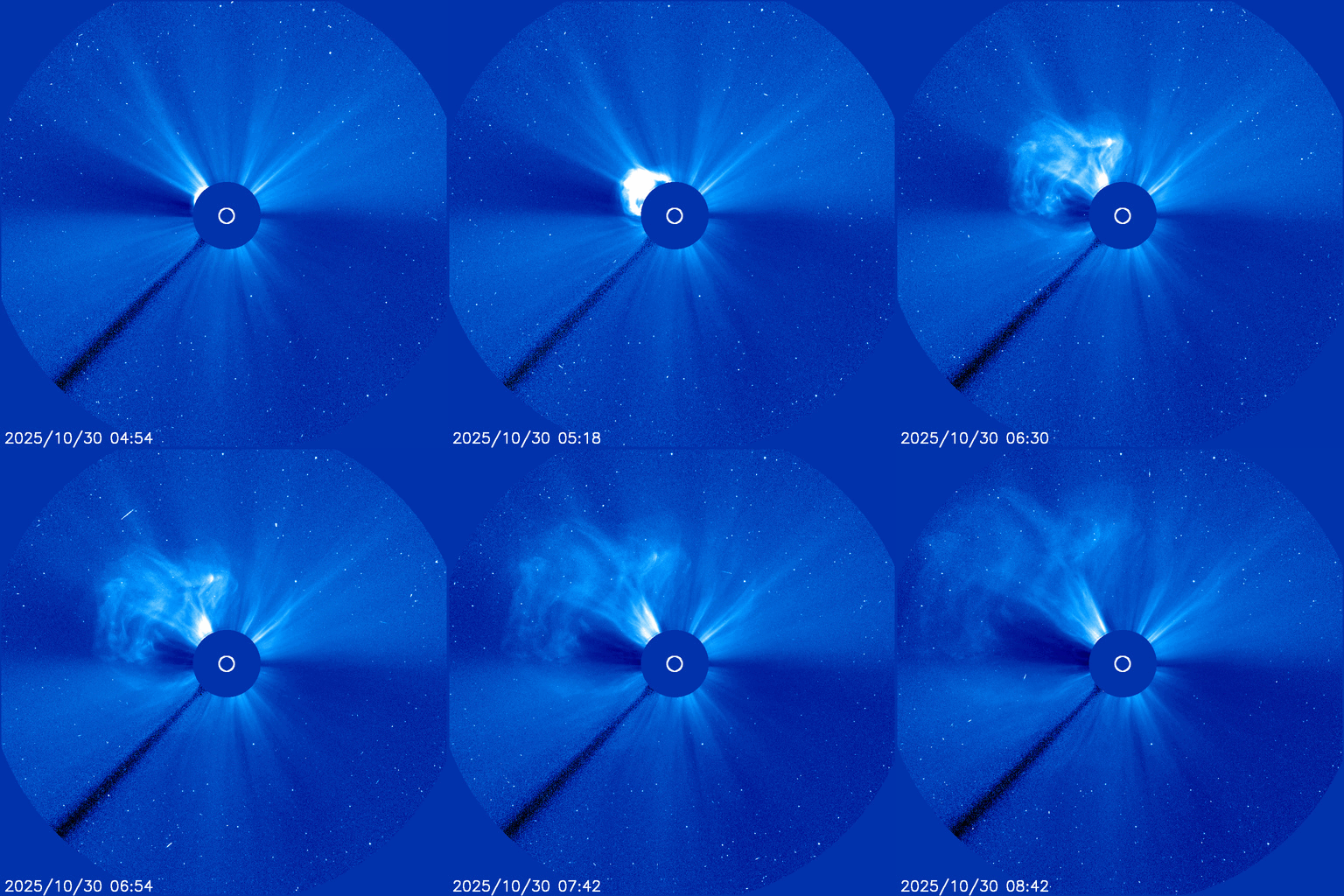
STRONG FARSIDE SOLAR ACTIVITY )(UPDATED): Earth is on the wrong side of the sun--if you love auroras. Three powerful CMEs have exploded from the sun's farside in recent days. Here they are: #1, #2, #3. All of them have missed our planet. Next week could be different. Solar rotation will soon turn the active sunspot toward Earth, and we could find ourselves in the strike zone as early as Nov. 3rd. CME impact alerts: SMS Text.
RAPID BRIGHTENING OF COMET 3I/ATLAS: Spacecraft monitoring the sun witnessed a dramatic surge in the brightness of Comet 3I/ATLAS as it plunged toward its Oct. 29th perihelion. Qicheng Zhang (Lowell Observatory) and Karl Battams (U.S. Naval Research Laboratory) reported the phenomenon in a preprint submitted to the Astrophysical Journal Letters on Oct. 28th.
"The reason for 3I’s rapid brightening, which far exceeds the brightening rate of most Oort cloud comets, remains unclear," the authors say.
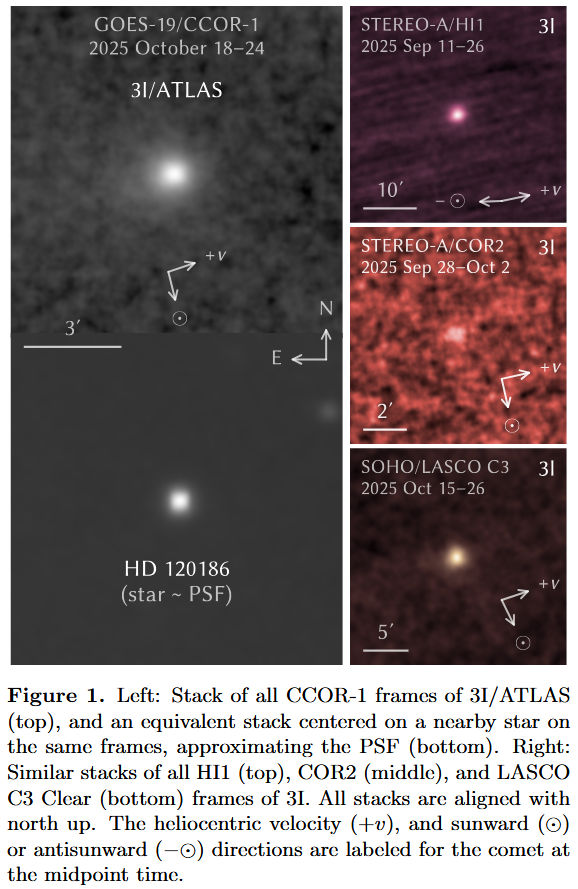
While Earth-based telescopes lost sight of the comet during its close approach to the sun, coronagraphs on spacecraft like STEREO-A, SOHO, and NOAA’s GOES-19 satellite never stopped watching. The composite image, above, shows how the comet looked to these instruments.
NOAA’s CCOR-1 coronagraph did the best job resolving the comet, showing a 4-arcminute-wide coma (atmosphere), while SOHO's C3 coronagraph collected the best color data, revealing the comet to be bluer than the sun. The blue color hints that glowing gas, not dust, now dominates its brightness.
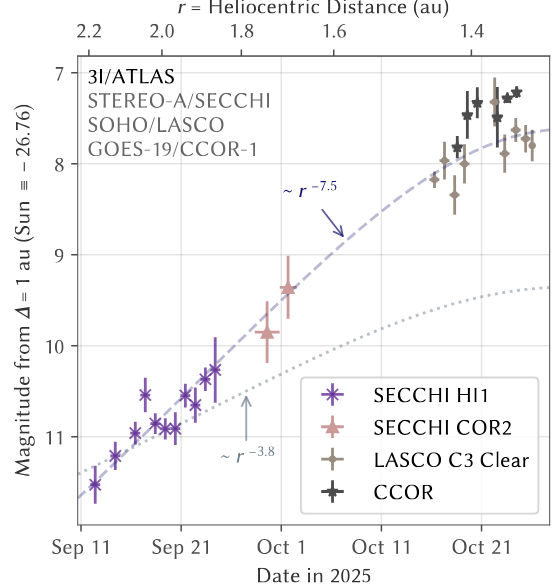 Zhang and Battams analyzed coronagraph data from September and October. They found that 3I/ATLAS has been increasing in brightness as the 7.5th power of decreasing distance from the sun--twice as fast as it was brightening earlier this year. This might be caused by a surge in water sublimating from the comet's core, they speculated in the paper.
"Our cursory analysis of this data indicates the comet will likely emerge from solar conjunction considerably brighter than when it entered," they say.
This bodes well for the future. Europe's JUICE spacecraft will encounter the comet for a closer look starting Nov. 2nd. Its instruments will benefit from the increased brightness. Moreover, telescopes on Earth will regain the ability to image 3I/ATLAS in late November and December when the interstellar object fully emerges from the glare of the sun.
What will they see? Stay tuned for updates!
Realtime Space Weather Photo Gallery
Free: Spaceweather.com Newsletter
NORTHERN LIGHTS PENDANT: Are you looking for a far-out gift? Consider the Northern Lights Pendant. Here it is, hitching a ride to the stratosphere onboard an Earth to Sky Calculus cosmic ray balloon:
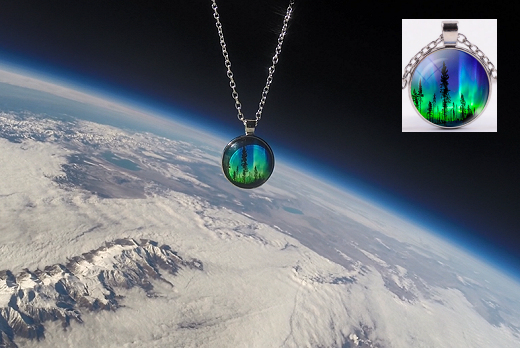
You can have it for $129.95. Featuring tall Norwegian Spruce trees silhouetted by blue-green auroras, the pendant makes an otherworldly birthday or anniversary gift.
The students are selling space pendants to support their cosmic ray ballooning program. Each one comes with a greeting card showing the ornament in flight and telling the story of its journey to the edge of space.
Far Out Gifts: Earth to Sky Store
All sales support hands-on STEM education
Realtime Aurora Photo Gallery
Free: Spaceweather.com Newsletter