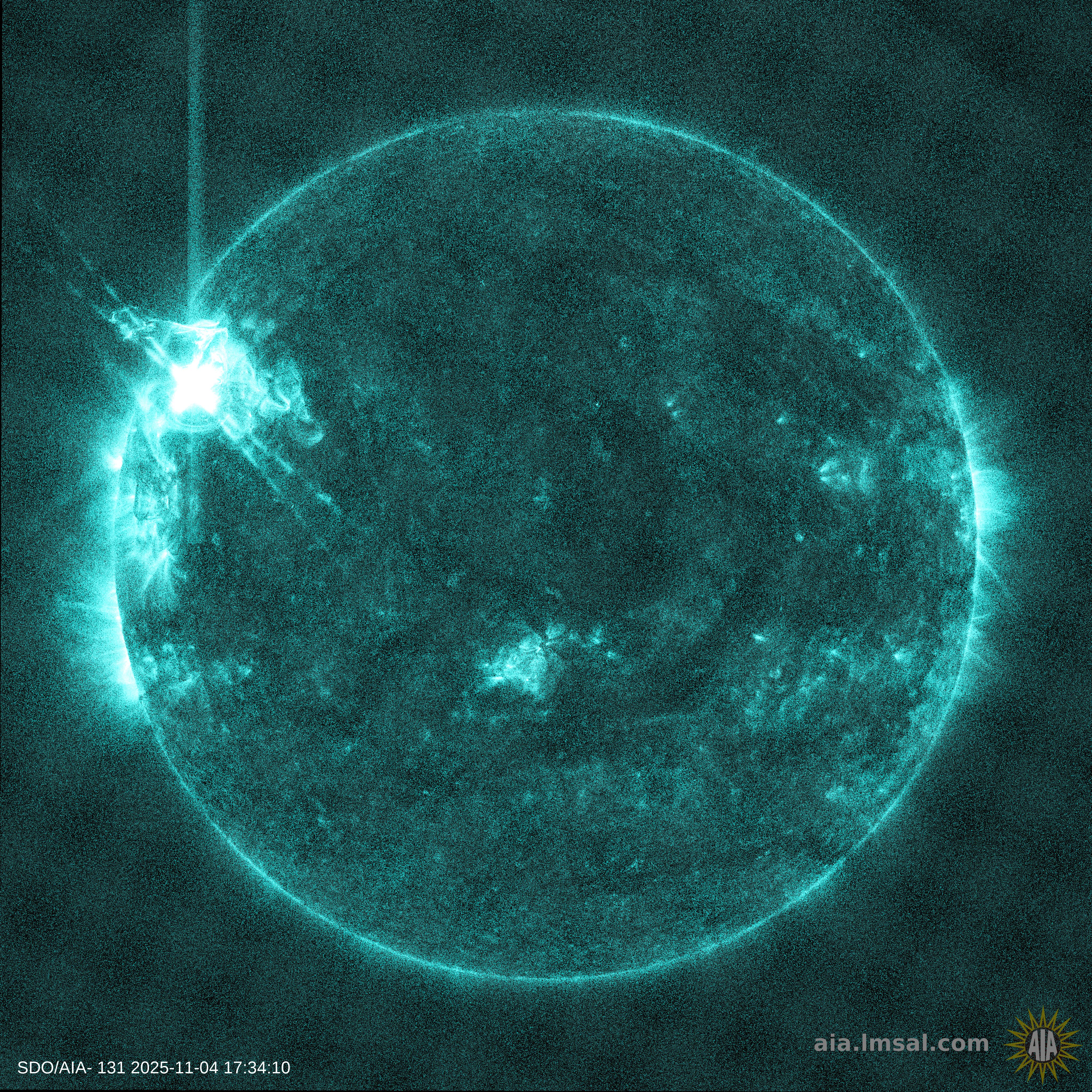
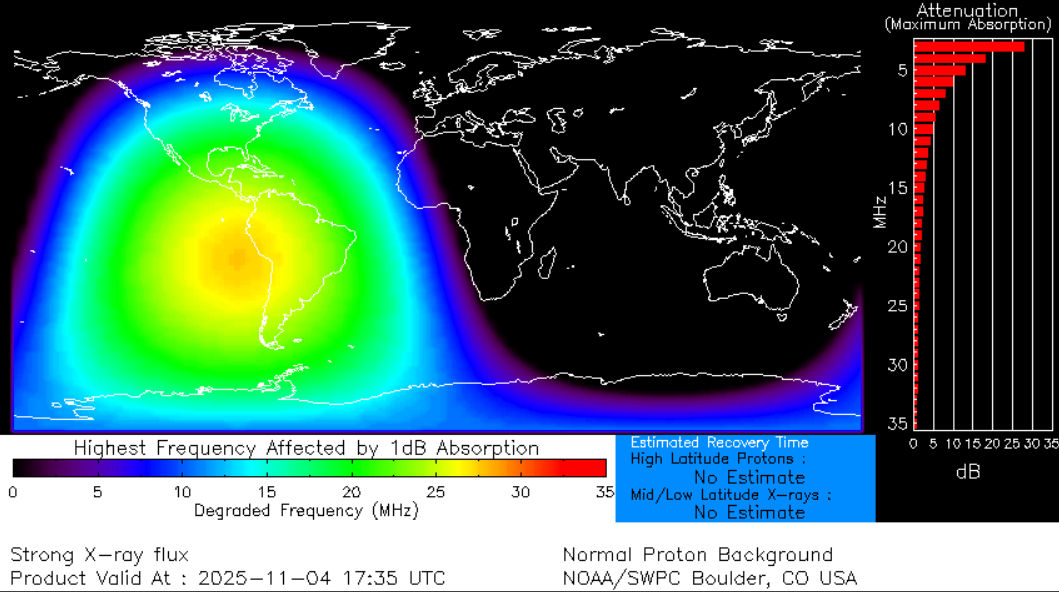
X-FLARE TODAY! Sunspot 4274 erupted again today, Nov. 4th (1734 UTC), producing an X1.8-class solar flare. The explosion was dramatic. A pulse of extreme ultraviolet radiation from the flare caused a shortwave radio blackout over South America, and a CME is emerging from the blast site. Stay tuned for updates as we receive fresh data from space-based coronagraphs. Solar flare alerts: SMS Text.
THE STRONGEST SOLAR FLARE OF THE SPACE AGE: Twenty-two years ago today, the sun unleashed the strongest X-ray solar flare of the Space Age. The underlying sunspot was not facing Earth; otherwise we might have experienced a new Carrington Event. Instead, the debris flew harmlessly off the sun's western limb:

The flare's extreme ultraviolet flash recorded by the Solar and Heliospheric Observatory
The explosion on Nov. 4, 2003, was so intense that, at first, no one knew how strong it was. X-ray detectors onboard GOES satellites were saturated for 11 minutes. This clipped the readings at X17.4, but clearly it was stronger. Shortwave radios in North America went silent as the continent experienced a deep radio blackout--a hint at the flare's true severity.
Eventually, researchers figured it out. Our personal favorite estimate comes from this paper, which describes how Earth's ionosphere was used as a giant solar flare detector. Their answer, X45, has been confirmed by other studies.
This puts it in the same ballpark as the Carrington Event. There were no X-ray detectors in the 19th century, so researchers have to use indirect methods to estimate the intensity of Carrington's flare on Sept. 1, 1859. Studies of auroras, ice cores, and magnetic disturbances suggest values near X45, although some estimates go as high as X80.
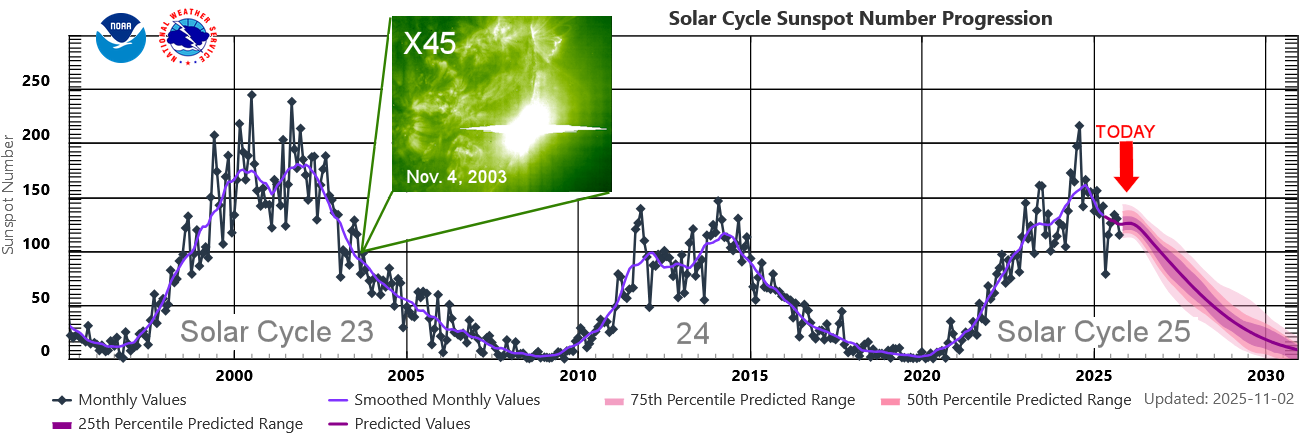
Now for the interesting part: The Nov. 4, 2003, flare occurred during the declining phase of Solar Cycle 23. Twenty-two years later, we are near the same point in Solar Cycle 25. As any good space weather forecaster will tell you, the downslopes of solar cycles are prime time for big explosions. No one knows why, but it's true.
In conclusion, don't be surprised if it happens again. Solar flare alerts: SMS Text.
Realtime Space Weather Photo Gallery
Free: Spaceweather.com Newsletter
DARK MATTER COINS FROM SPACE: These coins are not actually made of Dark Matter, but they are inscribed with the words "Dark Matter," and you can spend them. The US Mint has created a series of quarters honoring astronomer Vera Rubin, who discovered the pull of dark matter in galaxies. On Sept. 6, 2025, the students of Earth to Sky Calculus flew them to the stratosphere:
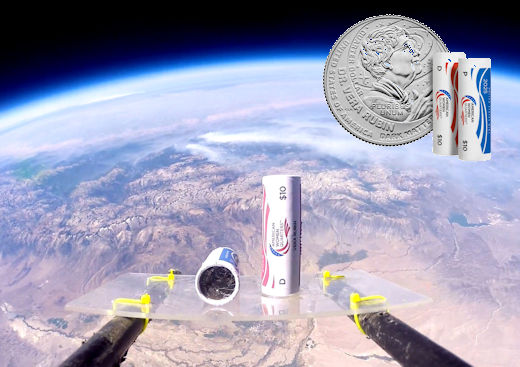
You can have two unbroken rolls for $199.95. The coin's design features a profile of Dr. Vera Rubin gazing upward, smiling as she contemplates the cosmos. She is surrounded by a spiral galaxy and other celestial bodies.
One of the rolls is D Mint, the other P Mint, so you'll have a complete set. You'll also receive a greeting card showing the coins in flight and telling the story of their journey to the edge of space.
Don't need a whole roll? You can buy a single coin for only $39.95.
Far Out Gifts: Earth to Sky Store
All sales support hands-on STEM education
Realtime Aurora Photo Gallery
Free: Spaceweather.com Newsletter