NASA TO RELEASE IMAGES OF 3I/ATLAS: Better late than never. This Wednesday, NASA will release images of interstellar Comet 3I/ATLAS including highly-anticipated data from the HiRISE camera onboard Mars Reconnaissance Orbiter. Obtained on Oct. 2nd when 3I/ATLAS made a close approach to Mars, HiRISE images have a spatial resolution of only 30 km per pixel with a side view of the comet's anti-tail and jets. The live event begins at 3 pm EST on Nov. 19th.
SOLAR STORM DISTORTS ATOMIC-TIME RADIO SIGNALS: To ham radio operators, no sound is more soothing than the metronome broadcast of atomic time signals from WWV. It has rarely changed in more than 100 years. On Nov. 12th, however, it changed. Mike Backus (KB9ZDD) of Davis, Illinois, recorded strong distortions in the broadcast during a severe geomagnetic storm. Click on the image to listen:
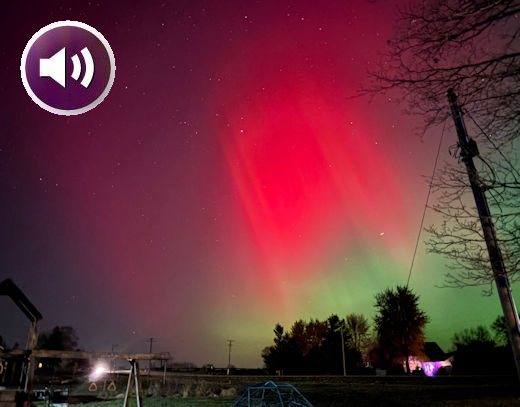
Auroras over Mike Backus's backyard on Nov. 12, 2025. WWV recordings: #1, #2, #3.
"After standing outside staring in awe at the auroras, I decided to go back inside the house and see what the storm was doing to the bands," he says. "I tuned in to WWV from Fort Collins, Colorado, at 10 MHz. The warbling and heterodyning were impressive."
In addition to the transmission from Fort Collins, Backus also picked up an overlapping signal from the WWH station in Hawaii. "I generally struggle to receive Hawaii from my location," he says. "Radio propagation conditions were just haywire."
During strong geomagnetic storms, Earth's ionosphere becomes turbulent and full of bubbles. Rapid changes in electron density cause shortwave radio signals to flutter, creating warbling tones, wavering pitch, and "underwater" sounds. The same fluctuations can affect GPS receivers at much higher radio frequencies, causing GPS-guided farm equipment to act crazy.
Twelve hours later, the storm subsided, and Backus made another recording. The metronome was back to normal.
Realtime Aurora Photo Gallery
Free: Spaceweather.com Newsletter
ARCTIC NIGHT SPACE PENDENT: Are you looking for a far-out Christmas gift? Consider the Arctic Night Pendant . It has flown to the edge of space onboard an Earth to Sky cosmic ray research balloon, more than 105,546 ft high:
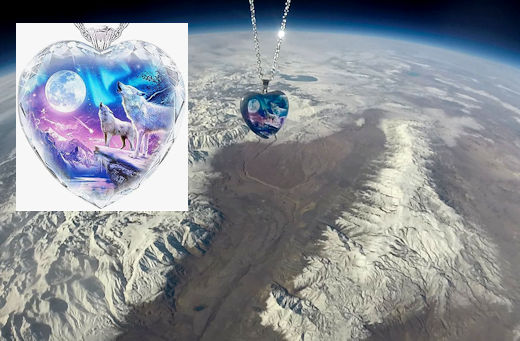
You can have it for $99.95. The heart-shaped pendant displays a loving pair of howling Arctic wolves, a shooting star, the full Moon, and rippling sheets of aurora borealis. It comes with a greeting card showing the pendent in flight and telling the story of its trip to the edge of space and back again.
Far Out Gifts: Earth to Sky Store
All sales support hands-on STEM education
Realtime Space Weather Photo Gallery
Free: Spaceweather.com Newsletter