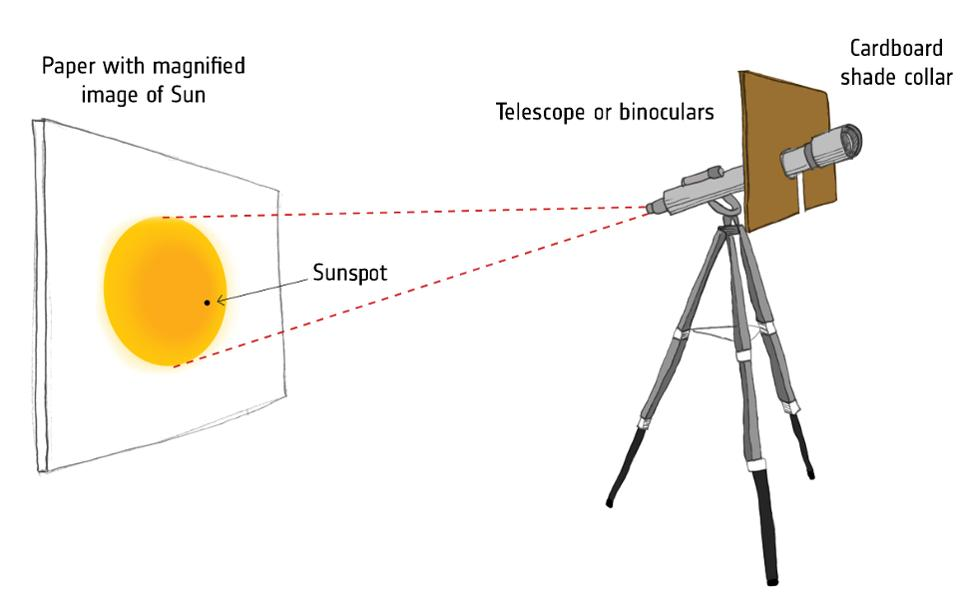
MONSTER SUNSPOT FACES EARTH: If there's no X-flare this weekend, it will be a waste of a truly monsterous sunspot. To see it, try this simple projection technique. Even Richard Carrington would be impressed. The sunspot group has an unstable delta-class magnetic field that harbors energy for geoeffective explosions. Solar flare alerts: SMS Text.
THE SODIUM TAIL OF MERCURY: The biggest comet in the Solar System is actually a planet. It’s Mercury. On Dec. 3rd, Steven Bellavia photographed Mercury's magnificent tail from Surry, Virginia:

"This 24 million kilometer plume of gas is being ejected from Mercury due to the sun, very much like a comet," says Bellavia.
First predicted in the 1980s, Mercury’s tail was discovered in 2001. Its source is Mercury’s super-thin atmosphere. Mercury is so close to the sun, pressure from sunlight pushes atoms out of the atmosphere and into space. The most important atom is sodium, which strongly scatters sunlight and gives the tail a yellow hue. Bellavia used a narrowband filter to capture the bright yellow sodium light at 589nm.
Mercury's tail waxes and wanes in brightness as it orbits the sun. The predictable pattern is shown in this movie from NASA's MESSENGER spacecraft, which spent years observing Mercury’s tail from close range:
For reasons having to do with the Doppler shift of sodium absorption lines in the solar spectrum, Mercury's tail is most luminous when the planet is ±16 days from perihelion (closest approach to the sun).
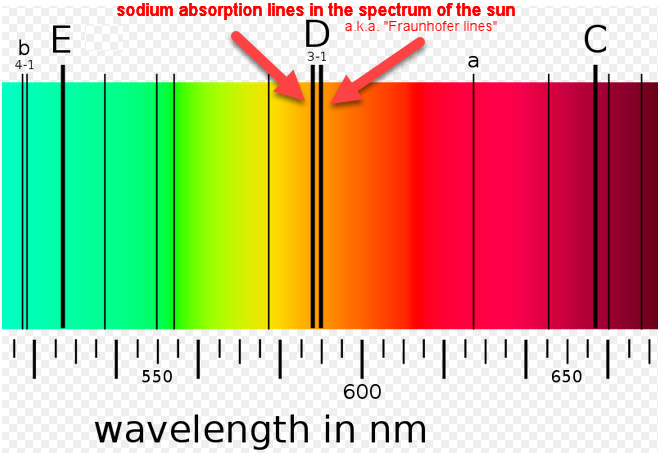
That special date is less than a week away: On Dec. 9th, Mercury will be 16 days past perihelion and the tail could be as much as 10 times brighter than what Bellavia saw. Take a look in the morning sky! Just don’t forget your sodium filter.
Realtime Space Weather Photo Gallery
Free: Spaceweather.com Newsletter
GIFTS FROM THE EDGE OF SPACE: Christmas is coming. Are you looking for a far-out gift? Check out the Earth to Sky Store. It's filled with unique items that have flown to the edge of space onboard cosmic ray research balloons.
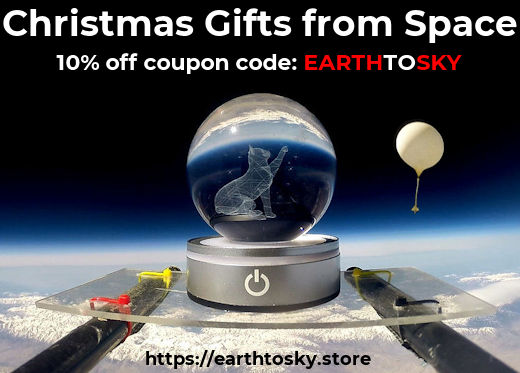
These unique gifts have flown above 99.7% of Earth's atmosphere, experiencing space-like blasts of cosmic rays, extreme cold, and a wild ride parachuting back to Earth after the balloon explodes. Even Amazon doesn't carry items this far out.
Don't forget to enter coupon code "EARTHTOSKY" at checkout for a 10% holiday discount.
Far Out Gifts: Earth to Sky Store
All sales support hands-on STEM education
Realtime Comet Photo Gallery
Free: Spaceweather.com Newsletter
Realtime Aurora Photo Gallery
Free: Spaceweather.com Newsletter