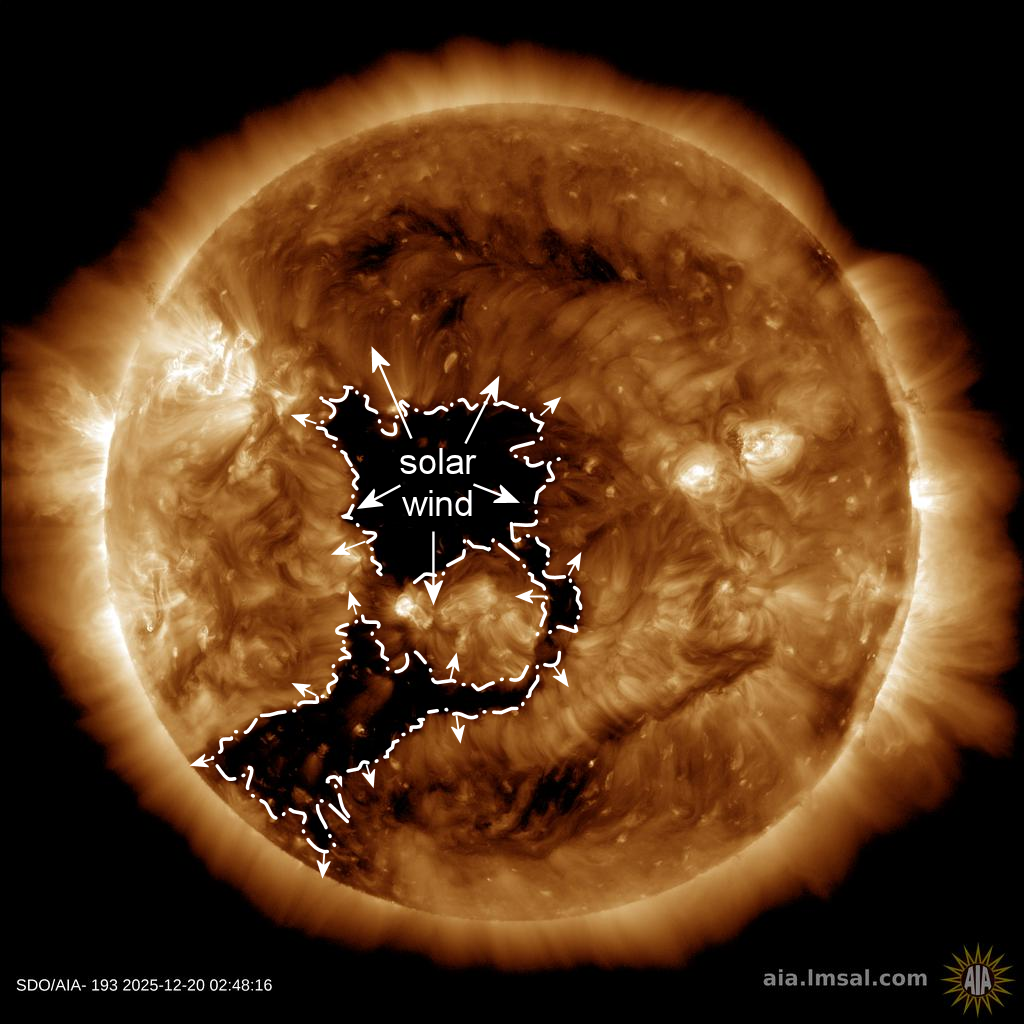
A HOLE IN THE SUN'S ATMOSPHERE: A hole in the sun's atmosphere is directly facing Earth, and it is spewing a stream of high-speed solar wind in our direction. Minor G1-class geomagnetic storms are possible on Dec. 24th when the gaseous material arrives. Arctic sky watchers should be alert for Christmas Lights. Aurora alerts: SMS Text.

ORBITAL HOUSE OF CARDS: Earth’s orbital environment has become dangerously fragile. A new study led by Sarah Thiele of Princeton University warns that if satellite collision-avoidance systems were knocked offline by a major solar storm, a catastrophic collision in low-Earth orbit could occur in as little as 2.8 days.

In 2018, before today’s megaconstellations filled the skies, the CRASH Clock stood at 121 days. Today, it’s less than three.
Orbital traffic is now at unprecedented levels, especially in dense shells of Starlink spacecraft near 550 km altitude. The study shows that close encounters between space objects happen every 20 seconds across low-Earth orbit. According to SpaceX’s most recent biannual report, Starlink satellites alone executed 144,404 collision-avoidance maneuvers between Dec. 1, 2024, and May 31, 2025.
At the best of times, avoiding collisions requires constant, precise maneuvering. But what would happen if satellite operators no longer knew exactly where their spacecraft were?
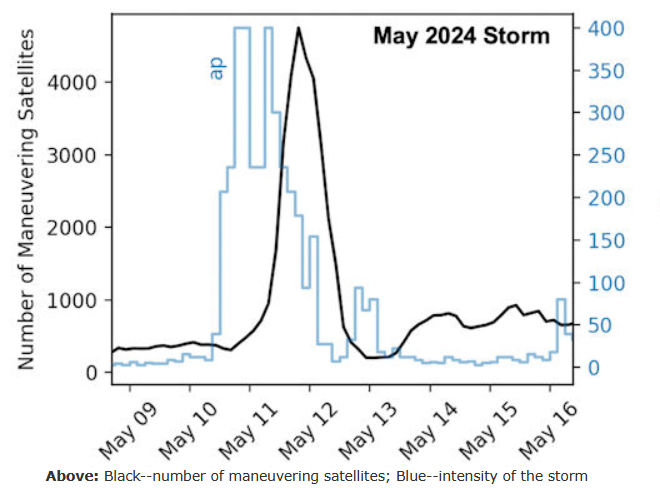 That scenario is not hypothetical. During the geomagnetic superstorm of May 10-11, 2024, more than 5,000 satellites made emergency maneuvers to maintain their orbits (full story). Most were Starlinks. Position uncertainties grew to kilometers--exactly the kind of disruption envisioned by the CRASH Clock. Fortunately, the storm subsided before a major collision occurred.
Satellite operators have long feared a doomsday scenario called the Kessler Syndrome--a runaway cascade of satellite destruction triggered by a single debris-producing impact. This paper argues we may not be in a Kessler cascade yet, but we are operating in conditions where one bad solar storm or software failure could start the CRASH Clock ticking.
Enjoy your Starlink--while you can.
Realtime Space Weather Photo Gallery
Free: Spaceweather.com Newsletter
CHRISTMAS GIFTS FROM THE STRATOSPHERE: Christmas is coming. Are you looking for a far-out gift? Check out the Earth to Sky Store. It's filled with items that have visited the edge of space onboard cosmic ray research balloons:
Earth to Sky gifts have flown above 99.7% of Earth's atmosphere, experiencing space-like blasts of cosmic rays, extreme cold, and a wild ride parachuting back to Earth after the balloon explodes. Even Amazon doesn't carry items this far out.
Don't forget to enter coupon code "BLACKCAT" at checkout for a 10% holiday discount.
Far Out Gifts: Earth to Sky Store
All sales support hands-on STEM education
Realtime Comet Photo Gallery
Free: Spaceweather.com Newsletter
Realtime Aurora Photo Gallery
Free: Spaceweather.com Newsletter