MEDICAL EMERGENCY ON THE ISS? A health issue affecting an astronaut aboard the International Space Station (ISS) may be serious enough to bring them home. NASA announced on Jan. 7th that it had canceled a spacewalk and was considering returning Crew 11 to Earth. "The situation is stable," says the space agency, and updates will be announced within 24 hours. Stay tuned.
AN EXPLOSION ON THE FARSIDE OFTHE SUN: Earlier today, a magnificent halo CME rocketed away the farside of the sun. NOAA's CCOR-1 coronagraph on GOES-19 recorded the explosion:
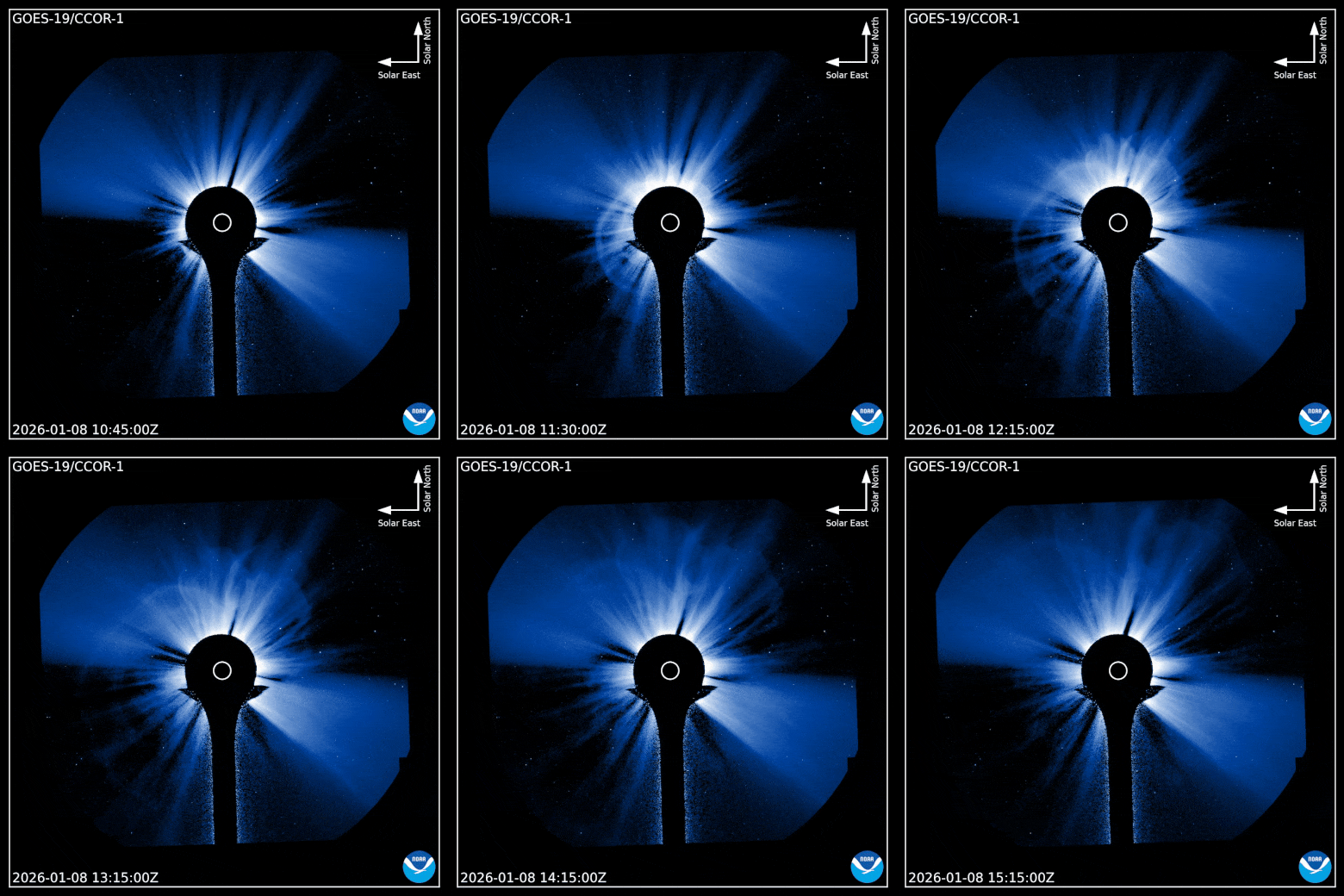
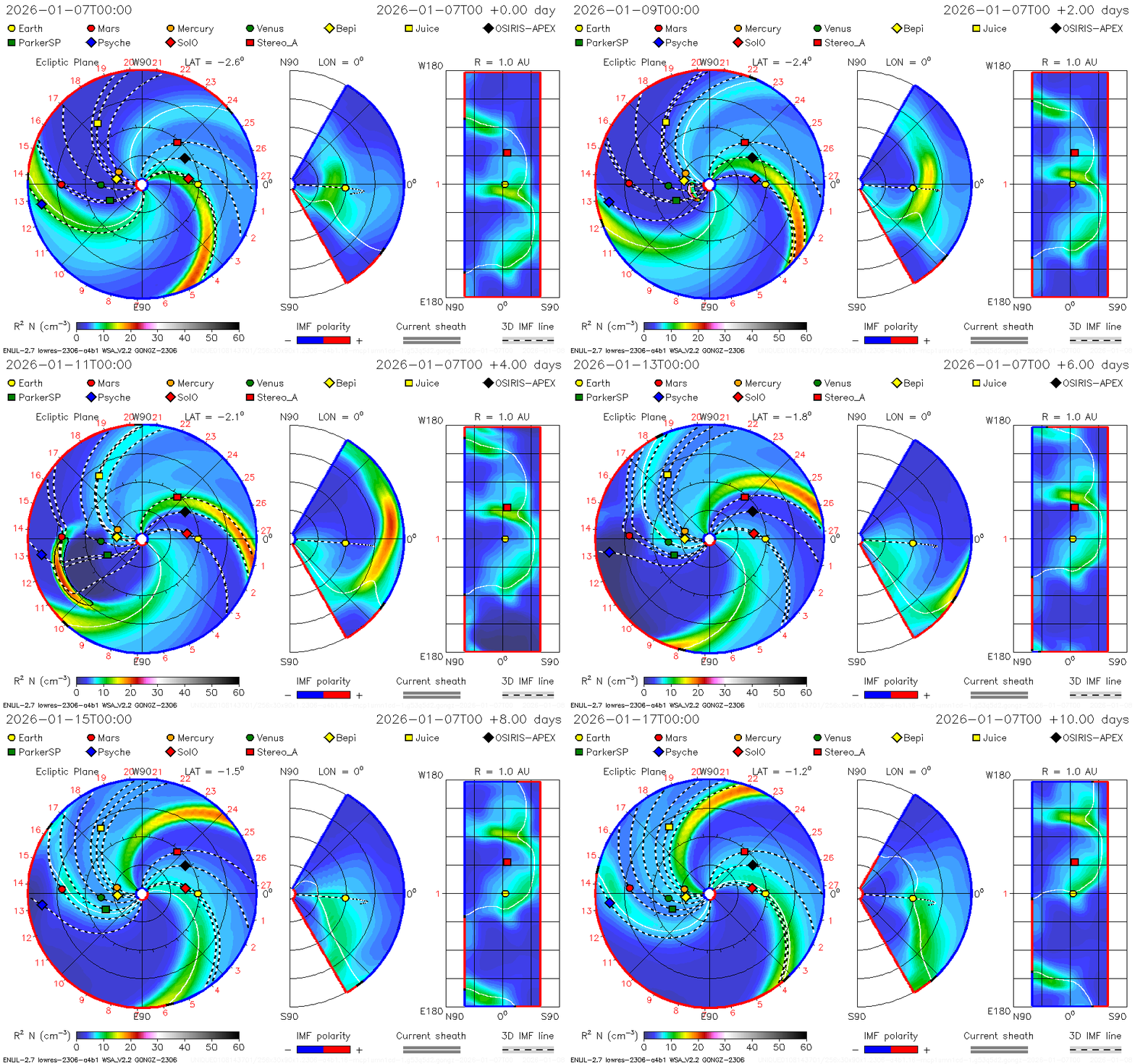
According to a NASA model, the CME will hit Venus and Mars, but not Earth.
This explosion suggests there is an active sunspot group on the farside of the sun. Unfortunately, images of the sun from NASA's Perseverance rover (which can see sunspots on the farside) are temporarily unavailable because Mars is at superior solar conjunction. The rover's radio signals cannot make it through the sun's atmosphere to Earth.
Realtime Space Weather Photo Gallery
Free: Spaceweather.com Newsletter
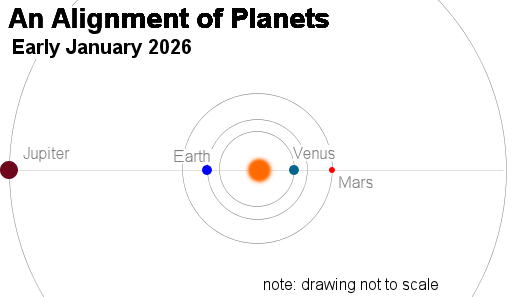
PLANETARY ALIGNMENTS AND THE SOLAR CYCLE: This week, Jupiter and Venus are on opposite sides of the sun. To some researchers, this geometry is more than a celestial coincidence. A small but persistent body of research suggests that planetary alignments help regulate solar activity.
"A decade ago, I set out to to find a viable mechanism by which the solar cycle could be synchronised by tidal forces of the planets," says Frank Stefani, a physicist at the HZDR national research center in Germany. "These forces are known to be very small, yet we have developed a model that shows remarkable agreement with observed solar activity."
This is a controversial topic. Some researchers, like Stefani, have focused their careers on it, while others are vehemently opposed. The idea refuses to go away mainly because Jupiter, Venus, and Earth form repeating alignment patterns with a characteristic period near 11 years, similar to the average length of the sunspot cycle. Coincidence--or something more?
Mainstream physics holds that the tides of Venus and Jupiter are too weak to affect solar activity. Jupiter's tides on Earth are a million times weaker than the Moon's tides, and Venus's tides are even weaker than Jupiter's. How could these absurdly small forces affect the sun?
A 2019 study led by Stefani suggested a way: The sun's inner magnetic dynamo is exquisitely sensitive to external perturbations ("parametric resonances"). Regular "taps" from planetary tides could nudge the dynamo into an 11-year pattern like a metronome keeping a piano player on time.
 Critics note that convective noise in the sun's interior (pictured right) dwarfs tidal stresses. Yet the coincidences are hard to ignore.
Stefani’s more recent work focuses on magneto-Rossby waves in the solar dynamo. "Our latest model shows that the natural periods of these waves fit amazingly well to the two-planet spring tides of Venus, Earth, and Jupiter: 118 days for Venus-Jupiter, 199 days for Earth-Jupiter, and 292 days for Venus-Earth."
These spring tides do not cause the solar cycle, clarifies Stefani. They help synchronize it. Tidal beat-periods match several well-known cycles of solar activity including the famous Schwabe cycle of 11 years, a Quasi-Biennial Oscillation (QBO) of 1.7 years, and the Suess-de Vries cycle of 193 years (plus two Gleissberg cycles at 90 and 58 years).
Again, critics have a counterargument: With so many cycles and harmonics to play with, you can always find a match. Indeed, this may be true.
But Stefani has a prediction: "The present alignment is happening only 40 to 60 days before the expected peak of a Quasi-Biennial Oscillation. If the alignment excites magneto-Rossby waves as our model predicts, we might expect a higher probability of strong solar activity 40 to 60 days from now."
That's science. Stay tuned for a follow-up story in two months.
Realtime Space Weather Photo Gallery
Free: Spaceweather.com Newsletter
IRON HEART VALENTINE'S GIFT: Valentine’s Day is coming. Do you have a truly far-out gift? The Iron Heart Valentine’s Swing celebrates a love that is strong, steady, and enduring. On Nov. 13, 2025, it flew to the edge of space, floating 100,895 feet above the Sierra Nevada Mountains of central California:
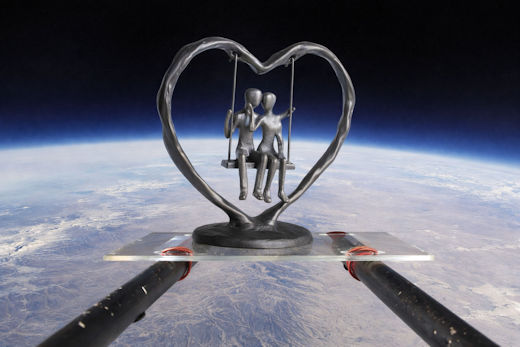
You can have it for $159.95. The gift-boxed swing includes a unique keepsake card featuring the Iron Heart at the top of Earth's atmosphere. Inside, the card tells the story of the flight and certifies that this swing has been to the edge of space.
Earth to Sky Valentine's gifts have flown above 99.7% of Earth's atmosphere, experiencing space-like blasts of cosmic rays, extreme cold, and a wild ride parachuting back to Earth after the balloon explodes. Even Amazon doesn't carry items this far out. And, best of all, all sales support student science projects and STEM education.
Far Out Gifts: Earth to Sky Store
All sales support hands-on STEM education
Realtime Comet Photo Gallery
Free: Spaceweather.com Newsletter
Realtime Aurora Photo Gallery
Free: Spaceweather.com Newsletter