SOLAR WIND STORM IN PROGRESS: Earth has entered a stream of solar wind blowing almost 700 km/s (1.6 million mph). The pressure on our planet's magnetosphere could spark a G1-class geomagnetic storm on Jan. 16th. High-latitude sky watchers should be alert for auroras. Aurora alerts: SMS Text

A RARE GATHERING OF PLANETS AROUND THE SUN: Beauty is in the eye of the beholder. For the record, we think this week's SOHO coronagraph view of Venus, Mars and Mercury near the sun is absolutely beautiful:
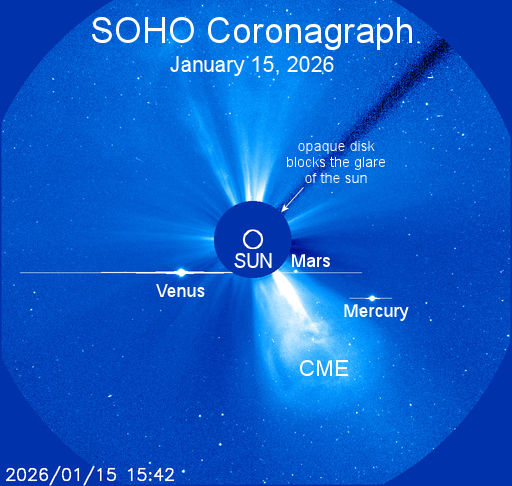
Astronomers call this a "triple superior solar conjunction." It's "superior" because all three planets are on the far side of the sun as seen from Earth. ("Inferior" conjunctions occur when planets are between Earth and the sun.) A superior conjunction like this is a decades-class event (at least).
Two dates of special significance are coming up: Jan. 18th when Mars is less than 1 degree from Mercury, and Jan. 29th when Venus and Mercury are only 2/3rd of a degree apart. Join SOHO for a ringside seat.
Realtime Space Weather Photo Gallery
Free: Spaceweather.com Newsletter
VALENTINE'S DAY IS LESS THAN A MONTH AWAY: Does your sweetheart love space? Shop the Earth to Sky Store for their perfect Valentine's gift. All items have flown to the stratosphere on board cosmic ray research balloons:

Earth to Sky Valentine's gifts have flown above 99.7% of Earth's atmosphere, experiencing space-like blasts of cosmic rays, extreme cold, and a wild ride parachuting back to Earth after the balloon explodes. Each one comes with a greeting card showing the item in space, and telling the story of its launch.
Far Out Gifts: Earth to Sky Store
All sales support hands-on STEM education
AIRPLANES 'LOST' DURING A GEOMAGNETIC STORM: A new study published in Space Weather suggests that flying during an extreme geomagnetic storm may not be a great idea. During the superstorm of May 10-13, 2024, disturbances in Earth’s ionosphere disrupted GPS tracking systems for airplanes flying over Europe. Some planes briefly appeared hundreds of kilometers from their true locations.
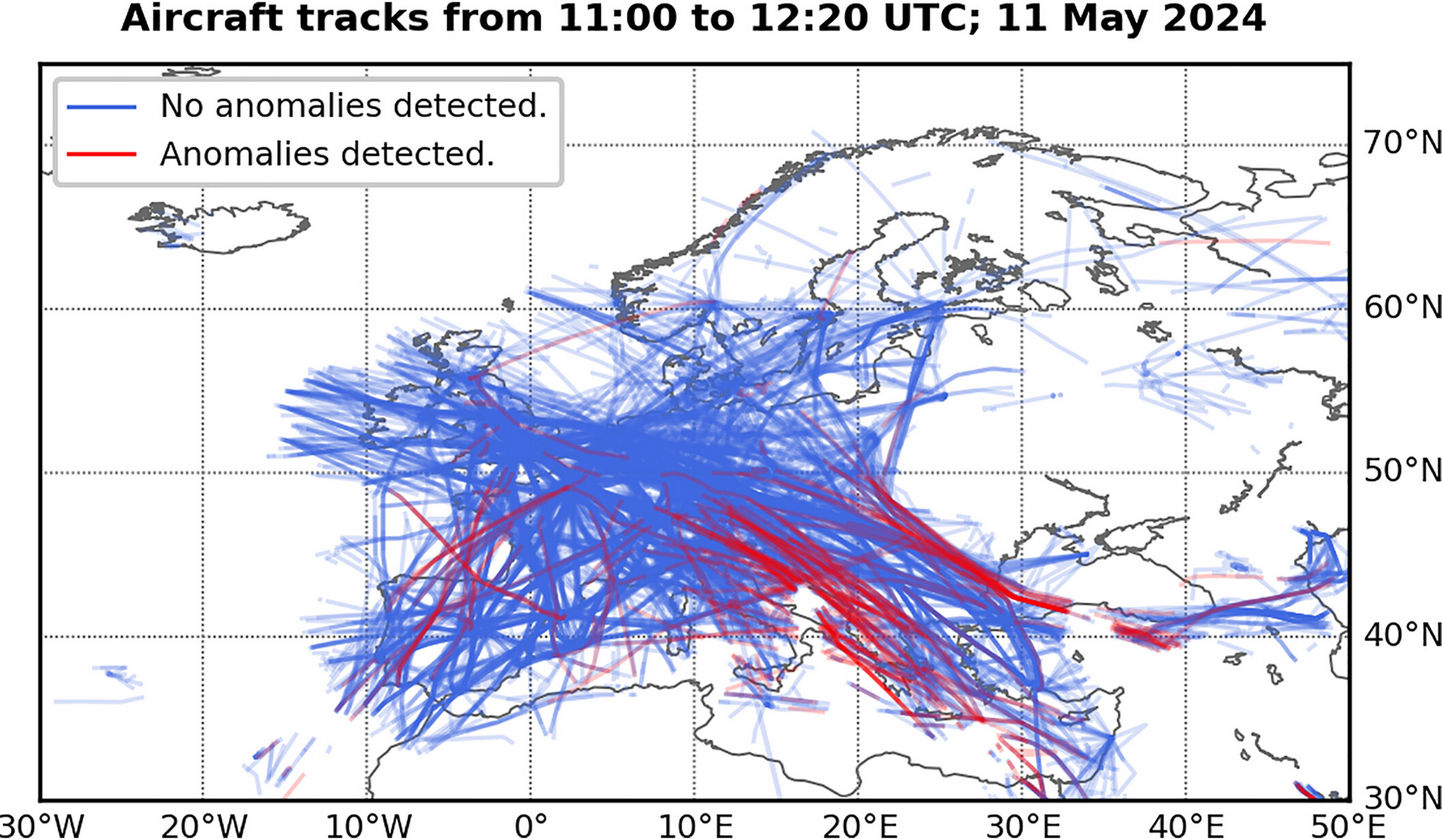
Researchers Erik Schmölter and Jens Berdermann of the German Aerospace Center analyzed more than 700 million ADS-B messages from 18,000 aircraft. ADS-B messages are short radio broadcasts sent by aircraft about once per second, reporting their GPS-derived positions. Air traffic controllers and nearby aircraft use them for real-time tracking. The superstorm caused significant position errors for days.
The problem was especially acute on May 11th when the sun hit Earth with an X5.8-class solar flare. Intense solar X-ray and radio emission caused direct interference with GPS signals on the sunlit side of Earth. As many as 53% of satellite-receiver links failed at latitudes south of ~50° N.
 In the map, right, red dots mark the location of 169 aircraft during the X-flare. ADS-B messages reported that these aircraft abruptly "jumped" off course during the flare. In fact, they were still flying normally
Fortunately, there were no mishaps. Aviation safety is built on layers, and ADS-B is only one of them. Conventional radar surveillance remained available around airports, and pilots retained full control of their aircraft. In most cases, they could simply look out the window to see exactly where they were. Stronger and longer storms could cause more problems, though.
Confused? So were the GPS receivers. Read the original study here.
Realtime Aurora Photo Gallery
Free: Spaceweather.com Newsletter