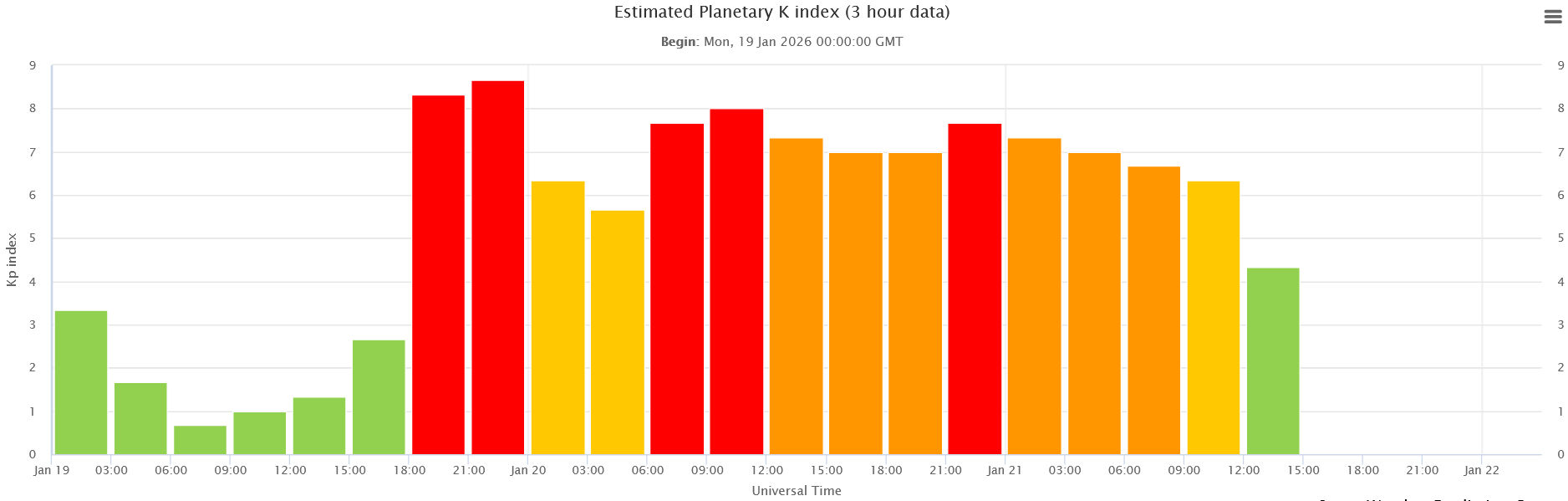
THE STORM IS OVER--GET READY FOR THE NEXT ONE: Earth's magnetic field is quiet again following 3 days of intense geomagnetic storms. From Jan. 19th to 21st, storm levels were severe (G4) for 15 hours, and strong (G3) for more than 18 hours; people saw auroras across most of Europe and at least 40 US states. This will go down as one of the biggest events of Solar Cyce 25. Did you miss the show? Next time get a wake-up call from Space Weather Alerts.


AURORAS INSIDE THE SOUTH ATLANTIC ANOMALY: Many unusual things happened during this week's severe geomagnetic storm. Mark this as one of the most unusual. "We saw auroras inside the South Atlantic Anomaly," reports Egon Filter, who sends this picture from Cambará do Sul, Brazil (latitude +29 S):

"We were looking south on Jan. 19th when this strange purple band appeared," says Filter. "At the time, the planetary K-index was 7.6."
The South Atlantic Anomaly is a weak spot in Earth's magnetic field centered on Brazil. There, the planet’s protective magnetic shield is thinner than elsewhere, allowing energetic particles from the inner Van Allen radiation belt to dip unusually close to Earth.
You might suppose that auroras would be strong in the South Atlantic Anomaly because solar storms can penetrate Earth's defenses there. In fact, the opposite is true. Multiple studies show that auroras are relatively weak in the Anomaly.
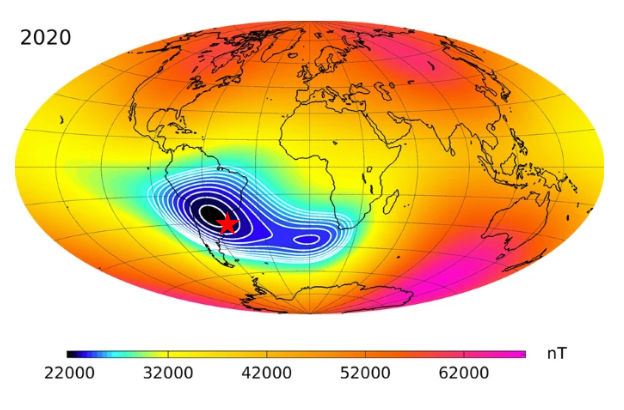
Above: The red star marks Egon Filter's location in the South Atlantic Anomaly
Why? It's a bit of a mystery. One idea holds that weak and disorganized magnetic fields in the Anomaly do a poor job focusing and accelerating solar wind particles. Instead of forming bright, narrow curtains of light, the incoming particles spread out and produce only faint, diffuse glows.
The lights Filter saw might have been a different phenomenon--an SAR arc. SAR arcs are red bands that appear during some geomagnetic storms when Earth's ring current system leaks heat energy into the upper atmosphere. Research suggests that SAR arcs should be supressed inside the Anomaly for much the same reasons that auroras are suppressed, but the jury is still out.
Auroras or SAR arcs: Either way something unusual happen in the South Atlantic Anomaly on Jan. 19th. Browse the gallery for more lights in strange places--and stay tuned for additional coverage.
Another sighting? Responding to this story, George Preoteasa recalls seeing red auroras (or perhaps a mixture of airglow and auroras) on May 10, 2024, from San Pedro de Atacama, Chile, which is also under the South Atlantic Anomaly. Watch his movie.
Realtime Aurora Photo Gallery
Free: Spaceweather.com Newsletter
VALENTINE'S LOVE LOCKET: Valentine’s Day is coming. Do you have a truly far-out gift? Consider the Valentine's Love Locket. On Jan. 2nd, it flew to the stratosphere onboard a cosmic ray research balloon:

You can have it for $107.95. The locket is openable, lockable, and can hold small items inside. You'll also receive a unique keepsake card showing the jewelry at the top of Earth's atmosphere. Inside, the card tells the story of the flight and certifies that this swing has been to the edge of space.
Earth to Sky Valentine's gifts have flown above 99.7% of Earth's atmosphere, experiencing space-like blasts of cosmic rays, extreme cold, and a wild ride parachuting back to Earth after the balloon explodes. Even Amazon doesn't carry items this far out. And, best of all, all sales support student science projects and STEM education.
Far Out Gifts: Earth to Sky Store
All sales support hands-on STEM education
Realtime Space Weather Photo Gallery
Free: Spaceweather.com Newsletter