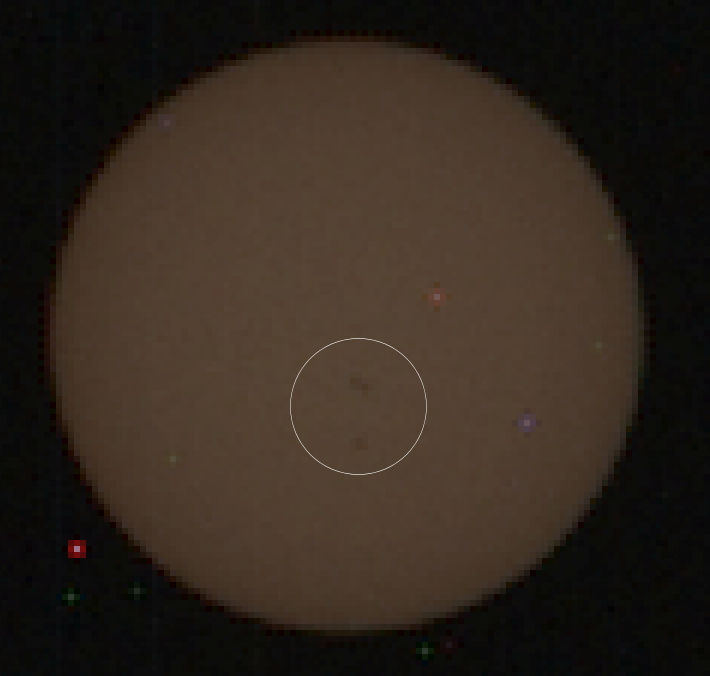
THE SUNSPOT REPORT FROM MARS: NASA has re-established communications with Mars rover Perseverance, which has been out of touch since December. The radio silence was caused by Mars passing directly behind the sun. Daily images of the sun from Mars may now resume. Today's photo shows a relatively large sunspot group on the farside of the sun.
LAST WEEK'S BLUE AURORA STORM: The vast majority of auroras are red and green. During last week's severe geomagnetic storm, many observers saw a different color: Blue. On Jan. 20th, David Varros photographed the phenomenon from Rileyville, Virginia:

The blue color was visible to the naed aye and bright enough for Varros to photograph using his off-the-shelf iPhone 16.
In auroras, blue is a sign of nitrogen. The color is produced by solar wind particles hitting ionized molecular nitrogen (N2+) at the top of Earth's atmosphere. It is extremely rare to see this blue glow, however, for the simple reason that there aren't a lot of N2+ molecules up there. Intense geomagnetic storming is required to ignite visible blue.
The CME that reached Earth on Jan. 19th struck with a velocity in the top few percent of all CMEs ever observed. This caused more than 12 hours of severe (G4-class) geomagnetic storming with conditions that favored bright blue. Browse the list below for more examples.

more images: from Brandon Lewis of Jeffersonton, Virginia; from Aaron Watson of West Elk Mountains, Colorado; from Jack Dembicky of Sunspot, New Mexico; from Glenna Bayer of NSW, Australia; from Michael Kenney of Dubois, Wyoming; from Jeff Williams-Gifford of Sequim, Washington; from Gianluigi of Ronchi dei Legionari, FVG, Italy; from Erik Tkal of Fitchburg, MA;from Klaus Schulze-Frerichs of Neuberg, Germany; from Anthony Kroes of Pulaski, Wisconsin; from Pete Novielli of Marquette, MI
Realtime Aurora Photo Gallery
Free: Spaceweather.com Newsletter
THE LOVE PUZZLE FOR VALENTINE'S DAY: Valentine’s Day is coming. Do you have a truly far-out gift? Consider the the Love Puzzle. On Jan. 15th, it flew to the stratosphere onboard an Earth to Sky cosmic ray research balloon:

You can have it for $91.95. This acrylic puzzle piece is a love note: "Thank you for being such an important piece of my life," the inscription says. It's a durable reminder that you fit together. The Love Puzzle comes with a unique gift card showing the keepsake at the top of Earth's atmosphere.
Earth to Sky Valentine's gifts have flown above 99.7% of Earth's atmosphere, experiencing space-like blasts of cosmic rays, extreme cold, and a wild ride parachuting back to Earth after the balloon explodes. Even Amazon doesn't carry items this far out. And, best of all, all sales support student science projects and STEM education.
Far Out Gifts: Earth to Sky Store
All sales support hands-on STEM education
Realtime Space Weather Photo Gallery
Free: Spaceweather.com Newsletter